An international team of astronomers has uncovered striking new evidence that the asteroid (44) Nysa — one of the brightest and largest objects in the main asteroid belt, with a surface composition resembling enstatite — possesses a three-lobed structure and is orbited by a small moon. The findings, based on high-resolution adaptive-optics images from some of the world’s most advanced telescopes, including contributions from Italy’s National Institute for Astrophysics (INAF), provide a rare glimpse into the complex history of one of the Solar System’s most enigmatic asteroids.
The research, accepted for publication in the journalAstronomy & Astrophysics, reveals that Nysa is unlike any asteroid observed to date. Astronomers have studied Nysa for more than a century because of its unusual brightness and composition, but earlier observations suggested only an elongated or possibly bilobed shape. Now, using the Italian-built Shark-Vis instrument on the Large Binocular Telescope (LBT) in Arizona and the Sphere/Zimpol instrument on the European Southern Observatory’s Very Large Telescope (VLT) in Chile, the team obtained the highest-resolution images of Nysa ever captured.
Those images show multiple large surface features, including two prominent valleys that appear to wrap around the asteroid’s circumference. The team interprets these features as «necks» — connection points between separate lobes. «The images reveal an extraordinarily unusual object,» said lead author Kate Minker of Lowell Observatory. «The most plausible explanation is that Nysa is either a trinary contact system, consisting of three linked components, or an extremely irregular coherent body unlike anything we have observed before.»
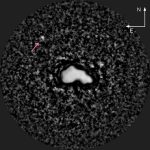
To better understand the asteroid’s shape, scientists combined the adaptive-optics images with extensive photometric observations from observatories around the world to generate a detailed three-dimensional model. The reconstructed shape strongly supports the presence of three distinct lobes connected by narrow bridging regions. «It was necessary to combine these observations with specially developed image-processing techniques to make the images even sharper and remove the bright halo surrounding the asteroid, which could have hidden any faint companions,» explained Anthony Berdeu, a co-lead author of the study. Minker added, «These observations probably represent the closest to space-quality images ever obtained from the ground, made possible by an exceptional combination of advanced instrumentation and sophisticated data-processing techniques.»
The study also reports the detection of a previously unknown moon, provisionally designated S/2026 (44) 1. The satellite was independently identified in observations from two separate campaigns. Researchers estimate the moon measures about one kilometer in diameter, while the primary asteroid has a diameter of 75 kilometers and orbits at a distance of at least 170 kilometers. «We borrowed a specialized technique from another field of astronomy, known as high-contrast imaging, to detect the small moon whose faint light was overwhelmed by the intense brightness of the primary asteroid,» said Gianluca Li Causi, a researcher on the Shark-Vis team at INAF. Future observations of the newly discovered satellite will allow scientists to determine Nysa’s mass and density more accurately, helping to distinguish between competing theories about the asteroid’s extraordinary structure.
The discovery provides an important clue about Nysa’s formation and evolution. Scientists hypothesize that the unusual structure may have formed through a low-velocity accumulation of fragments from an ancient collision, possibly before Nysa reached its current position in the asteroid belt. Another possibility is that Nysa represents the remnants of a dramatic hit-and-run collision involving a larger parent body. Because E-type asteroids like Nysa may preserve a record of the enstatite-rich inner Solar System — either as primitive planetesimals or as crustal fragments of differentiated protoplanets — understanding Nysa’s origin could shed light on the processes that operated in the earliest stages of Solar System formation. «These new images appear consistent with several earlier clues that Nysa is not a conventional asteroid,» noted Al Conrad of the Large Binocular Telescope Observatory. «For the first time, we can see details that help explain its unusual nature.»
The findings underscore the power of adaptive optics and advanced imaging techniques to reveal the true nature of objects in the Solar System. As researchers continue to study Nysa and its newly discovered moon, they hope to unlock more secrets about the early history of our planetary neighborhood. The study, led by an international collaboration involving INAF, Lowell Observatory, and other institutions, marks a significant step forward in asteroid science.