Jupiter’s moon Europa has long been regarded as one of the most promising places in the solar system to search for life beyond Earth. The idea that its buried ocean could contain signs of biology continues to drive planetary exploration, but reaching that ocean and testing it remains a major engineering and scientific challenge.
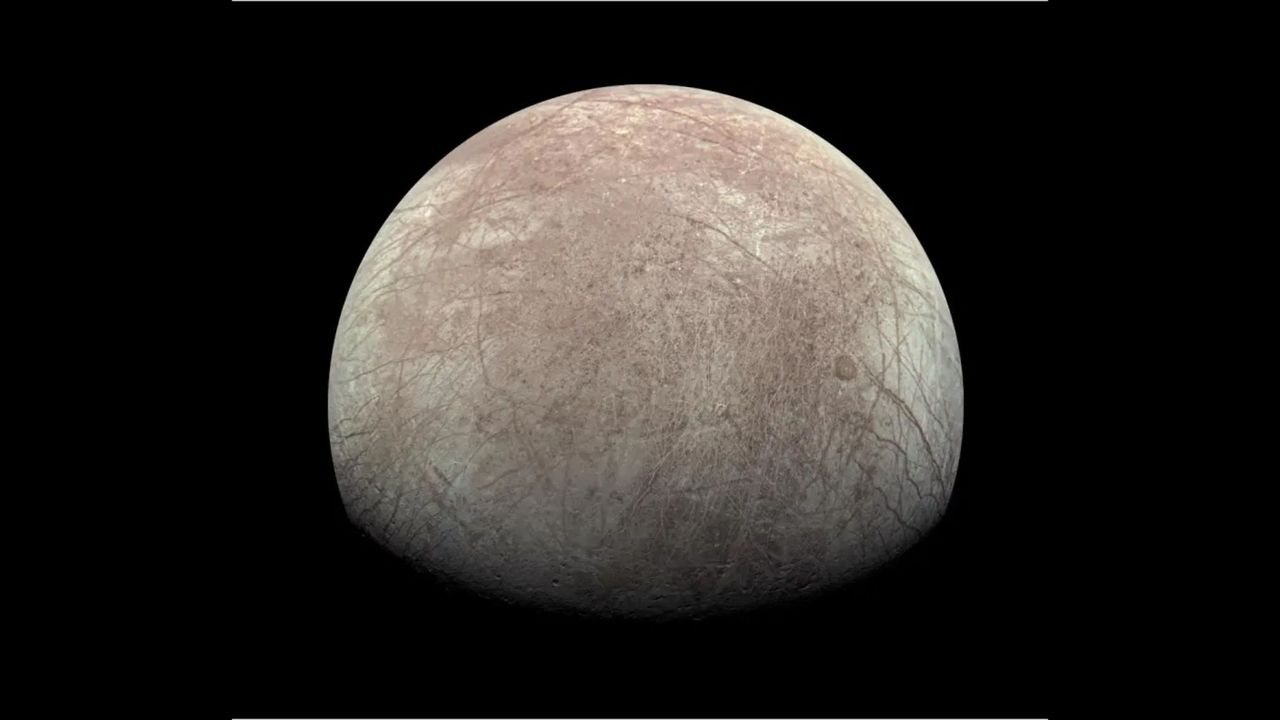
Beneath Europa’s fractured, icy surface, scientists believe there is a global saltwater ocean containing more water than all of Earth’s oceans combined. The ocean is kept in liquid form by tidal heating, a process in which Jupiter’s powerful gravity constantly flexes the moon as it travels along its elliptical orbit. That internal friction generates heat and provides an energy source that could support microbial life similar to organisms found around deep-sea vents on Earth.
For astrobiologists, Europa offers a rare combination of three basic requirements for life as we know it: liquid water, the chemical building blocks of biology, and a source of energy. These ingredients do not guarantee that life exists, but they make the moon one of the few places in the solar system where a second example of biology might be found.
The greatest obstacle is the ice shell itself. Europa’s crust is thought to be many kilometers thick, possibly tens of kilometers, which separates the ocean below from the instruments scientists would need to study it. Drilling through that shell would require heavy equipment, enormous amounts of power, and a way to avoid contaminating the pristine ocean with organisms carried from Earth.
Jupiter’s radiation belts add another layer of difficulty. Europa sits inside the intense radiation environment around Jupiter, and any spacecraft operating on or near the surface would need robust shielding to survive long enough to collect meaningful data. Radiation is also a concern for the instruments themselves, since it can damage electronics and interfere with the kinds of chemical measurements needed to identify biosignatures.
One alternative is to look for material from the ocean at the surface. Scientists have observed features on Europa that suggest the ice is geologically active, and some observations have hinted at water vapor plumes erupting from the moon’s surface. If such plumes exist, a spacecraft might be able to fly through them and sample the material directly without having to drill into the ice.
NASA’s Europa Clipper mission is a central part of the effort to answer these questions. Launched in 2024, the spacecraft is expected to arrive in the Jupiter system in the 2030s and will study Europa during a series of close flybys, mapping the moon’s ice shell, investigating the structure and composition of its ocean, and searching for active plumes. It is not equipped to land, but its observations are expected to help scientists identify the most promising places where a future lander might go.
The mission’s results may also sharpen the debate over how to reach the ocean without contaminating it. Planetary protection is a serious concern for missions to icy moons, because the search for life would be compromised if Earth microbes reached the water first. Scientists are therefore studying ways to ensure that any future probe is sterilized and that samples are handled without direct contact with the environment until they have been safely collected.
Even with a successful landing, scientists would still face the problem of studying signs of life that may exist deep below. Organisms in Europa’s ocean, if present, would almost certainly be microbial and could be concentrated near hydrothermal vents or in the upper layers of the ocean beneath the ice. Sampling those zones would require either penetration through the ice or a way to catch ocean material that reaches the surface through fractures or plumes.
For now, Europa remains a world of unanswered questions. Scientists do not yet know whether its buried ocean truly contains the chemistry needed for life, whether any organisms could survive there, or whether evidence of them can be recovered from orbit. Each new observation narrows the unknowns and brings the question of access closer to the center of future mission planning.
The difficulty of reaching Europa’s hidden ocean means progress will likely come in stages. Orbital reconnaissance comes first, and any future lander or sample-return mission will build on that foundation. Until then, the buried ocean remains one of the most intriguing scientific targets in the solar system.