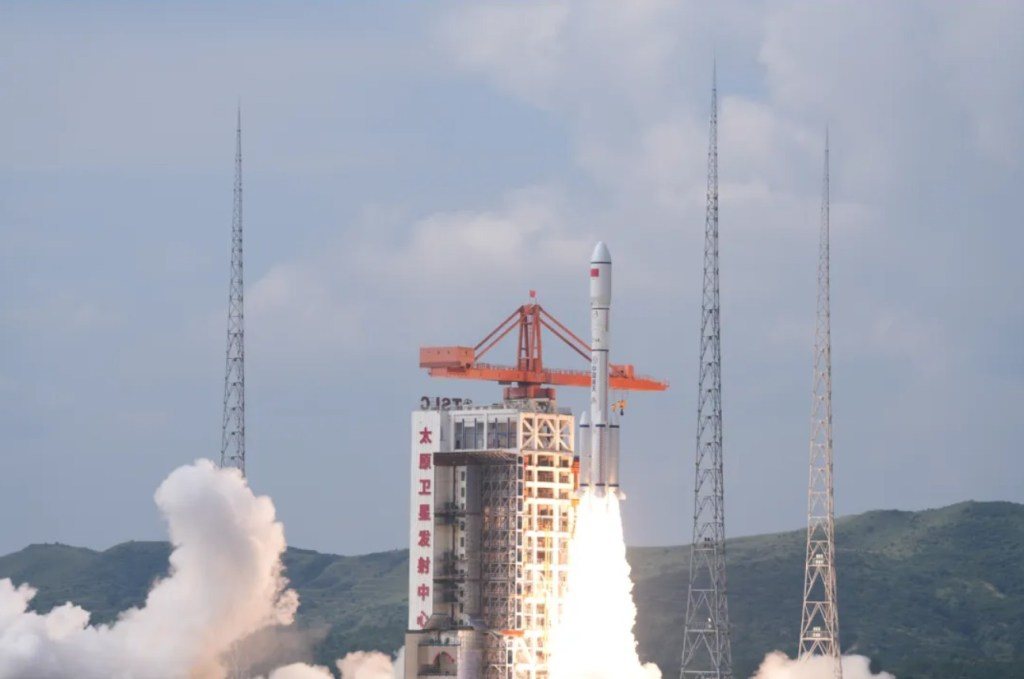
China expanded its orbital communications infrastructure Wednesday with a Long March 6A launch that carried a pair of secretive TJS-27 satellites and a next-generation Tianlian relay satellite. The flight placed the TJS-27 pair in a new orbital regime for the program and added a modern relay platform to China's space-based communications network. The mission was the latest in a series of Chinese launches that combine operational spacecraft with experimental or classified payloads.
The TJS-27 satellites belong to a Chinese series that has long drawn scrutiny because Beijing discloses very little about its missions. The spacecraft are publicly identified only as technology-testing or experimental satellites, with no details about their instruments, users, or operational roles. That lack of transparency has led outside analysts to associate the series with communications experiments and possible defense-related work. The new launch attracted additional attention because the pair was sent into an orbit that differs from the profiles used by earlier TJS missions, marking what observers described as a programmatically new orbital choice.
The second major payload was a next-generation Tianlian relay satellite. Tianlian is China's family of data-relay spacecraft, which orbit above Earth to connect ground teams with satellites, space stations, and other vehicles that are out of direct view of ground antennas. Relay satellites of this kind are essential for supporting crewed spacecraft and long-duration orbital operations. By launching an upgraded version, China is reinforcing the communications backbone that underpins its Tiangong space station, its crewed missions, and its expanding fleet of remote-sensing and navigation spacecraft.
Wednesday's launch was carried out by the Long March 6A, a medium-lift rocket that pairs a liquid-fueled core with solid strap-on boosters. The vehicle is part of a broader effort by China to modernize its launch fleet and provide more flexible access to orbit for both government and commercial payloads. Its use on this mission shows how newer Chinese rockets are taking on increasingly important national-security and infrastructure roles.
The flight fits a wider pattern of Chinese space activity in which civilian science and classified programs advance in parallel. In recent cycles, China has completed its Tiangong station, continued scientific operations in orbit, and pushed forward with lunar exploration and interplanetary missions. Each of those efforts depends on reliable communications, making the deployment of an upgraded relay satellite strategically significant for the country's near-term space plans. Growing demand for high-bandwidth connections between Earth and orbit is one of the main drivers behind the expansion of the Tianlian system.
Independent analysts and orbital trackers will now examine publicly available data to determine exactly where the TJS-27 satellites will operate and how the new Tianlian satellite performs once it reaches its intended position. For the moment, the mission stands out as a rare combination of a confidential deployment and a visible infrastructure upgrade on a single launch vehicle, and it underscores the growing sophistication of China's space program.