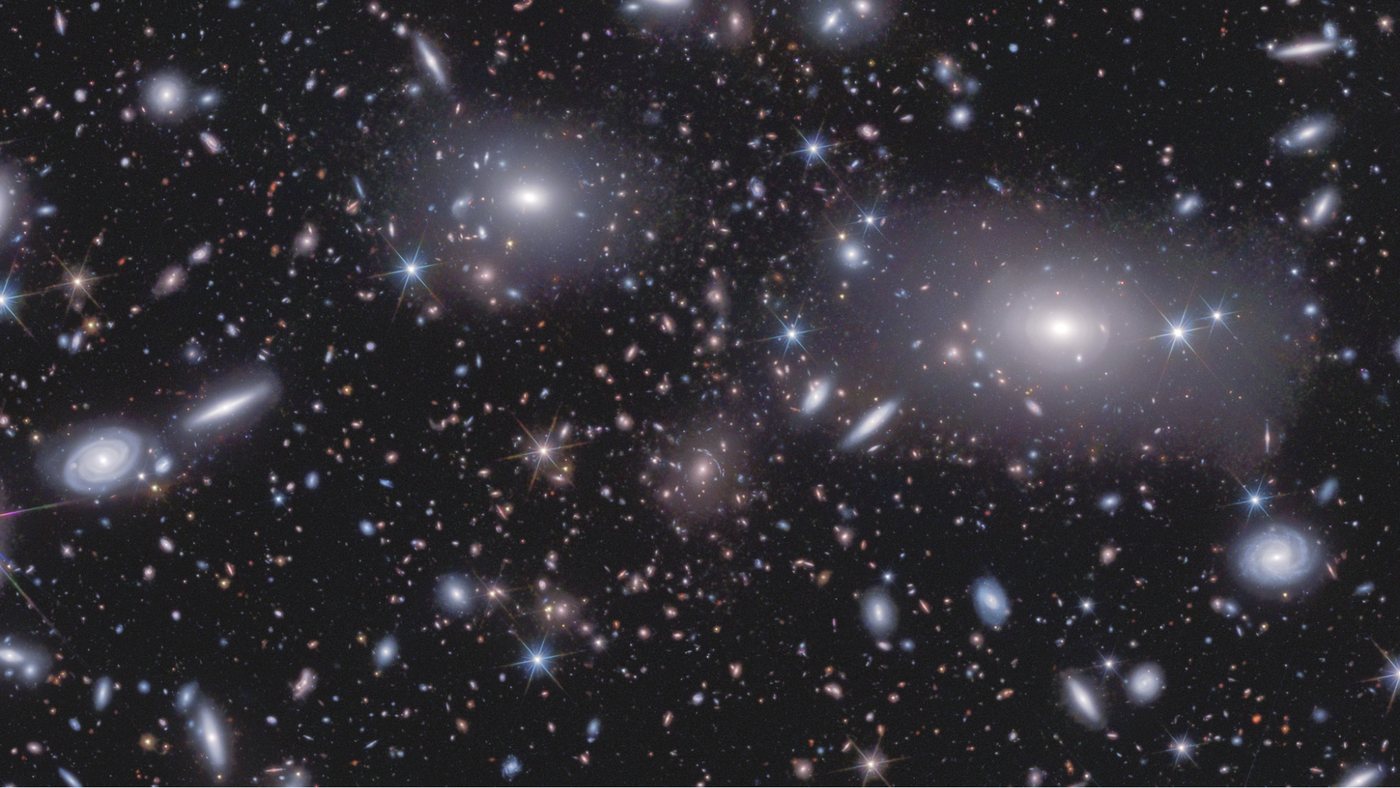
The European Space Agency has released the first substantial data set from its Euclid space probe, a move that lays the groundwork for what the agency expects to be the largest three-dimensional map of the cosmos ever compiled. The release covers thirteen months of observations and already includes more than one billion objects in the sky, among them about 900 million galaxies.
Euclid was launched in the summer of 2023 with a single purpose: to chart billions of galaxies and look back roughly ten billion years into cosmic history. Its two instruments are a visible-light camera and a near-infrared spectrometer and photometer known as NISP. Institutes of the Max Planck Society in Garching and Heidelberg contributed parts of the NISP instrument. Observing from space allows the telescope to avoid the atmospheric distortion that limits telescopes on Earth.
The mission is aimed at two of the greatest mysteries in physics. Dark matter and dark energy together make up most of the universe, while ordinary matter, including all stars and galaxies, accounts for only about five percent. Scientists still understand poorly how these invisible components behave, and Euclid's maps are intended to shed light on them.
The first data set also includes a catalog of possible strong gravitational lenses, the largest of its kind released so far, along with around 60 million possible active galactic nuclei. Astronomers such as Natalie Lines of the University of Portsmouth say that gravitational lensing could help weigh galaxies and probe how the universe is expanding. ESA scientist Carole Mundell described the release as a scientific milestone, and the agency sees it as the first concrete step toward the full survey.
Credit. Based on reporting for Handelsblatt. Is this your work? Write to us.
1,068