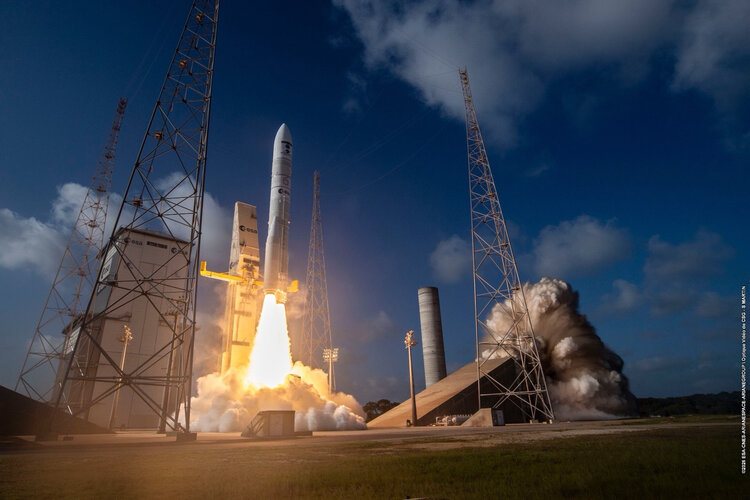
Europe’s latest weather satellite, the second Meteosat Third Generation Imager (MTG-I2), has been launched on board an Ariane 6 rocket from Europe’s Spaceport in French Guiana. The flight, designated VA270, took off on Thursday evening, completing the first family of Meteosat Third Generation (MTG) satellites and marking a significant step forward for meteorological monitoring over Europe and northern Africa.
The satellite will deliver weather forecasting data with unprecedented quality, quantity and frequency, according to the European Space Agency. MTG-I2 joins its predecessor, MTG-I1, which has been operational since 2024, and the MTG-S1 sounder satellite launched earlier this year. Together, the trio forms the backbone of Europe’s next-generation geostationary weather observation system, a collaborative programme between ESA and Eumetsat, the European Organisation for the Exploitation of Meteorological Satellites.
MTG-I2 carries the Flexible Combined Imager, an advanced instrument capable of scanning the full disk of Earth in 16 spectral channels, from visible to infrared wavelengths. This allows meteorologists to track rapidly developing weather systems, including severe storms, fog and volcanic ash, with a refresh rate of up to 10 minutes for the full disk and 2.5 minutes for specific regions of interest. The satellite also hosts a Lightning Imager, which detects and locates lightning strikes continuously, providing early warning of severe convective weather.
The launch on Ariane 6 is notable not only for the satellite itself but also for the rocket. This was the second operational flight of Europe’s new heavy-lift launcher, which is designed to replace the Ariane 5 and provide independent European access to space. The successful deployment of MTG-I2 demonstrates the launcher’s capability to carry large geostationary satellites into transfer orbit, a critical requirement for future European missions.
Once fully commissioned, MTG-I2 will enter service alongside its sister satellites, doubling the imaging capacity available to forecasters. The MTG system is expected to operate for at least two decades, providing continuity of data for numerical weather prediction models, nowcasting and climate monitoring. The programme represents a major investment in European meteorological infrastructure, with the satellites built by a consortium led by Thales Alenia Space and involving more than 50 subcontractors across Europe.
The data from the MTG constellation will be used by national weather services across Europe and northern Africa, improving forecasts for aviation, agriculture, maritime operations and disaster management. The enhanced temporal resolution and spectral coverage are particularly valuable for detecting rapidly evolving phenomena such as thunderstorms, which can develop and intensify within minutes.
Eumetsat will take over operational control of MTG-I2 after the commissioning phase, which is expected to last several months. During this period, engineers will calibrate the instruments and validate the data products before the satellite is declared fully operational. The successful launch marks the completion of the first generation of MTG imagers, with the system now poised to deliver a step change in weather observation capability for the region.
124