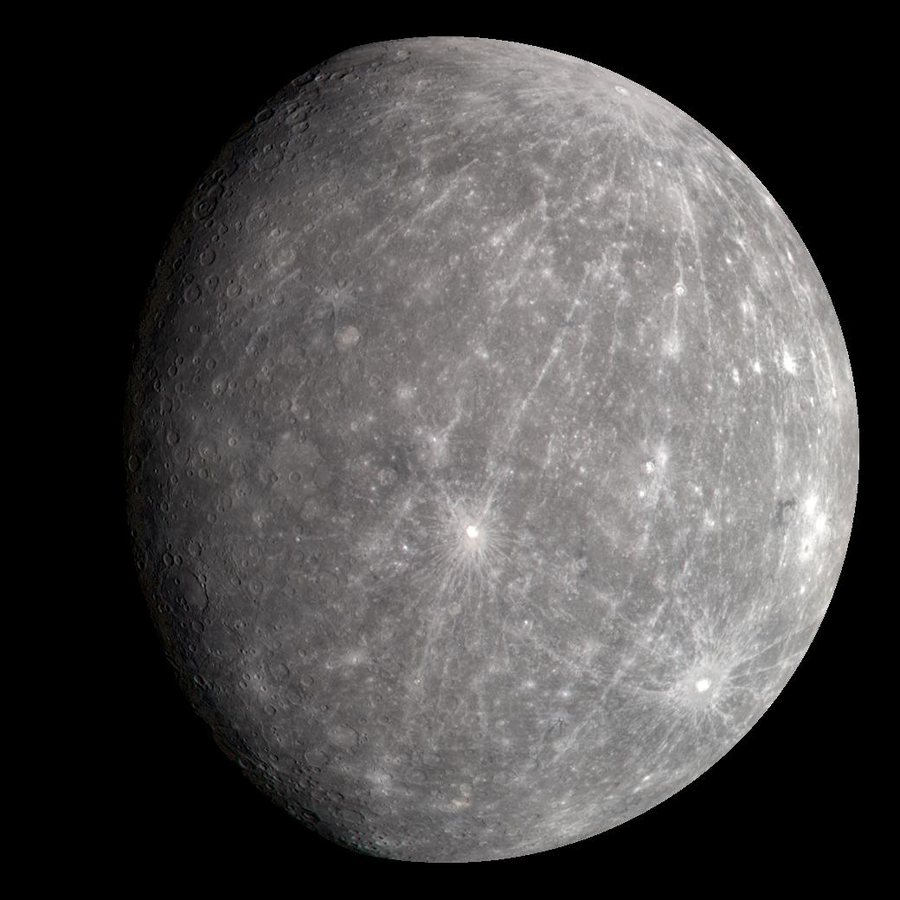
Mercury, the smallest planet in the Solar System, has been contracting for billions of years as its interior cools. That contraction has deformed the surface, creating towering landforms known as lobate scarps — the surface expression of enormous faults that can stretch for hundreds of kilometers and rise up to two thousand meters. A study published in late August in Nature Communications now shows that this deformation was facilitated by a hidden lubricant in Mercury's crust: graphite, the same material used in pencil leads.
The research was conducted by a team from the University of Padua, the National Institute for Astrophysics (INAF), and the University of Milan-Bicocca. The work combined analysis of the planet's surface topography with laboratory friction experiments on rocks similar to those in Mercury's crust, carried out at the University of Padua. The results revealed that graphite-rich layers, inherited from Mercury's earliest stages of formation, have continued to silently shape the planet's tectonics to the present day — and that Mercury may have contracted much more than previously estimated.
«The results suggest that, without graphite, some of the imposing fault systems observed today on Mercury could not exist in the form in which we see them,» explains first author Natalia A. Vergara Sassarini, who was affiliated with the University of Padua at the start of the research and is now at INAF. «More generally, they show how the first moments of a planet's formation can determine the shape of its surface billions of years later.» The study was coordinated by Professor Matteo Massironi of the University of Padua.
«We have demonstrated that large-scale fault systems can be controlled by thin films of graphite that can condition the crustal deformation of an entire planet, making Mercury a unique world in the Solar System,» adds Telemaco Tesei of the Department of Geosciences at the University of Padua, who handled the mechanical experiments for the research.
The findings address a long-standing puzzle. «Earth's faults are often 'lubricated' by the presence of fluids that facilitate their movement,» observes Andrea Bistacchi of the Department of Environmental and Earth Sciences at the University of Milan-Bicocca, a co-author of the study who has also dedicated his research to weak faults on our own planet. «But fluids like those present on Earth are not available on Mercury because of its extreme proximity to the Sun and its reduced gravity. For this reason, it was necessary to discover an alternative mechanism to explain the weakness of Mercury's faults.»
The discovery comes just months before the BepiColombo probe, a joint mission of the European and Japanese space agencies ESA and JAXA, is scheduled to enter orbit around Mercury next November. «This discovery lays the groundwork for targeted research to verify in detail the geometries of these enormous faults and the presence of graphite in their vicinity,» concludes Massironi, a co-author of the article and project scientist for the Simbio-Sys instrument, designed to map and analyze Mercury's geology, surface, and composition. «Simbio-Sys will certainly be able to do this, allowing us to reconstruct these landforms in three dimensions, observe the surface in very great detail, and at the same time understand its mineralogical composition.»
The study, titled «Graphite lubricates Mercury's global contraction,» was authored by Natalia A. Vergara Sassarini, Matteo Massironi, Telemaco Tesei, and Andrea Bistacchi. It offers a new framework for understanding how the earliest chemical conditions of a rocky planet can leave a lasting mark on its geological evolution, and it sets the stage for direct observations that could confirm the role of graphite in shaping Mercury's scarred surface.
88