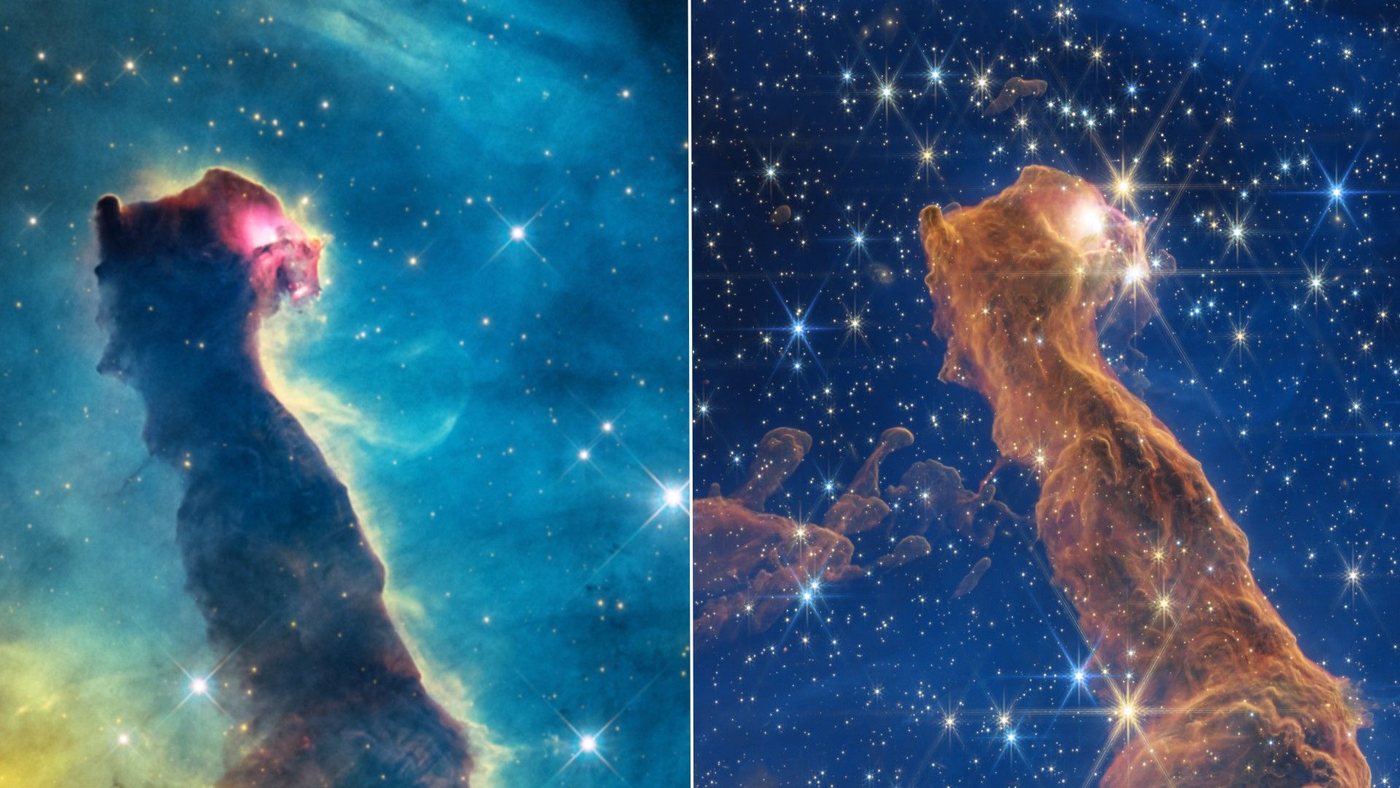
NASA's Hubble and James Webb space telescopes have released new views of the Cat's Head Nebula, a glowing region of gas and dust whose outline resembles a cat's head. Timed for Halloween, the three images show the nebula in visible, near-infrared and mid-infrared light, revealing details that each wavelength captures differently.
The nebula takes its name from its distinctive shape, which is easiest to see on the left side of the images. In the Hubble picture, taken in visible light, the nebula appears as a brown pillar of dust set against a hazy, multicolored field of dust and gas. The colors come from Hubble's filters, which pick up light from oxygen, hydrogen and sulfur as well as light scattered by dust. Within the cat's head, the images also show a glowing red spot that experts suggest could be a young star trapped in the nebula's dusty material.
The Cat's Head Nebula is about 7,500 light-years from Earth and forms part of the larger Carina Nebula. Its shape was sculpted over eons by intense ultraviolet radiation and winds of gas streaming from massive stars in the surrounding region. The same forces continue to act on the nebula, and as stars in the Carina Nebula form, grow and evolve, the structure will keep changing, eventually losing its feline appearance.
The Webb telescope observed the nebula in near-infrared and mid-infrared wavelengths, complementing Hubble's visible-light view. Looking at the same region through different wavelengths and with different instruments allows astronomers to uncover details that a single view would miss, offering a more complete picture of this distant star-forming region.
Source: space.com
14