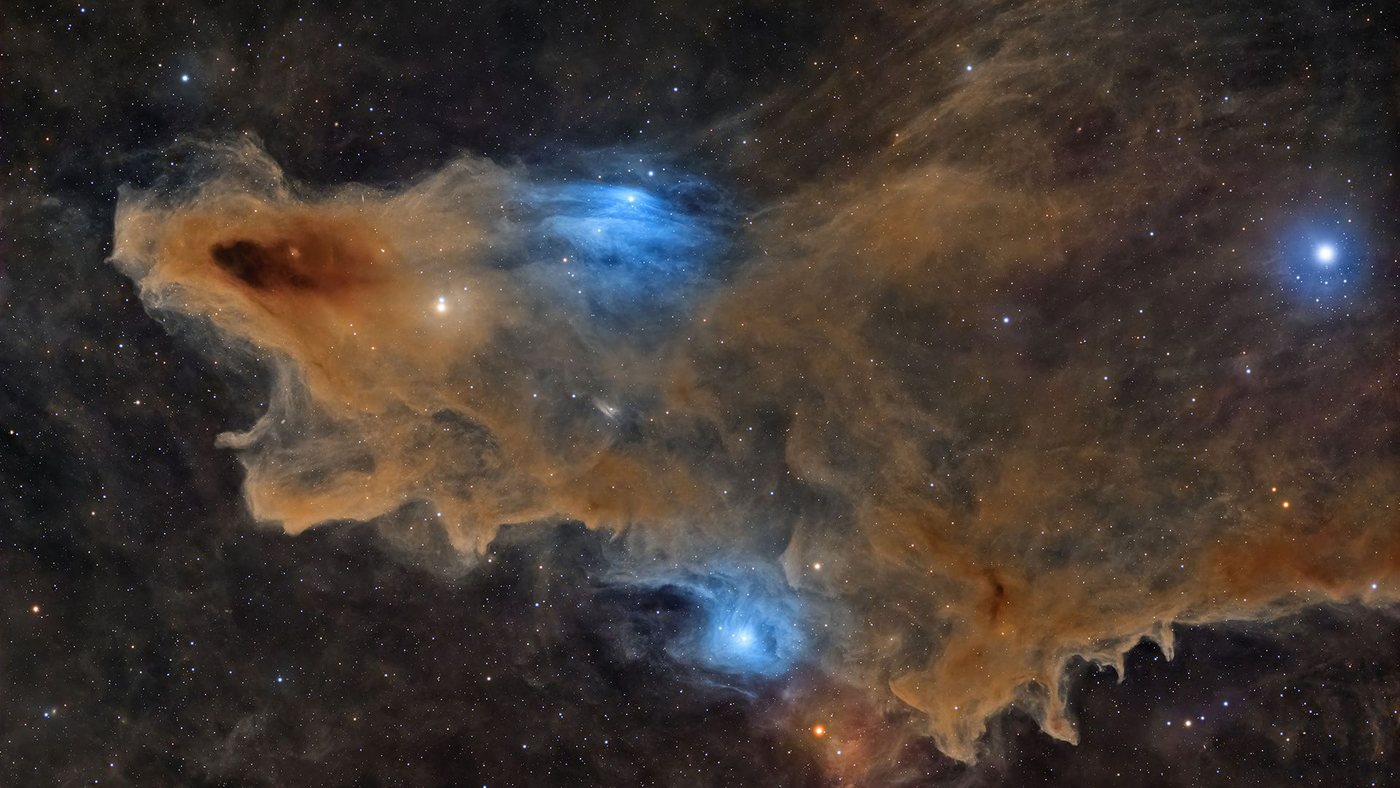
A Kuwaiti astrophotographer has won the 2026 Astronomy Photographer of the Year competition, organised by the Royal Observatory in Greenwich, London, with a painstakingly captured image of a dark nebula 650 light years from Earth.
Ali Alobaidly's The Quiet Predator shows the Shark Nebula in the constellation Cepheus, a dense cloud of interstellar dust so thick it blocks the starlight behind it. The blue-tinted regions visible in the frame are reflection nebulae — clouds of dust that do not emit their own visible light but scatter and reflect the glow of nearby stars. Capturing the scene required more than 28 hours of observing, according to the competition organisers.
The image was taken in August 2025 with an Askar 140 APO telescope from the Jahra Governorate in Kuwait. Alobaidly said the award was a « tremendous honour » and described the appeal of the subject in personal terms. « The juxtaposition of an oceanic predator prowling the skies above the Kuwaiti desert is something I find deeply poetic, and it is what first drew me to this remarkable region of the sky, » he said. « To me, it represents perfectly my love for both the Universe and the deserts of my ancestors. »
Sam Wen, founder and chief executive of the astrophotography firm ZWO, which supports the award, called the winning entry « a stunning blend of technical excellence and artistic vision ». He added that it showcases the intricate structures of a rarely photographed nebula, combining remarkable detail with a striking composition and colour palette.
The competition, now in its 18th year, is run by the Royal Observatory Greenwich in association with ZWO and BBC Sky at Night Magazine. Alobaidly takes home a £10,000 top prize, and his image will appear in an exhibition at the National Maritime Museum in London from 18 September alongside other selected pictures from the contest.
Alobaidly said he hopes to continue using astrophotography for outreach and scientific research. The organisers noted that the astonishing diversity of the cosmos is on display across this year's entries, from our own solar system to distant nebulae, all captured from the ground on Earth.
The runner-up, Beyond the Wormhole by Kfir Simon of Israel, depicts the centre of the Helix nebula, about 650 light years away in the constellation Aquarius. While the image may evoke a hole in space-time, it actually shows the central star that formed the nebula when it shed its outer layers thousands of years ago, with extraordinarily distant galaxies shining through the surrounding dust and gas.
In the Our Moon category, Petr Horalek of Czechia won with Venusian Pearl on the Moon, taken as the moon passed in front of Venus in the middle of the day. He captured the relatively rare event, called an occultation, just as Venus slipped behind the crescent moon.
The runner-up in the Our Sun section went to Peter Ward of Australia for Anatomy of the Chromosphere, which combines two different wavelengths of light. One captures emission from hydrogen along the sun's edges, represented in red, while the other shows emission from calcium, shown in lilac. Together they reveal the structure of the chromosphere, the layer just above the sun's visible surface but below its corona.
A highly commended image by Julien DeWinter of Belgium and Landon Boehm of the United States shows Comet C/2025 A6 (Lemmon) streaking across the sky over Texas. When it was captured in October 2025, the comet was almost at its closest point to the sun, about 101 million kilometres from Earth. That proximity triggered remarkable activity, creating two long plumes — one of dust and the other of electrically charged plasma.
In the Skyscapes category, Stefano Pellegrini of Italy won with Botswana Star Trail, which records the movement of stars above a grove of baobab trees over the course of 340 camera exposures, each lasting 30 seconds. The result is a more earthly setting for a celestial phenomenon, pairing the rotation of the night sky with a familiar landscape.