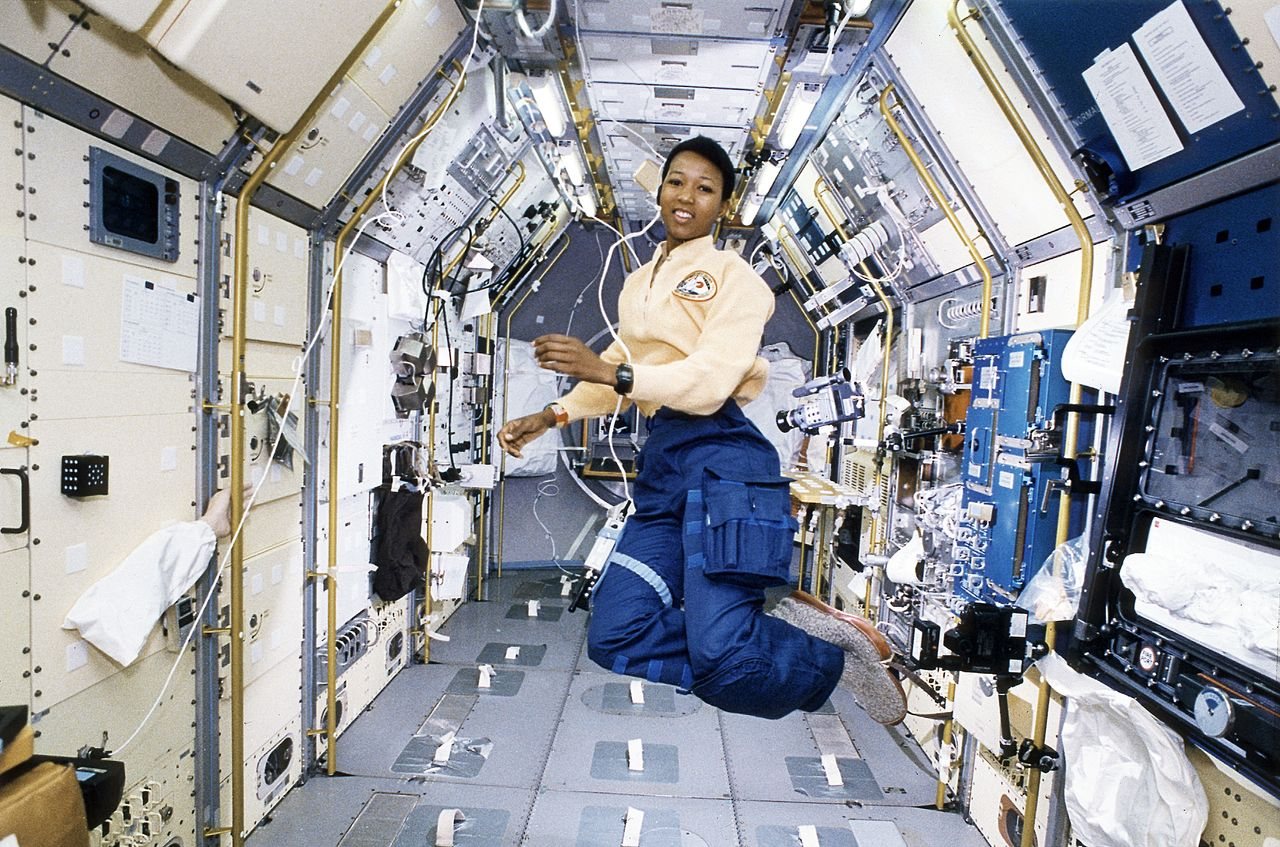
On September 12, 1992, NASA astronaut Mae Jemison became the first Black woman to travel to space, flying aboard the Space Shuttle Endeavour on mission STS-47. The launch marked a historic milestone in human spaceflight and a breakthrough for representation in the U.S. space program.
Jemison, a physician and engineer, served as a mission specialist during the eight-day flight. The crew conducted a range of experiments in materials science, life sciences, and technology development, taking advantage of the microgravity environment of low Earth orbit. The mission was a joint effort with Japan, carrying the Spacelab-J module, a laboratory designed for research in biology, biotechnology, and fluid physics.
Her path to orbit was unconventional. Born in Decatur, Alabama, and raised in Chicago, Jemison earned a degree in chemical engineering from Stanford University before completing her medical degree at Cornell University. She worked as a general practitioner and later served in the Peace Corps in Sierra Leone and Liberia, where she conducted medical research and provided primary care. In 1987, she was selected by NASA as one of 15 astronauts in Group 12, becoming the first Black woman admitted to the astronaut corps.
STS-47 launched from Kennedy Space Center in Florida and landed at the same site on September 20, 1992. During the mission, the crew orbited Earth 126 times and traveled more than 3.3 million miles. The flight was notable not only for Jemison’s presence but also for the first married couple to fly in space together, astronauts Mark Lee and Jan Davis, and the first Japanese astronaut to fly on a U.S. shuttle, Mamoru Mohri.
Jemison’s achievement resonated far beyond the space community. She became a symbol of possibility for women and minorities in science, technology, engineering, and mathematics. After leaving NASA in 1993, she founded The Jemison Group, a technology consulting firm, and later established the Dorothy Jemison Foundation for Excellence, which promotes science education. She also led the 100 Year Starship project, an initiative to pursue interstellar travel within the next century.
Her legacy continues to shape discussions about diversity in space exploration. NASA has since flown numerous women and astronauts of color, but Jemison remains a pioneering figure. In 2022, the 30th anniversary of her flight, she reflected on the importance of broadening access to space and ensuring that the next generation sees themselves in the cosmos.
As the world marks this day in space history, Jemison’s flight stands as a reminder that scientific progress is intertwined with social progress. Her journey from a Chicago childhood to Earth orbit opened doors and expanded the vision of who can contribute to humanity’s future beyond the planet.
105