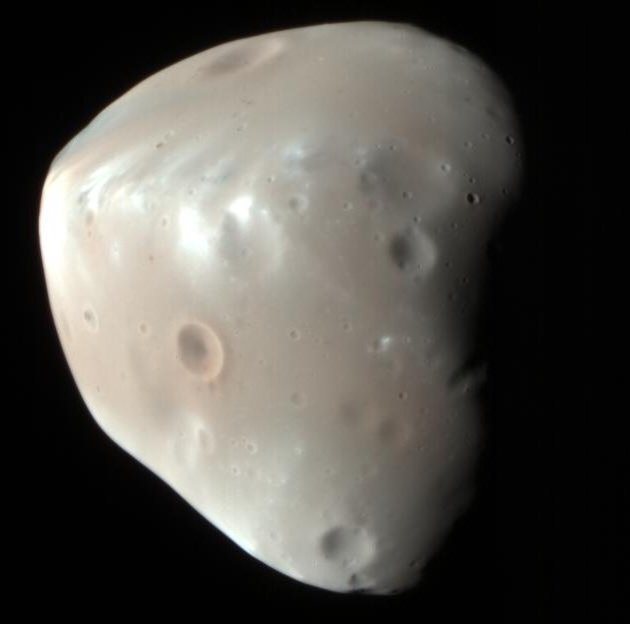
A massive crater on Phobos, the larger of Mars' two moons, may hold a dense pocket of compressed material that could finally answer one of planetary science's most persistent questions: whether the moon is a captured asteroid or a fragment of Mars itself, blasted into orbit by an ancient impact.
The crater's structure suggests that whatever struck Phobos left behind a concentrated mass beneath the surface, a signature that could distinguish between the two competing origin theories. If the moon formed from debris ejected by a giant impact on Mars, its interior would likely be porous and loosely bound. If it was captured from the asteroid belt, its interior could be denser and more uniform, reflecting a different history of formation and collision.
Japan's Martian Moons eXploration mission, known as MMX, is designed to resolve the debate. The spacecraft is scheduled to survey both Phobos and Deimos, land on Phobos, and collect surface samples for return to Earth. Those samples would allow scientists to measure the moon's composition directly, rather than inferring it from remote observations. The crater's compressed material could be among the most valuable targets for sampling, because it may preserve evidence of the impact that created it and of the moon's deeper structure.
The origin of Phobos matters beyond the moon itself. If Phobos and Deimos are captured asteroids, they would represent a class of small bodies that Mars has collected over its history, offering a window into the early solar system's population of planetesimals. If they formed from a giant impact, they would join Earth's moon as examples of a planet's debris disk coalescing into a satellite, a process that may be common in the solar system.
Phobos is also a moon with a limited future. It orbits Mars closer than any other known moon, and tidal forces are gradually pulling it inward. In roughly 50 million years, it is expected to break apart or crash into Mars, leaving a ring of debris that could briefly circle the planet. That fate makes the moon a time-sensitive target: its surface and interior preserve a record that will eventually be destroyed.
The crater's dense material could also help explain Phobos' unusual surface features. The moon is marked by long grooves and a chain of craters that some researchers have linked to the impact that formed the Stickney crater, its largest surface feature. A compressed mass beneath the crater would support the idea that a powerful collision fractured the moon and redistributed material across its surface.
MMX is expected to provide the first direct samples from a Martian moon, a step that could settle the origin question within the next decade. Until then, the crater remains one of the strongest clues that Phobos may not be a simple captured asteroid, but a world shaped by a violent event in Mars' deep past.