The Saturn V rocket that carried Apollo astronauts to the Moon was formally taken out of production on Aug. 1, 1968, a decision that shaped the rest of NASA's lunar program and left the agency with a limited supply of its most powerful launch vehicle.
The move ended the production line for the towering three-stage rocket, which remains one of the most powerful machines ever built. It came as the Apollo program was accelerating toward its first crewed lunar missions, and it meant that NASA would have to complete its Moon landings using the Saturn V boosters already on order or under construction.
The rocket was developed in the 1960s under the direction of German-American engineer Wernher von Braun and his team at NASA's Marshall Space Flight Center in Huntsville, Alabama. Standing about 363 feet tall and generating roughly 7.6 million pounds of thrust at liftoff, the Saturn V was designed specifically to send astronauts beyond low Earth orbit and toward the Moon.
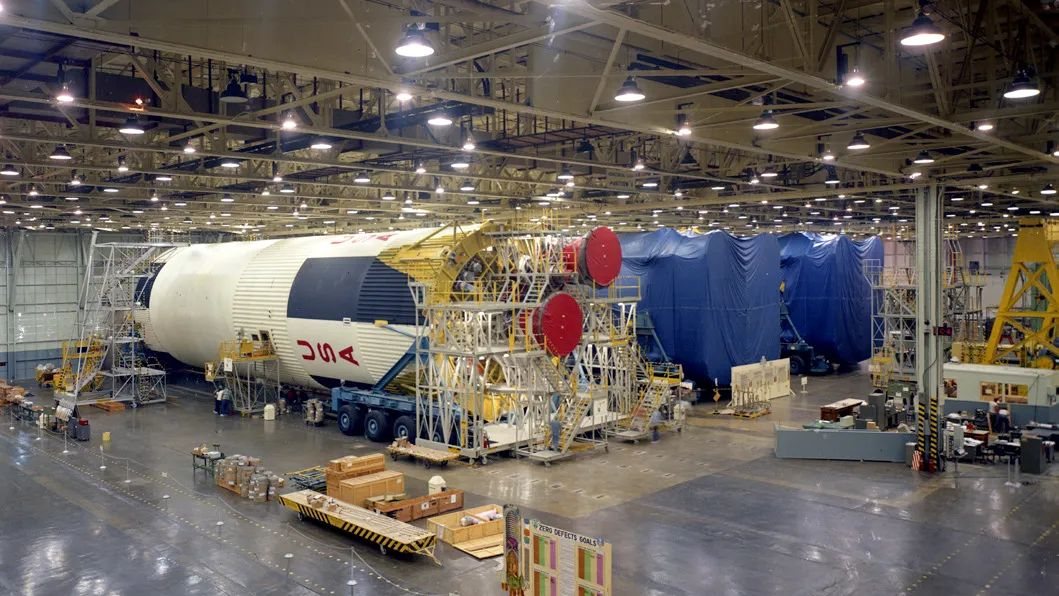
The Saturn V was built in three stages, each with a distinct role in pushing the spacecraft toward the Moon. The S-IC first stage lifted the rocket off the launch pad with five F-1 engines, the S-II second stage carried it through the upper atmosphere, and the S-IVB third stage inserted the Apollo spacecraft into Earth orbit before firing again to send it on a lunar trajectory.
Production was centered at NASA's Michoud Assembly Facility in New Orleans, where Boeing built the first stage, and at other facilities across the country. By the time production ended, NASA had ordered a total of 15 Saturn V rockets. Thirteen of them would ultimately fly, including the 12 used during the Apollo program and one used to launch the Skylab space station in 1973.
The decision to shut down the production line was driven by budget pressures and by NASA's expectation that the Apollo program would not need additional rockets beyond those already planned. With the space race against the Soviet Union effectively won after the Apollo 11 landing in July 1969, political support for continued lunar missions faded, and the agency shifted its focus toward the Space Shuttle program during the 1970s.
Three Saturn V rockets that were built but never flew remain on display. One stands at the Johnson Space Center in Houston, another at the Kennedy Space Center in Florida, and the third at the U.S. Space & Rocket Center in Huntsville, Alabama. They serve as a reminder of the scale of the Apollo program's engineering effort.
The Saturn V's first crewed mission, Apollo 8, lifted off in December 1968 and became the first human spaceflight to orbit the Moon. Apollo 11 followed in July 1969, when astronauts Neil Armstrong and Edwin «Buzz» Aldrin became the first humans to walk on the lunar surface. In total, twelve American astronauts walked on the Moon between 1969 and 1972, all of them carried by Saturn V rockets.
The Saturn V's guidance computer had far less processing power than a typical smartphone by today's standards. Despite that, the rocket achieved an extraordinary reliability record, with no launch failures in its thirteen flights.
The Saturn V remains the only launch vehicle ever built that has carried humans beyond low Earth orbit. Its successors, including the Space Launch System developed by NASA in recent years, have been designed to perform similar deep-space missions, but none has yet matched the Saturn V's record of crewed lunar flights.
NASA's decision to end production on Aug. 1, 1968, is often cited as one of the turning points of the Apollo era. It locked in the number of lunar landing opportunities available to the agency and contributed to the early end of the Apollo program. Originally, NASA had considered additional missions beyond Apollo 17, including flights to the Moon's polar regions and potential lunar surface bases, but those plans were abandoned.
The legacy of the Saturn V endures in museum displays, in the design of modern heavy-lift rockets, and in the memory of the Apollo missions. The rocket's final flight in 1973, which launched Skylab, marked the last time a Saturn V left Earth.