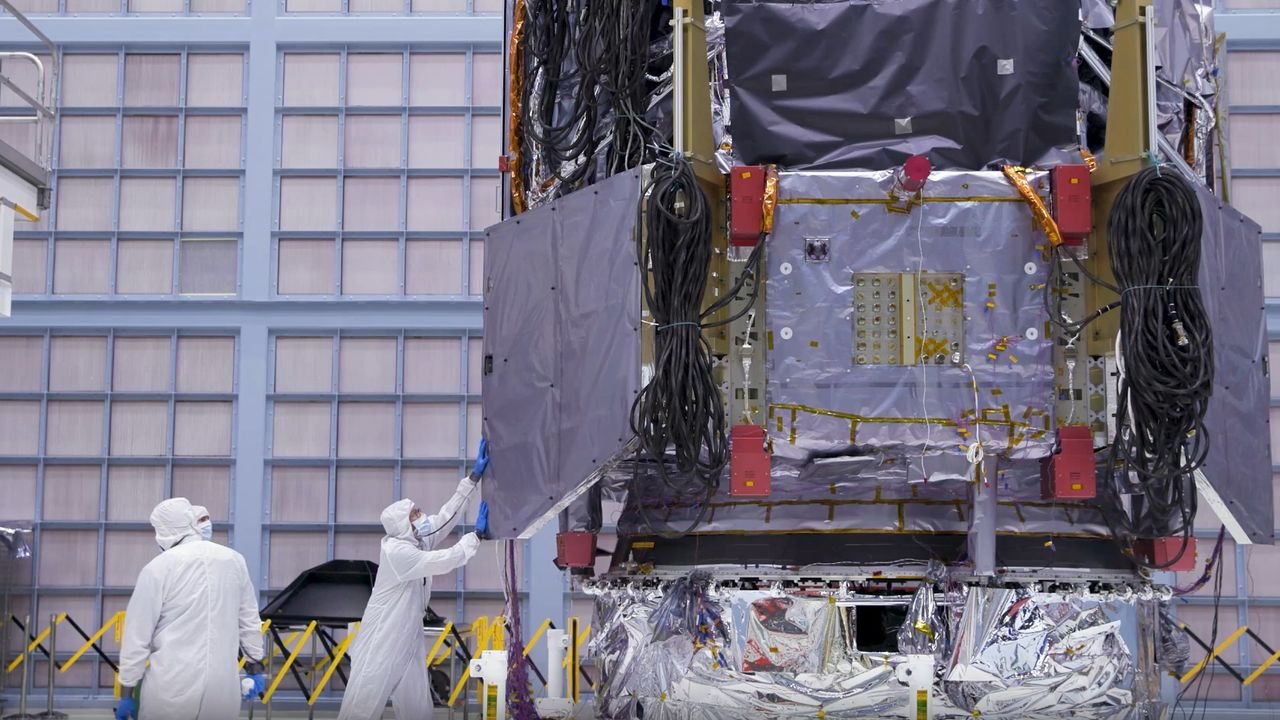
NASA announced that it has finished fueling the Nancy Grace Roman Space Telescope, a major milestone that moves the observatory closer to its anticipated launch in August. The fueling operation, carried out at the Kennedy Space Center in Florida, involved loading the spacecraft with hydrazine propellant necessary for orbital maneuvers and attitude control after reaching space.
The Roman Space Telescope, originally known as WFIRST, is a next-generation observatory designed to address some of the most profound questions in astrophysics. Its primary mirror measures 2.4 meters in diameter, the same size as the Hubble Space Telescope, but Roman has a field of view 100 times larger than Hubble's infrared instrument. This unique capability will allow it to survey vast areas of the sky quickly.
One of the mission's core objectives is to study dark energy, the mysterious force driving the accelerated expansion of the universe. By measuring the distribution of galaxies and the growth of cosmic structure, Roman will provide new insights into this enigmatic phenomenon. The telescope will also conduct a microlensing survey to detect and characterize exoplanets, including Earth-sized worlds, and will image nearby galaxies to study star formation and galactic evolution.
With fueling complete, Roman now enters the final phase of prelaunch preparations. The spacecraft will be moved to the launch pad and integrated with its Falcon Heavy rocket. The launch window opens in August, and if on schedule, Roman will be placed into a halo orbit around the Sun-Earth L2 Lagrange point, about 1.5 million kilometers from Earth.
The Roman Space Telescope represents a collaboration among NASA, the Jet Propulsion Laboratory, the Goddard Space Flight Center, and numerous academic and research institutions. Its development has spanned more than a decade and involved intricate engineering to achieve the required sensitivity and stability. Once operational, Roman is expected to generate massive data sets that will be publicly available, enabling discoveries across many fields of astronomy.
Astronomers worldwide are eagerly awaiting the mission's launch. Roman will complement the James Webb Space Telescope by providing wide-area surveys that Webb cannot efficiently perform. Together, these observatories will give scientists a more complete picture of the universe, from the first stars and galaxies to the distribution of dark matter and the potential for life elsewhere.
NASA officials have expressed confidence in the mission's readiness. The successful fueling is one of the last major hurdles before launch, and the team is now focused on final checks and countdown simulations. If all goes as planned, Roman will begin its science operations within a few months after reaching orbit, revolutionizing our understanding of the cosmos.