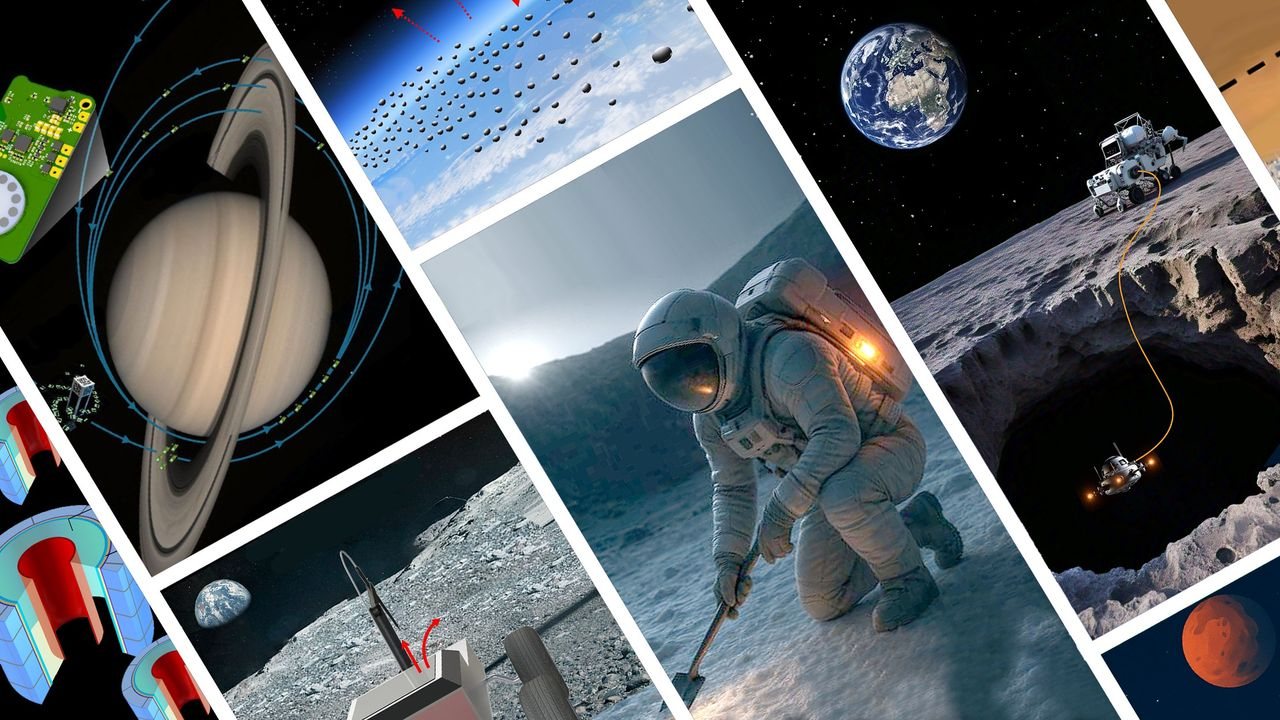
NASA has awarded initial funding to 18 visionary spaceflight concepts through its Innovative Advanced Concepts (NIAC) program, including a proposal to launch a swarm of 10,000 tiny satellites, or “femtosats,” to Saturn. The selected ideas range from a solar system-scale telescope to a swarm of robots designed to explore Venus, each receiving a grant to study feasibility and develop early-stage designs.
The Saturn mission concept, led by researchers at the University of California, Berkeley, envisions deploying thousands of wafer-thin spacecraft, each weighing less than a gram, to study the ringed planet and its moons. The femtosats would be propelled by sunlight and could provide unprecedented coverage of Saturn’s atmosphere, magnetosphere, and rings, potentially revealing details about the planet’s internal structure and the habitability of its icy moons like Enceladus.
Another notable selection is a proposal for a “solar system-scale telescope” that would use the Sun as a gravitational lens to image exoplanets in high resolution. This concept, studied by scientists at the Jet Propulsion Laboratory, would place a spacecraft at a distance of about 550 astronomical units from the Sun, using the Sun’s gravity to magnify light from distant worlds, potentially allowing direct imaging of Earth-like planets around nearby stars.
NASA’s NIAC program supports early-stage research into bold, science-fiction-like ideas that could transform future space missions. Each selected project receives a Phase I grant of up to $175,000 to conduct a nine-month feasibility study. The 18 concepts were chosen from a pool of proposals submitted by researchers across academia, industry, and government, reflecting a wide range of innovative approaches to space exploration.
Among the other funded ideas are a swarm of robotic “bees” for Mars exploration, a self-assembling space telescope, and a concept for a spacecraft that could land on the surface of Venus using a novel cooling system. The program aims to identify technologies that, while still in early stages, could enable breakthrough missions in the coming decades.
“These concepts are at the very beginning of their journey, but they represent the kind of bold thinking that can lead to transformative discoveries,” said a NASA official in a statement. “By investing in these early-stage ideas, we are planting the seeds for future missions that could expand our understanding of the universe.”
The femtosat concept, in particular, highlights a growing interest in using small, distributed spacecraft for scientific observations. Traditional missions rely on a single large spacecraft, but swarms of tiny probes could offer resilience, redundancy, and the ability to gather data from many points simultaneously. The Saturn mission would be a major step toward this new paradigm, though significant technical challenges remain, including communication, propulsion, and data transmission from such small platforms.
NIAC’s Phase I selections are not guaranteed to become actual missions; they are the first step in a multi-stage process that includes further feasibility studies and potential Phase II and III funding. However, the program has a history of nurturing ideas that eventually fly, such as the Mars helicopter Ingenuity, which began as a NIAC concept.
The 18 concepts will be presented at the NIAC Symposium later this year, where researchers will share their initial findings and outline next steps. The program is part of NASA’s broader effort to foster innovation and maintain American leadership in space exploration.
107