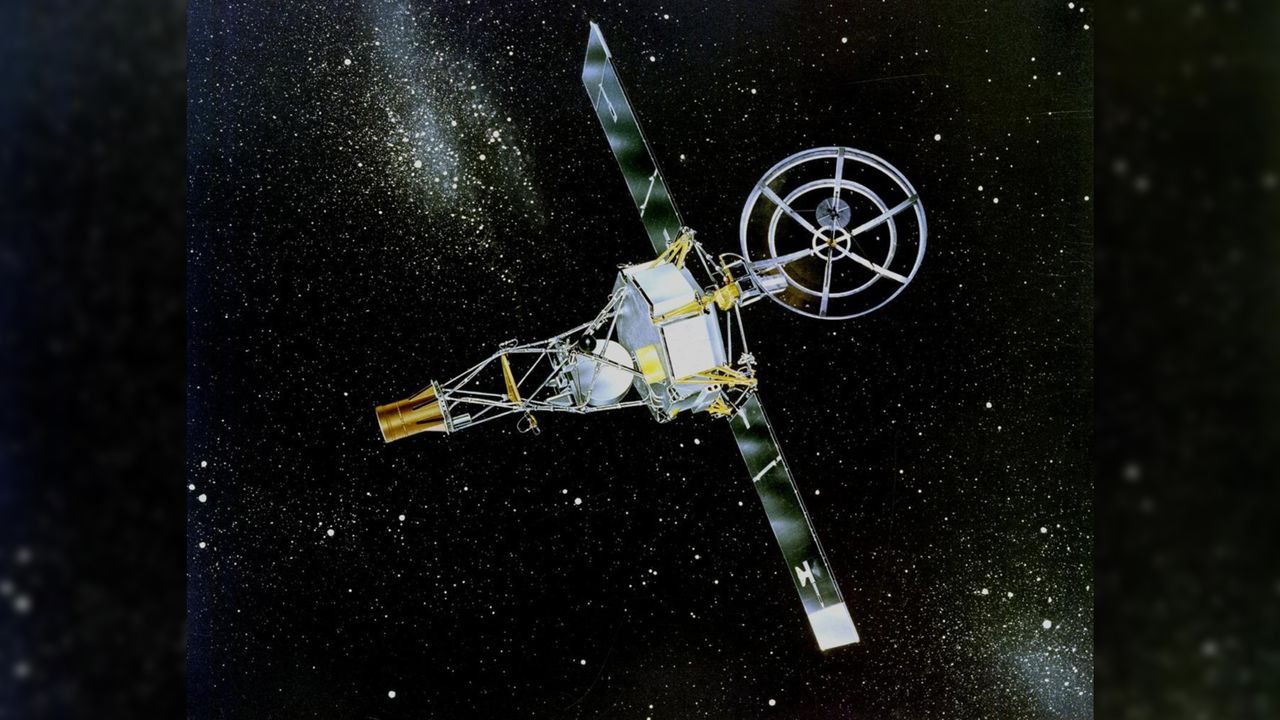
On Sept. 4, 1962, NASA's Mariner 2 spacecraft performed the first-ever maneuver in deep space, a course correction that set it on a trajectory to Venus and ultimately made it the first successful interplanetary probe. The maneuver, executed more than a month after launch, was a critical step in proving that spacecraft could be guided across millions of miles of space.
Mariner 2 launched on Aug. 27, 1962, from Cape Canaveral, Florida, atop an Atlas-Agena B rocket. Its goal was to fly past Venus and study the planet's atmosphere, surface temperature, and interplanetary space. But shortly after launch, the spacecraft's trajectory was slightly off, and mission controllers at NASA's Jet Propulsion Laboratory in California needed to adjust its path to ensure a close encounter with Venus.
The mid-course correction, performed on Sept. 4, 1962, involved firing the spacecraft's small hydrazine thruster for about 27 seconds. This changed Mariner 2's velocity by roughly 37 miles per hour, enough to redirect it toward a flyby of Venus. The maneuver was a technical milestone: it demonstrated that deep-space navigation was possible, a capability essential for all future planetary missions.
After the correction, Mariner 2 continued on its journey, traveling more than 180 million miles over 3.5 months. On Dec. 14, 1962, it flew within about 21,600 miles of Venus, becoming the first spacecraft to successfully encounter another planet. During the flyby, Mariner 2's instruments scanned the planet and returned data that reshaped scientific understanding of Venus.
The spacecraft's microwave and infrared radiometers measured Venus's surface temperature at approximately 800 degrees Fahrenheit, confirming that the planet was far hotter than earlier estimates suggested. Mariner 2 also detected that Venus rotates slowly and in a retrograde direction, and it found no detectable magnetic field. These findings helped dispel older theories that Venus might harbor a temperate, Earth-like environment.
Mariner 2's success came after a series of early failures in both American and Soviet planetary programs. The Soviet Union had launched several probes toward Venus in the late 1950s and early 1960s, but none survived the journey or returned useful data. The United States had also suffered setbacks, including the failure of Mariner 1, which was destroyed shortly after launch in July 1962 due to a guidance error.
Mariner 2's achievement was therefore a turning point in the space race, demonstrating that interplanetary exploration was feasible. The mission also laid the groundwork for later Mariner missions to Mars, Mercury, and beyond, and it established the mid-course correction as a standard technique for deep-space navigation.
After its Venus encounter, Mariner 2 continued to operate for several more months, sending back data on the solar wind and cosmic dust. Contact was lost in early January 1963, but the spacecraft had already fulfilled its primary objectives and exceeded expectations.
The success of Mariner 2 was a major boost for NASA and the Jet Propulsion Laboratory, which had managed the mission. It proved that robotic spacecraft could be built, launched, and guided to distant targets, opening the door to the exploration of the solar system. Today, the techniques first tested on Mariner 2 are used in every interplanetary mission, from Mars rovers to the Voyager probes and the James Webb Space Telescope.
Mariner 2 remains a landmark in space history, not only for its scientific discoveries but for demonstrating that humanity could navigate the vast emptiness between planets. The Sept. 4, 1962, maneuver was a small firing of a thruster, but it was a giant step for space exploration.
86