On Aug. 3, 2004, NASA launched the MESSENGER spacecraft from Cape Canaveral Air Force Station in Florida, beginning a mission that would make history as the first to orbit Mercury. The robotic probe, carried aloft by a Delta II rocket, set off on a winding, 6.5-year journey through the inner solar system before finally settling into orbit around the planet closest to the Sun.
At the time, Mercury remained one of the least explored planets of the inner solar system. The only previous visitor was NASA's Mariner 10, which flew past Mercury three times in the mid-1970s and photographed less than half of the planet's surface. MESSENGER was built specifically to close that gap with a complete orbital survey.
Named for the MErcury Surface, Space ENvironment, GEochemistry, and Ranging investigation, the spacecraft carried cameras, spectrometers, and magnetometer experiments designed to answer basic questions about Mercury's composition, geology, and magnetic field. Scientists hoped the mission would reveal how the little planet formed and why its dense iron core takes up so much of its volume.
Getting to Mercury is notoriously difficult. A spacecraft launched from Earth must shed a large amount of orbital energy to fall inward toward the Sun and then slow down enough to be captured by Mercury's gravity. To make this possible with a single rocket, mission planners charted a winding route using the gravity of other planets. MESSENGER flew past Earth once, Venus twice, and Mercury three times before making the engine burn that put it into orbit on March 18, 2011. By then, the probe had traveled more than 4.9 billion miles.
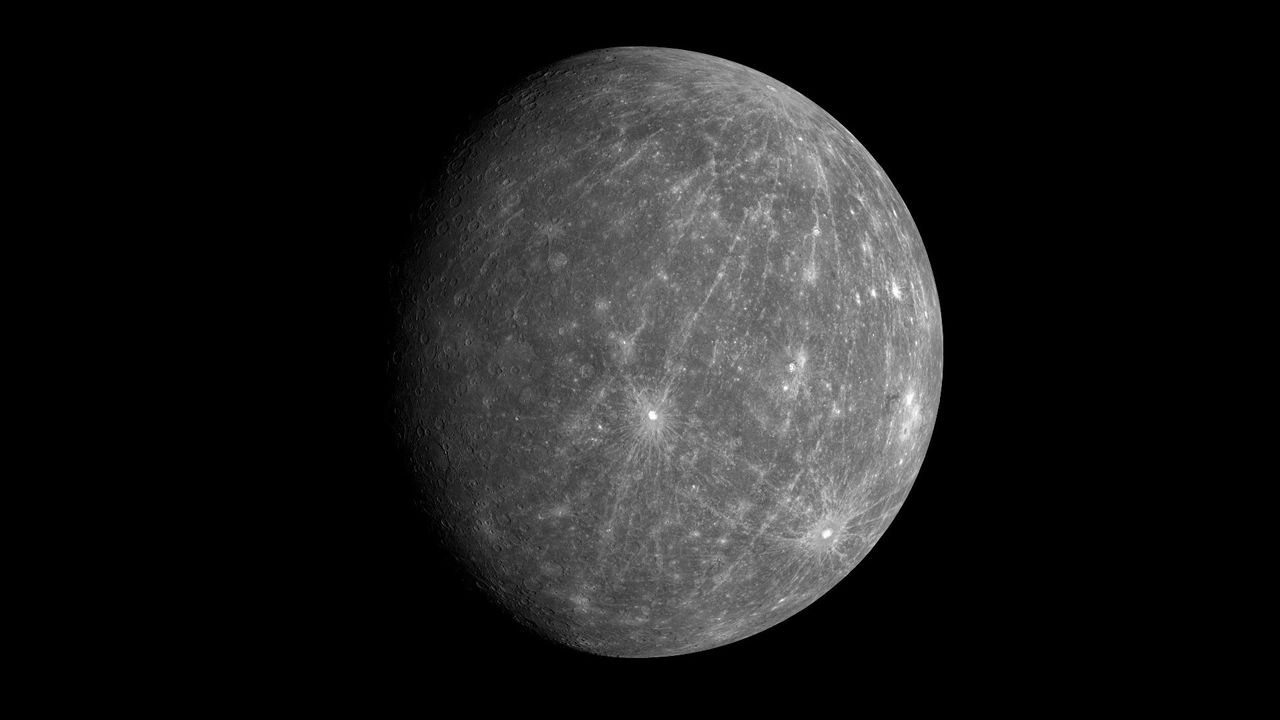
The orbital insertion made MESSENGER the first spacecraft ever to orbit Mercury. From that position, the mission spent four years producing global maps of the planet's surface, measuring its topography, and tracking the composition of its extremely thin exosphere. The results painted Mercury as a dynamic world shaped by ancient volcanic eruptions, sweeping lava plains, and a long history of impacts.
One of the mission's most striking discoveries involved water. Mercury's daytime surface temperature can soar above 800 degrees Fahrenheit, hot enough to melt lead, but deep, permanently shadowed craters near the poles never see direct sunlight. MESSENGER found that these dark craters contain abundant water ice and organic material. The discovery showed that even the planet closest to the Sun has managed to store water in protected pockets.
The spacecraft also confirmed that Mercury possesses a global magnetic field, making it the only other rocky planet in the solar system known to have one. Data from MESSENGER linked that field to a dynamo in Mercury's partly liquid iron core, and showed that the planet's core occupies a far larger fraction of its interior than Earth's core does. The mission documented wrinkle-like ridges and steep cliffs indicating that Mercury cooled and shrank over time.
After more than four years in orbit, MESSENGER ran low on propellant. Controllers lowered the spacecraft's path to collect additional high-resolution data from closer range, and on April 30, 2015, they allowed it to strike Mercury's surface. By the end of the mission, MESSENGER had completed thousands of orbits and returned more than 277,000 images.
MESSENGER's datasets remain in active use by planetary scientists, and its results helped shape the European-Japanese BepiColombo mission, which continues the study of Mercury. The mission's findings transformed Mercury from a distant, cratered mystery into one of the best-characterized rocky planets in the solar system.