Bacteria and fungi carried by astronauts could survive for up to a week or more in the permanently shadowed regions near the Moon's south pole, according to new research from NASA's Goddard Space Flight Center and the University of Maryland. The finding suggests that future crewed missions to the lunar poles — including NASA's Artemis IV — will need to account for the unintended transfer of Earth life to environments that may one day be studied for signs of native biology.
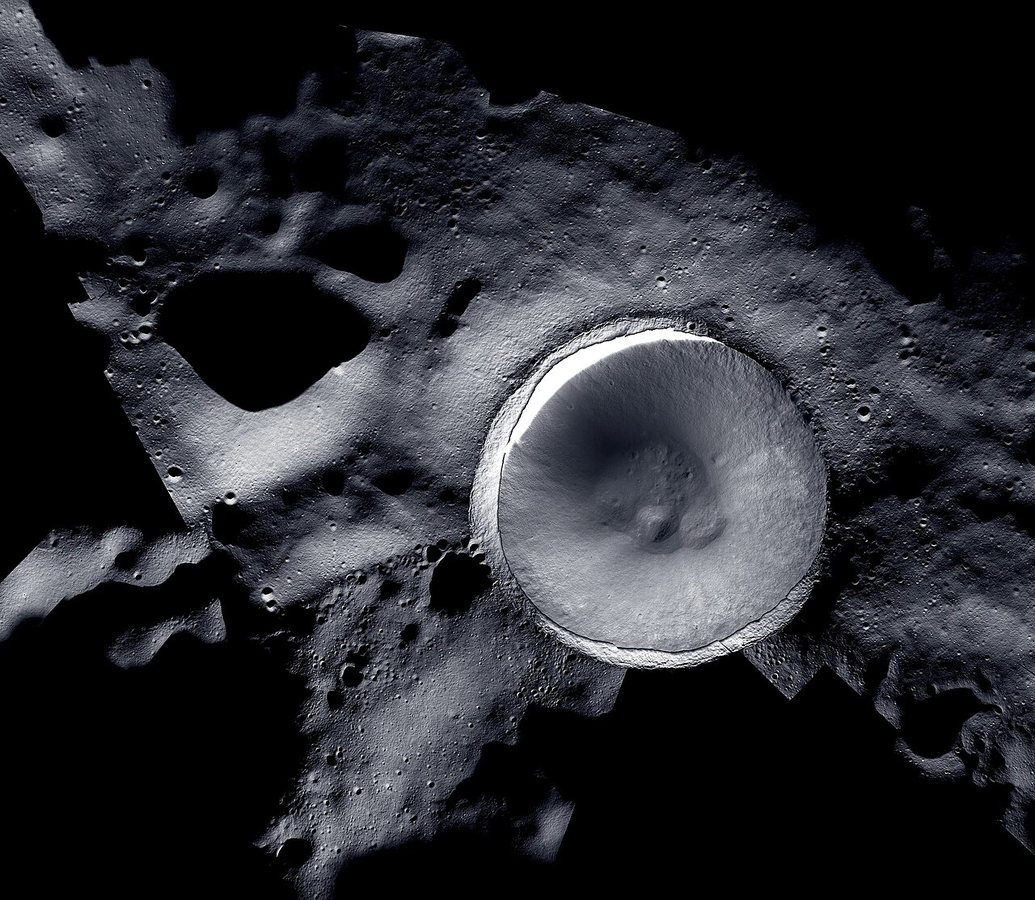
The Moon's surface is generally hostile to microorganisms. High ultraviolet radiation and extreme temperature swings make survival difficult, particularly in the equatorial regions where all previous crewed missions landed. But the polar regions are different. Because the Moon's axial tilt is only about 1.5 degrees relative to the Sun, sunlight strikes the poles at a very low angle, creating long permanent shadows. Rugged terrain, including mountains, hills, and deep craters, casts additional shadows that shield the surface from solar heat and ultraviolet flux. These conditions also allow water ice to persist.
To investigate whether microbes could survive in these environments, the researchers, led by Prabal Saxena of NASA Goddard and Stefano Bertone of the University of Maryland, modeled how bacteria and fungi commonly found on human skin would behave at three candidate landing sites for Artemis IV. They began by building highly resolved spatial maps of the topography in these regions, including ruggedness, slopes, and shadowing effects. They then modeled ultraviolet exposure and temperature to identify specific locations where microorganisms could survive for at least 24 hours.
Seasonal temperature data on scales of 240 meters came from measurements by the Diviner instrument aboard NASA's Lunar Reconnaissance Orbiter. Estimates of regional ultraviolet flux at wavelengths of 320 nanometers or shorter were derived from averaged illumination maps with a pixel scale of 60 meters, based on topography from the orbiter's Lunar Orbiter Laser Altimeter. The team then analyzed ultraviolet fluxes at finer spatial scales using a technique called ray tracing, incorporating optical effects such as reflection and refraction as sunlight hits the lunar surface, using updated topography maps at a resolution of 5 meters per pixel.
«Since the temperatures at the lunar poles are rarely high enough to kill bacteria and low temperatures can preserve microbes on Earth, UV radiation is generally likely to be more dangerous in these regions,» Saxena said. He added that understanding how sunlight behaves at the poles is crucial. «Since the Moon has a very small axial tilt, the Sun appears to hover just above the horizon here, so even small hills and rocks can prevent light from reaching lower-lying ground, creating small, shadowed areas protected from UV rays.»
The simulations revealed that the bacteria and fungi studied could survive in certain niches for up to or potentially beyond seven days. One fungus in particular, Aspergillus, is highly resistant to ultraviolet radiation and could potentially survive in 15 to 30 percent of the areas assessed, even those that receive some sunlight during the lunar winter. The reconstructions also showed that all five microbes in the study — Bacillus, Deinococcus, Staphylococcus, Aspergillus, and Fusarium — could possibly survive in certain areas of the De Gerlache Rim's permanently shaded regions, including when scattered ultraviolet light is incorporated into the simulations.
Saxena stressed that survival does not mean growth, which would require active metabolism and potential reproduction. Surviving microbes would be in a dormant, cryptobiotic state and would only grow if conditions were amenable to life — which is not the case for the Moon as currently understood. «Cells may also be dead,» he said, «but even dead cells may persist in the environment as another potential source of contamination.»
The implications extend beyond the Moon. A number of airless bodies, including Mercury, Ceres, some asteroids and comets, and exoplanets with similar properties, could also have potential survivable niches for microbial life. Understanding how these niches may exist, how life may be transferred to them, and how human exploration may leave its mark will serve as a key testbed for future human exploration of Mars, which likely has far more habitable environments.
«We need to understand what was there before us, because when we search for signs of life beyond our planet on these bodies, we will want to make sure it's not stuff we brought,» Saxena said. The research is described in the journal Science Advances.