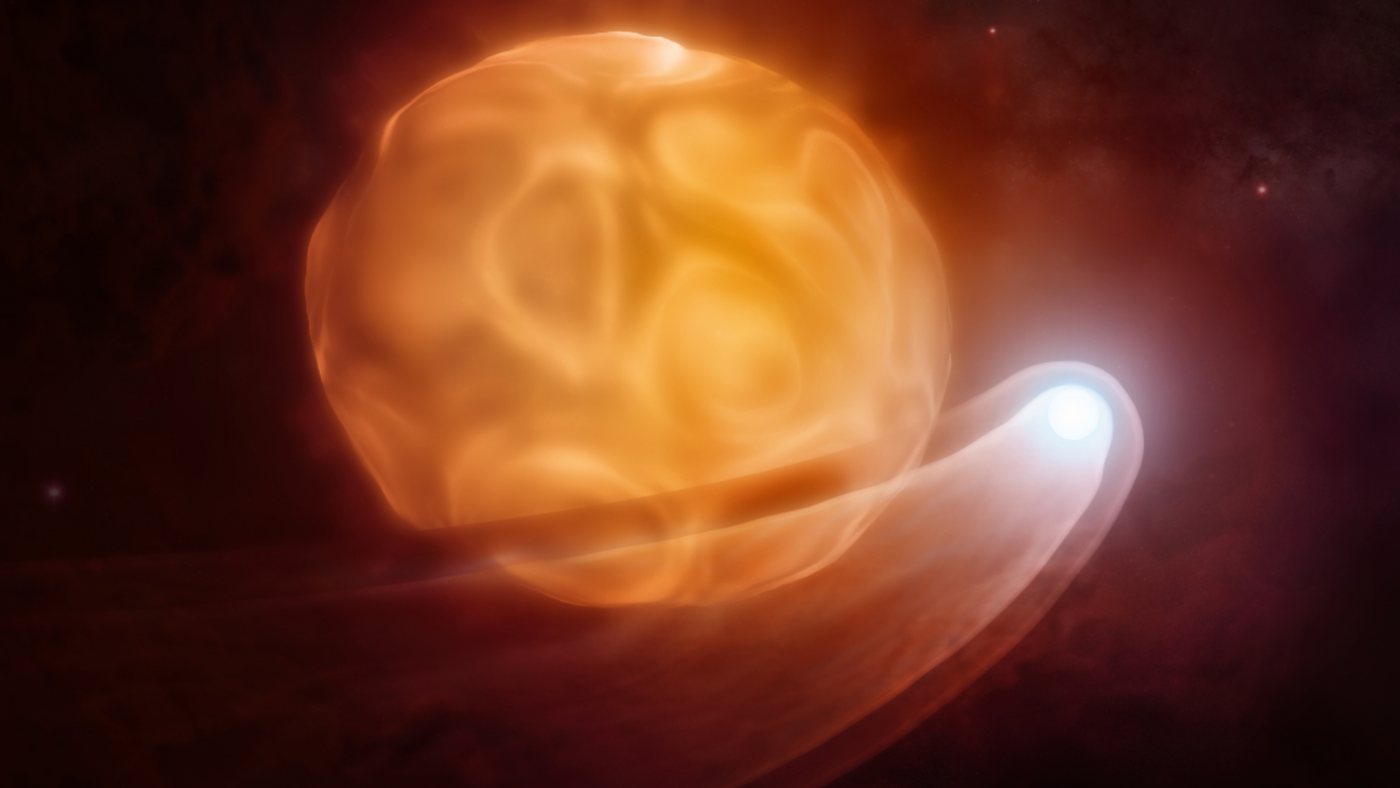
Betelgeuse, the bright red supergiant at the shoulder of the constellation Orion, is behaving in ways that have puzzled astronomers. Its outer atmosphere appears to be disturbed by a phenomenon that researchers have described, half in jest, as a cosmic poltergeist tormenting the doomed star.
Betelgeuse is nearing the end of its life. As a red supergiant, it has exhausted much of the fuel that once kept it stable, and astronomers expect it to eventually explode as a supernova. Because the star is relatively close to Earth by astronomical standards, it has long been a favorite target for observers studying the late stages of massive stellar evolution.
The atmosphere of such a star is vast, cool and turbulent, and its behavior is difficult to model. Changes in its surface and outer layers can reveal how material is expelled into space and how the star is shedding mass as it ages. The unexpected features now being examined suggest that processes in the star's outer envelope are more complex than current models predict.
Scientists continue to study the data to determine the cause of the disturbances. Researchers are watching for further changes in the star's brightness and atmospheric structure, which could help clarify whether the effects reflect internal pulsations, convection or interactions with material around the star.
17