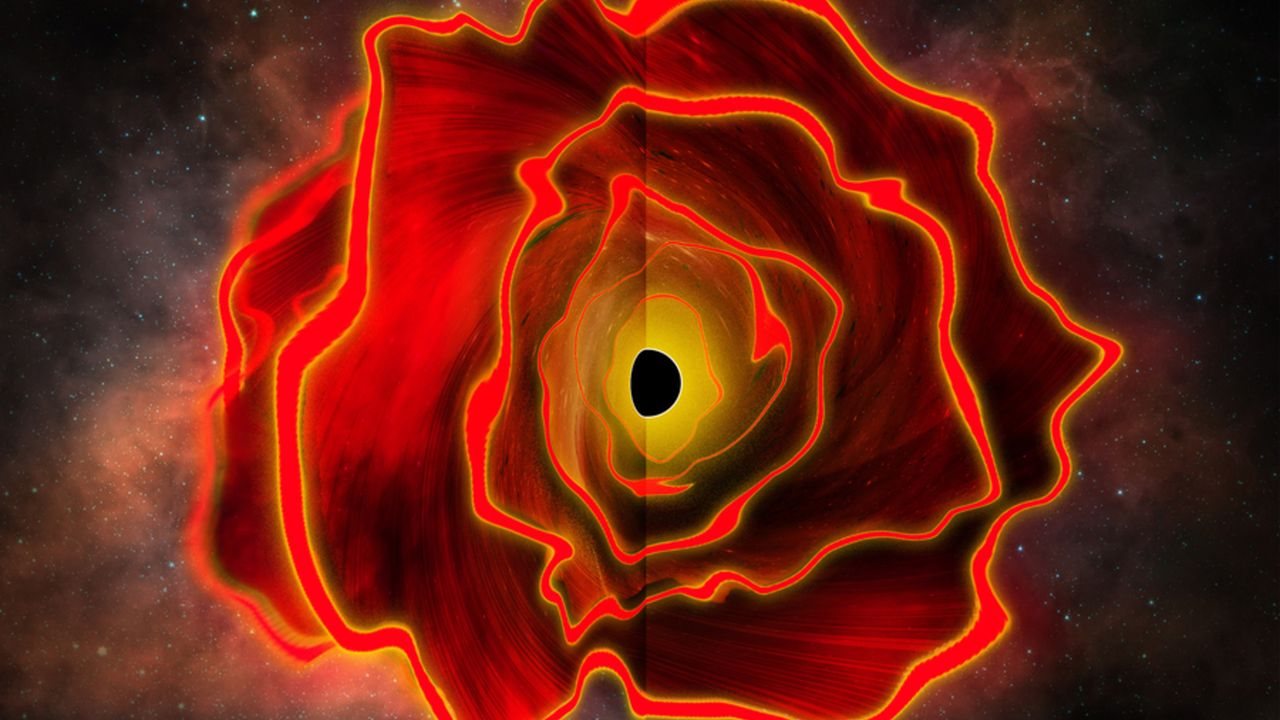
Astronomers have identified a compact, solar-system-sized object from the early universe that may be the strongest evidence yet of a brand-new type of cosmic body, potentially a hybrid between a black hole and a star. The object, detected as a tiny, bright dot in observations of the distant cosmos, challenges existing models of how massive celestial structures form and evolve.
The discovery, reported by a team of researchers analyzing data from early-universe surveys, points to an object that is far smaller than typical galaxies but far more massive than ordinary stars. Its size—comparable to our solar system—and its extreme brightness suggest it could be a "black hole star," a theoretical object that has been proposed but never conclusively observed until now. If confirmed, the finding would open a new chapter in astrophysics, offering a glimpse into a transitional phase between stellar and black hole behavior.
The object was found in observations of the early universe, a period when the cosmos was less than a billion years old. At that time, conditions were radically different from today, with denser matter and more intense radiation. The newly detected "dot" stands out because it is both extremely luminous and remarkably compact, properties that do not fit neatly into known categories of celestial objects. Standard black holes are typically detected by their gravitational effects or the radiation emitted by infalling matter, while stars shine through nuclear fusion. This object appears to exhibit characteristics of both, suggesting a possible intermediate stage.
Researchers involved in the study describe the finding as the best evidence yet for a new class of cosmic objects. The term "black hole star" refers to a hypothetical object that forms when a massive star collapses, but instead of becoming a full black hole, it retains a stable structure supported by exotic physics, such as dark energy or other unknown forces. Such objects were first theorized in the 1960s but have remained elusive due to the difficulty of observing them across vast cosmic distances.
The detection was made possible by advanced telescopes and imaging techniques that can resolve extremely distant and faint sources. The object's apparent size, comparable to our solar system, is a key clue. If it were a conventional galaxy, it would appear much larger and more diffuse. If it were a typical star, it would be far less massive and luminous. The combination of extreme compactness and high energy output points to a novel physical mechanism.
While the findings are preliminary and require further verification, they have already sparked excitement in the astrophysics community. Confirming the existence of black hole stars could have profound implications for our understanding of the early universe, the formation of supermassive black holes, and the fundamental physics governing matter under extreme conditions. The object may also help explain the origins of some of the most powerful phenomena observed in the cosmos, such as quasars and gamma-ray bursts.
The team plans to conduct follow-up observations using next-generation telescopes to study the object's spectrum and variability, which could reveal more about its composition and structure. If the black hole star hypothesis holds, it would represent a major advance in astrophysics, providing a new laboratory for testing theories of gravity and quantum mechanics in regimes that are currently inaccessible on Earth.
For now, the solar-system-sized dot from the early universe stands as a tantalizing mystery, one that could reshape our cosmic narrative. As researchers continue to probe its nature, the discovery underscores how much remains to be learned about the universe's most extreme and enigmatic objects.
69