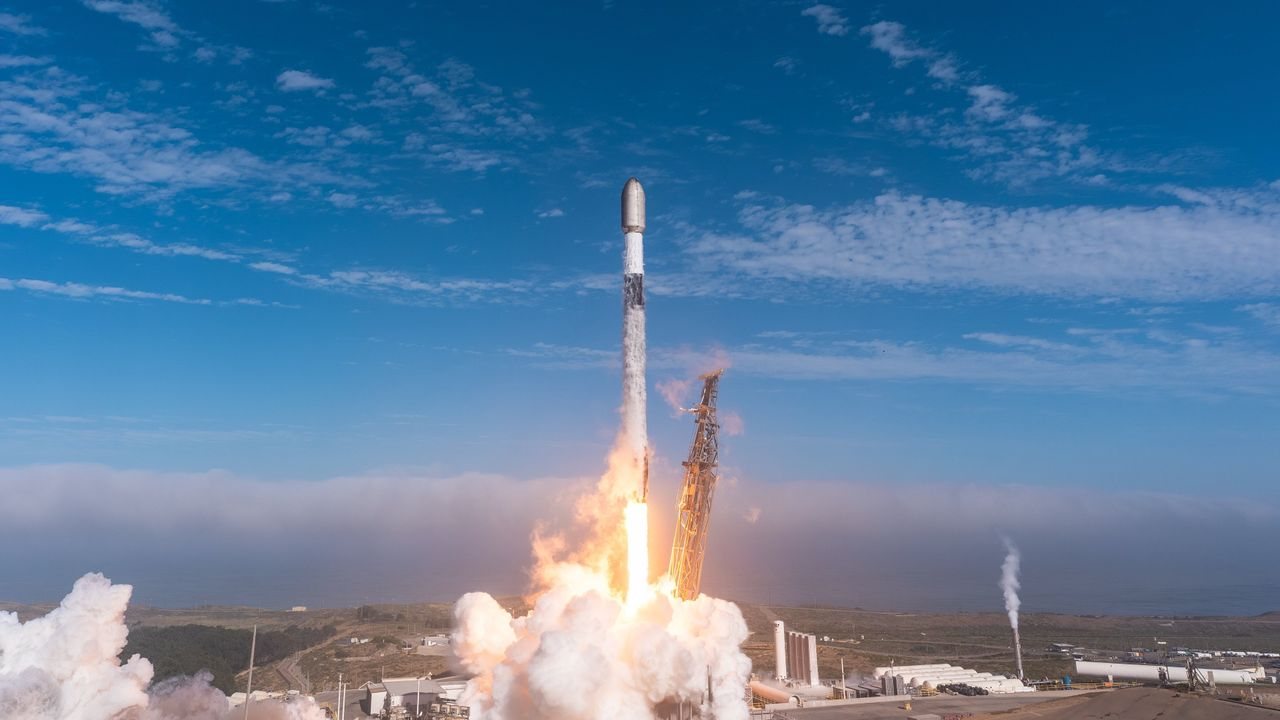
SpaceX launched 24 Starlink satellites into orbit on Thursday from California, marking the company's latest mission to expand its broadband megaconstellation. The flight came just hours after SpaceX conducted a test flight of its Starship vehicle from its Texas facility, highlighting the company's ability to manage multiple high‑cadence launch campaigns simultaneously.
The Falcon 9 rocket lifted off from Space Launch Complex 4 East at Vandenberg Space Force Base at 10:31 a.m. EST. The first stage of the rocket, which had flown on previous missions, successfully landed on the droneship «Of Course I Still Love You» stationed in the Pacific Ocean. This was the booster's 17th flight, a testament to SpaceX's reusable rocket technology.
About 64 minutes after liftoff, the 24 Starlink satellites were deployed into their intended orbit. The satellites join thousands already in low Earth orbit, forming the backbone of SpaceX's internet service that now serves customers in more than 60 countries. The Starlink constellation is designed to provide low‑latency broadband connectivity to underserved and remote areas worldwide.
The launch, designated Starlink 17‑51, came less than a day after SpaceX's Starship vehicle completed its latest integrated test flight from Boca Chica, Texas. While the two missions are independent, the proximity illustrates SpaceX's growing operational tempo. The company is simultaneously pushing forward with Starship development — intended for deep‑space missions — while continuing to build out its commercial satellite network.
SpaceX has now launched more than 6,500 Starlink satellites since the project began in 2019. The current spacecraft, Version 2 Mini, are equipped with advanced phased‑array antennas and laser inter‑satellite links for efficient routing of data. The constellation provides service to residential, business, maritime, and aviation customers, and has been particularly critical for emergency responders in disaster‑stricken areas.
The Falcon 9 booster used in Thursday's launch — tail number B1100 — has previously supported several Starlink missions as well as other customer payloads. Each flight of a reused booster reduces launch costs and accelerates the pace of deployment. SpaceX currently operates three drone ships in the Atlantic and Pacific to recover boosters.
The rapid sequence of launches reflects SpaceX's strategy of mass‑producing both rockets and satellites to achieve global coverage. The Federal Communications Commission has authorized SpaceX to deploy up to 12,000 Starlink satellites, with plans for an eventual constellation of 30,000. Critics have raised concerns about space debris and light pollution, but SpaceX has implemented measures such as visors and sunshades to reduce satellite brightness.
The Starship test flight earlier in the week marked another milestone for SpaceX's most ambitious vehicle. While the full details of that test have not yet been released, SpaceX is working toward making Starship fully reusable for missions to the Moon, Mars, and beyond. The ability to launch a Falcon 9 and a Starship within hours of each other demonstrates the company's unique position in the space industry, straddling both commercial satellite delivery and deep‑space exploration.
Thursday's launch was the 17th orbital mission of 2024 for SpaceX from Vandenberg, a schedule that has significantly increased activity at the West Coast spaceport. The military and commercial customers also rely on the site for polar launches. With each Starlink deployment, SpaceX inches closer to its goal of providing continuous global internet coverage, while the revenue from Starlink helps fund the company's long‑term exploration goals.