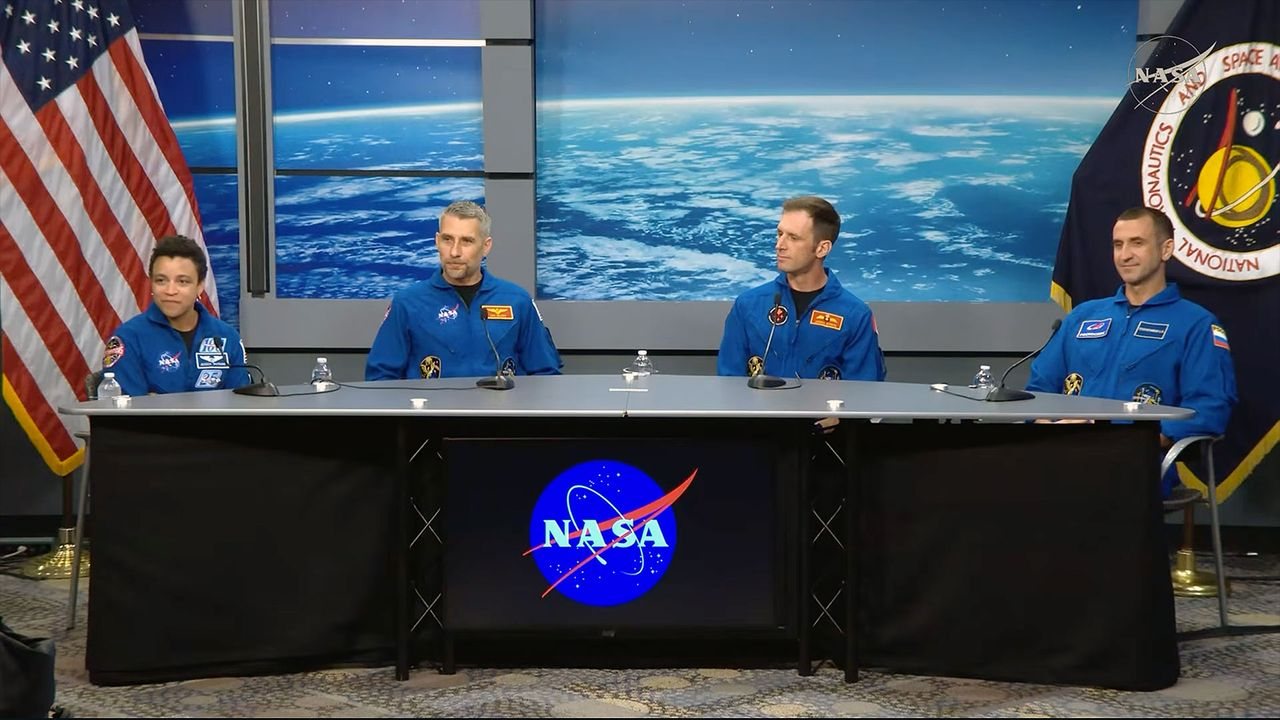
SpaceX is on track to launch four astronauts to the International Space Station on Sept. 12, and mission officials are already describing the upcoming flight as «a very busy mission». The crew rotation flight is expected to continue the station’s long-standing cycle of staffing, with preparations for liftoff moving forward at the company’s facilities in Florida.
The astronauts will ride into orbit inside a Crew Dragon capsule carried by a Falcon 9 rocket. After reaching orbit, the capsule is scheduled to chase down the International Space Station and dock with one of its ports. From there, the four crew members will settle into life aboard the orbiting laboratory for what is expected to be a demanding stay.
The mission’s schedule will center on scientific research and the routine work required to keep the station functioning. Crew members are typically responsible for maintaining life-support systems, performing repairs, and supporting a wide range of experiments that rely on the microgravity environment. Those experiments cover fields such as biology, materials science and human health, and their results are often used by scientists on Earth. The phrase «a very busy mission» reflects the amount of work planners have packed into the flight plan.
The flight fits into a larger effort that began with NASA’s Commercial Crew Program, which turned to private companies to transport astronauts after the space shuttle was retired. SpaceX carried out its first crewed mission to the station in 2020 and has flown several operational rotations since then. Each of these missions normally lasts about six months, allowing a steady presence of astronauts aboard the outpost.
SpaceX’s Crew Dragon capsule and Falcon 9 rocket have become a familiar pairing on American crewed missions. The rocket’s first stage is designed to land back on Earth after launch, and the capsule is built to carry astronauts safely to orbit and back. Over the past several years, the company has used the same type of hardware to deliver crews, cargo and satellites into space.
The space station itself has been continuously occupied since November 2000, making it one of the longest-running human outposts in space. During that time, crews from many countries have worked together on experiments and technology demonstrations. This long-term presence is considered essential for understanding how the human body responds to months in space and for testing systems that will be needed on future missions to the Moon and Mars.
The station travels around Earth at an average altitude of about 250 miles and at a speed of roughly 17,500 mph. That environment makes it possible to study the effects of weightlessness in ways that cannot be reproduced on the ground. The crew’s work is monitored closely from mission control centers around the world, with teams on different continents sharing responsibility for the outpost.
A final decision on whether to proceed with the Sept. 12 launch will depend on weather, technical readiness and other factors that are standard for crewed flights. Launch teams usually keep a close eye on the forecast and on the performance of the rocket and spacecraft during the final preparations. If all goes as planned, the four astronauts will begin a mission that adds to the station’s nearly uninterrupted record of human presence in orbit.
The upcoming launch is another step in the station’s busy operating rhythm, one that relies on regular crew exchanges. With research, maintenance and international cooperation continuing aboard the outpost, the station remains one of the most active places in orbit. For the crew preparing to fly, the work will begin long before the rocket leaves the pad.