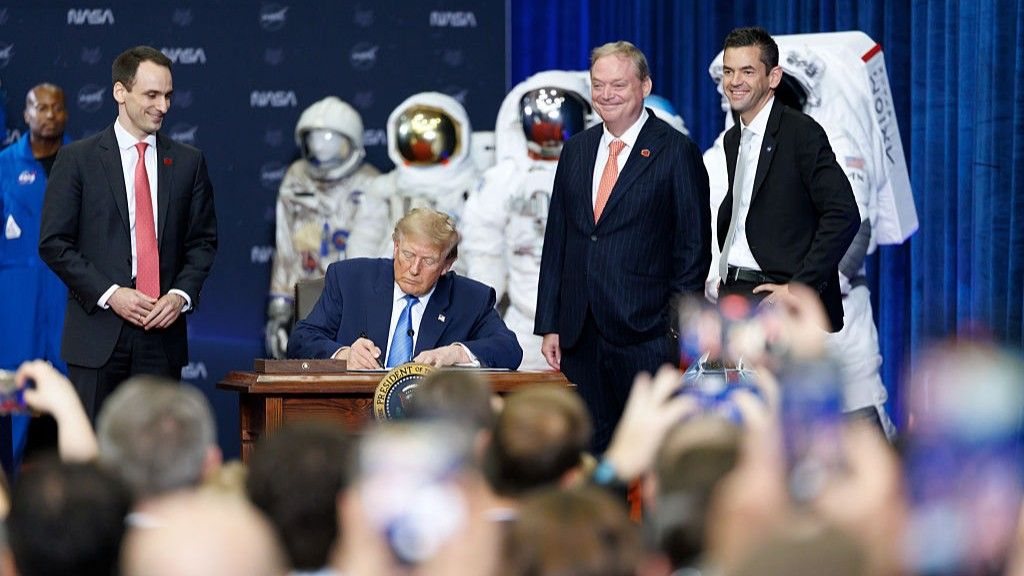
A proposal by former President Donald Trump to create a United States Space Academy is drawing attention to the increasingly porous boundary between America's civilian space agency and its military space operations. The idea, which surfaced as part of a broader space policy vision, would establish a dedicated institution for training space professionals. But according to an op-ed, its creation could fundamentally blur the lines between NASA's scientific and exploratory mission and the Pentagon's national security objectives in orbit.
The proposal comes as space has become a contested domain. The US Space Force, established in 2019, already operates alongside NASA, and both rely on a small pool of trained engineers, scientists, and operators. A Space Academy would formalize that pipeline, but critics warn it could tilt the balance toward military priorities at a time when NASA is focused on returning humans to the Moon and eventually reaching Mars. The op-ed argues that without clear guardrails, a single academy could produce graduates whose skills serve both civilian and defense needs, making it difficult to separate peaceful exploration from strategic competition.
Supporters of the idea say the United States needs a dedicated institution to maintain its edge in space. China and Russia have both expanded their space capabilities, and the commercial space sector is growing rapidly. A Space Academy, modeled perhaps on the service academies at West Point or Annapolis, would offer a focused curriculum in astrodynamics, satellite operations, and space policy. But the op-ed points out that NASA's own workforce is already aging, and the agency has struggled to recruit and retain talent. A new academy could either complement or compete with NASA's existing training programs, depending on how it is structured.
The op-ed also raises ethical and legal questions. NASA operates under a civilian mandate, with a mission of peaceful scientific discovery. The military's space activities are governed by different authorities and often classified. If a Space Academy were to train both civilian and military personnel, it could create conflicts over funding, oversight, and the sharing of sensitive technology. The op-ed suggests that Congress would need to define the academy's mission carefully to avoid mission creep.
Public reaction has been mixed. Some space policy experts see value in a centralized institution that could streamline education and research. Others worry that it would further militarize space at a time when international treaties and norms are already under strain. The op-ed notes that the proposal is still in its early stages and would require congressional approval and significant funding. It also remains unclear whether the academy would be part of NASA, the Department of Defense, or an independent agency.
For now, the debate reflects a larger question: as space becomes more crowded and more strategic, who should train the people who will work there? The answer will shape not only America's space program but also its role in the global space community. The op-ed concludes that without a clear separation of civilian and military functions, a US Space Academy could end up serving neither mission well.