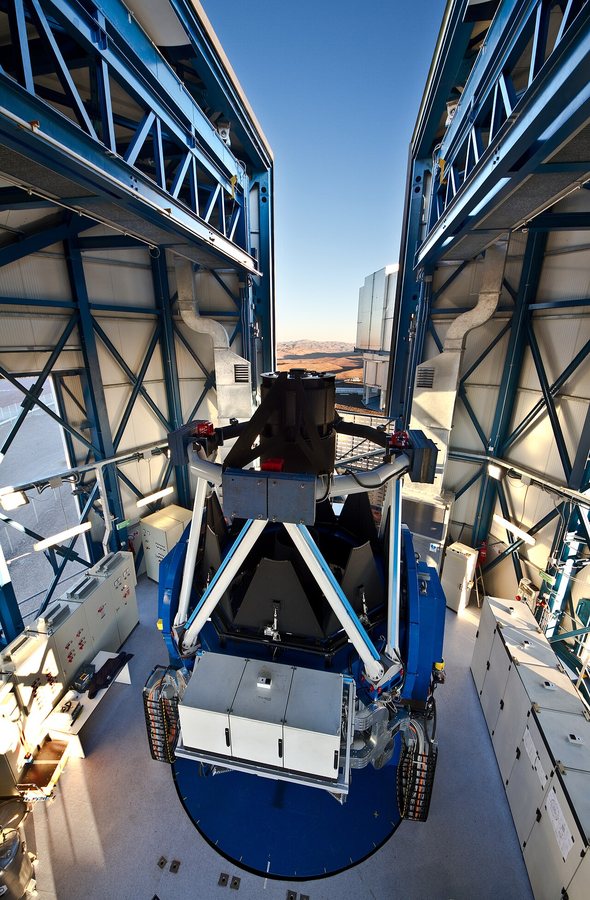
An international team led by Italy's National Institute for Astrophysics (INAF) has catalogued 47 candidate dwarf galaxies around three massive galaxies — NGC 5068, NGC 5084 and NGC 5087 — using the VLT Survey Telescope (VST) at the European Southern Observatory's Paranal site in Chile. The findings, published in Astronomy & Astrophysics, add a significant new sample to a field where observations have long clashed with predictions of the standard cosmological model.
Dwarf galaxies, with masses around a billion suns or often far less, are the most abundant galaxies in the universe, yet their low luminosity makes them extremely difficult to detect. Most known examples lie near the Milky Way, in the so-called Local Group, but at greater distances current instruments cannot yet resolve the individual stars inside them. Extending the search beyond our immediate cosmic neighbourhood is therefore essential to determine whether puzzles seen locally are universal or specific to our own environment.
The three host galaxies lie at 17, 80 and 100 million light-years from Earth and represent a spiral, a lenticular and an elliptical type respectively. The VST-SMASH survey data produced the deepest optical images yet obtained in red-to-green wavelengths for the surrounding fields, covering an area of sky roughly 12 times that of the full Moon. Through meticulous visual inspection of the images, both in individual filters and in colour, the team identified 47 possible dwarf galaxies. Only four were previously known, substantially increasing the number of dwarfs catalogued in this patch of sky.
«Studying these almost invisible islands of stars is not just astronomical collecting», said Crescenzo Tortora, an INAF researcher, principal investigator of the VST-SMASH survey and first author of the new paper. «It is the only way we have to resolve some of the great enigmas of the cosmological model and finally understand how the mysterious dark matter shapes and moulds the entire universe».
The team deliberately avoided automatic algorithms, which would easily have missed such faint objects. Instead, three authors independently inspected the images by eye, masking foreground stars and other artefacts so that the weak light of the dwarfs could be measured correctly. Tortora also created a small online game that reproduces a process very similar to the one the team used, allowing the public to try spotting dwarfs near NGC 5087.
The nature of the objects was assessed from their colour and structural properties, which are consistent with those of other dwarf galaxies. Definitive confirmation, however, must await future spectroscopic observations capable of estimating their distance and velocity — hence the careful description of the objects as candidates. Their spatial distribution suggests they are probably satellites of the larger galaxies in the field, namely NGC 5084, NGC 5087 and NGC 5068. In the case of NGC 5084, the arrangement even appears to show a planar distribution similar to that of the Milky Way's own satellites, though only spectroscopic follow-up can confirm the hypothesis.
Many of the newly found objects are diffuse galaxies with low surface brightness and no internal structure, classifying them as dwarf spheroidals or dwarf ellipticals. Others show internal features and could be classified as dwarf spirals or irregulars. Each is estimated to have a mass between one million and one billion solar masses.
The work speaks directly to a long-running dispute. For years, simulations of the standard cosmological model predicted more dwarf satellites around galaxies like our own than observations could find — the so-called missing satellites problem. More recently, some studies have suggested the opposite, an overabundance of satellite galaxies in the data compared with simulations. The spatial distribution of dwarfs around their hosts, often arranged on a plane perpendicular to the central galaxy's disc as in the Milky Way, also remains debated. By cataloguing faint dwarfs around galaxies far beyond the Local Group, the VST-SMASH team aims to establish whether these tensions reflect a universal behaviour of galaxy formation or a quirk of our own cosmic neighbourhood.