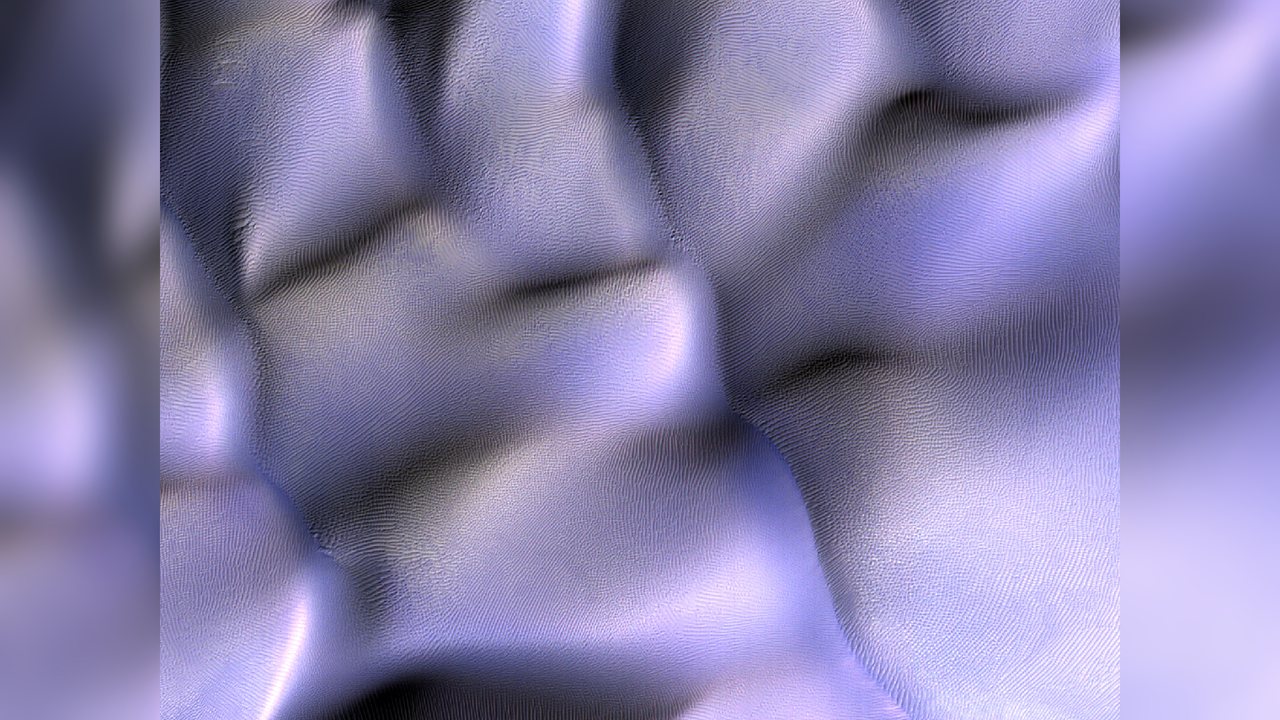
An image of Mars reveals vast fields of dark sand dunes rippling across the planet's surface in wave-like patterns, offering a striking view of the forces that continue to shape the Martian landscape. The dunes, captured in a new photograph, stretch across the terrain in undulating ridges that resemble ocean waves frozen in place.
The formations are the product of wind, not water. On Mars, where the atmosphere is thin but still capable of moving fine grains, prevailing winds sculpt sand into repeating crests and troughs. Over time, these processes build dune fields that can span hundreds of kilometers, creating some of the most recognizable features on the planet's surface.
Scientists study such dune fields to understand present-day surface activity on Mars. Unlike ancient river valleys or lake beds that record a wetter past, active dunes indicate that the planet's surface is still changing today. The orientation and spacing of the ridges can reveal wind direction and strength, while the composition of the sand offers clues about the underlying geology.
The dark color of the dunes likely comes from iron-rich minerals, such as olivine or pyroxene, that are common in volcanic rocks on Mars. As wind erodes these materials, it concentrates the darker grains into dune fields that stand out sharply against the lighter, dust-covered plains. This contrast makes them easy to spot from orbit and from the surface.
Mars is not the only world with dune fields. Similar wind-formed features appear on Earth, Venus, and Saturn's moon Titan, making them a subject of comparative study across planetary science. Each environment, however, has its own atmospheric density, gravity, and sand supply, so the details of dune formation differ from one planet to another.
The new image adds to a growing collection of observations that track how Martian dunes move and change over time. By comparing images taken months or years apart, researchers can measure the migration of individual dunes and estimate how quickly the surface is being reshaped. Such measurements help refine models of the Martian climate and atmosphere.
For the public, the wave-like dunes serve as a reminder that Mars is not a static, dead world. Wind, dust, and sand continue to alter its surface, even in the absence of liquid water. The patterns visible in the photograph are the result of processes that remain active, making the Red Planet a dynamic environment worthy of continued exploration.