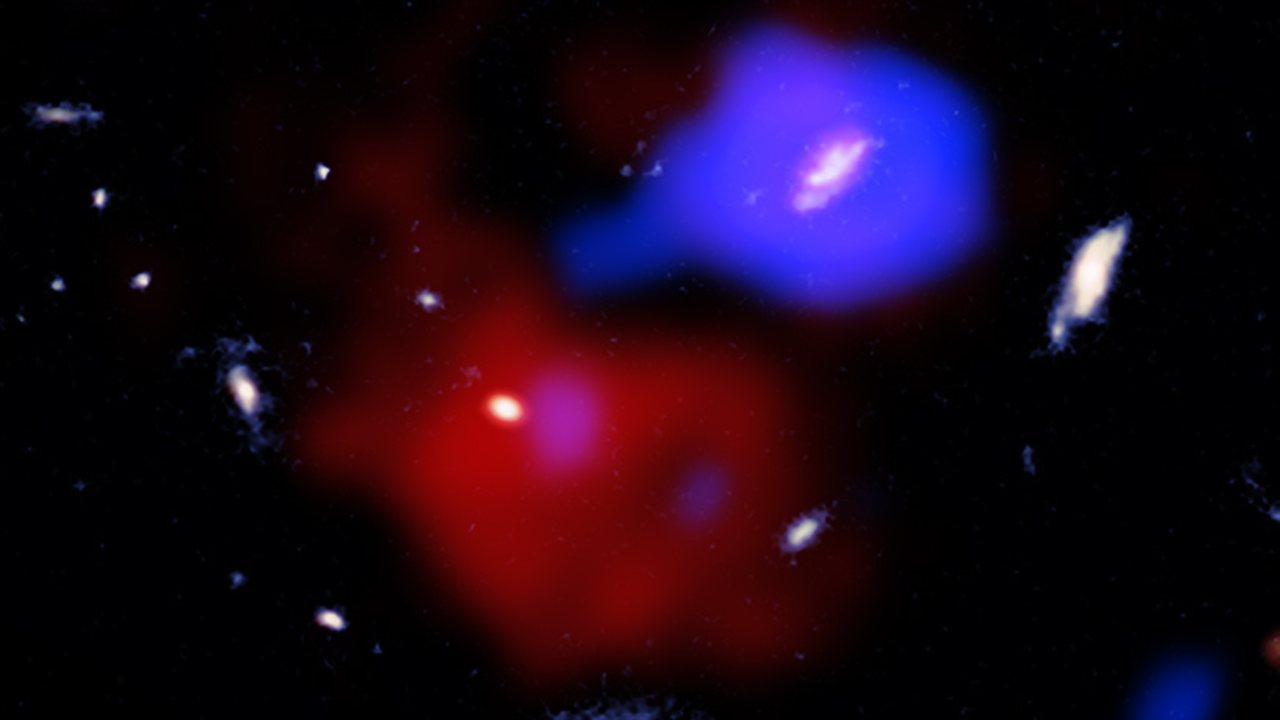
A supermassive black hole at the heart of a so-called «red potato» galaxy is actively stirring up the surrounding gas, according to new observations from an X-ray spacecraft. The discovery provides fresh insight into how these cosmic behemoths regulate the evolution of their host galaxies, keeping them quiescent and starved of the raw material needed to form new stars.
The galaxy, nicknamed «the red potato» for its reddish hue and lumpy shape, belongs to a class of elliptical galaxies that are largely devoid of cold gas and dust. Such galaxies are often described as «red and dead» because their stellar populations are old and star formation has effectively ceased. But exactly why these galaxies shut down their star-forming activity has long puzzled astronomers. The new X-ray data now point to the central black hole as a key agent in maintaining this state.
X-ray images from the spacecraft reveal extended structures of hot, ionized gas being pushed outward from the galactic center. Astronomers interpret these features as evidence that the supermassive black hole is injecting energy into the surrounding medium, heating the gas and preventing it from cooling and collapsing into new stars. In effect, the black hole is «stirring» the cosmic kitchen, keeping the pot from boiling over.
«There may be a cook in this cosmic kitchen,» one researcher involved in the study said, referring to the black hole’s role in regulating the galaxy’s thermal balance. The metaphor captures how the black hole continuously adds energy to the interstellar medium, much like a chef keeps a pot simmering by stirring it.
The X-ray observations also show cavities or bubbles in the hot gas, likely carved by jets or outflows launched from the vicinity of the black hole. These cavities rise buoyantly through the galactic halo, transporting energy outward and further disrupting any potential for cool gas to accumulate. The process, known as active galactic nucleus feedback, is thought to be a primary mechanism by which supermassive black holes influence their host galaxies on scales far larger than the black hole’s own gravitational reach.
Elliptical galaxies like the red potato are especially common in dense galaxy clusters, where they often sit at the centers of massive cooling flows. In such environments, the hot intracluster gas should theoretically cool and flow inward, fueling star formation. Yet observations show that central elliptical galaxies are surprisingly devoid of young stars. The new findings suggest that the central black hole, by reheating the gas, counteracts this cooling, thereby preserving the galaxy’s quiescent state.
The study also reinforces a broader picture emerging from multi-wavelength astronomy: that supermassive black holes are not merely passive gravitational anchors but active participants in galaxy evolution. Their feedback can either trigger or quench star formation depending on the circumstances, and understanding this balance is essential for models of how galaxies form and change over cosmic time.
Future observations with other telescopes, including radio and optical facilities, are expected to follow up on these results. Astronomers hope to map the detailed kinematics of the hot gas and link the black hole’s activity to the galaxy’s star-formation history more precisely. For now, the red potato galaxy stands as a vivid example of a cosmic kitchen where the black hole chef is hard at work.