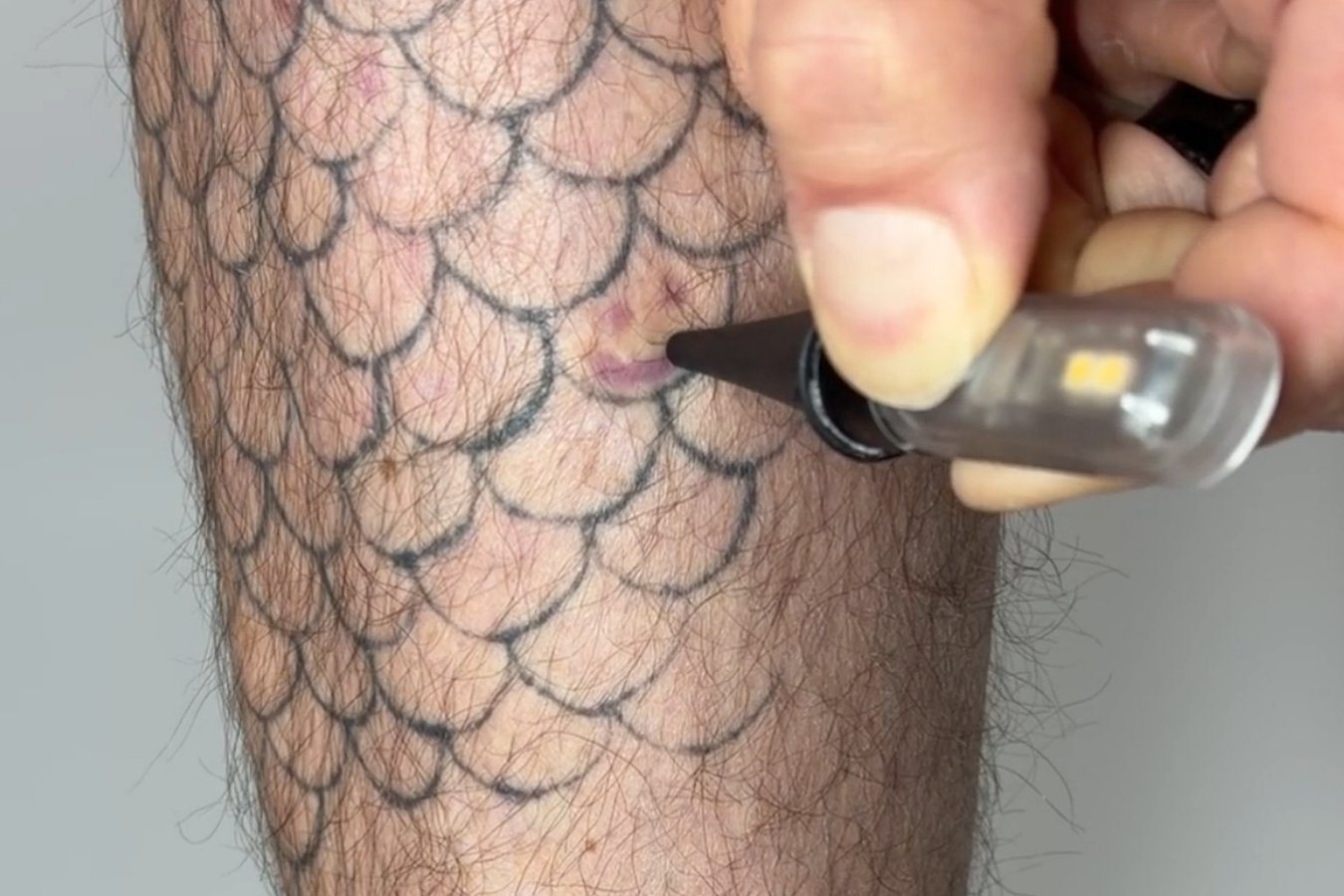
Researchers at the University of Colorado have developed a new class of tattoo inks that can be turned on and off with light, a technology they call PhotoTat. The inks use photochromic dyes that shift from transparent to colored when exposed to specific wavelengths of light, allowing a tattoo to remain permanently in the skin while its visibility is controlled at will.
«You can simply turn the tattoo off whenever you don't want to see it and it disappears from view,» said Carson Bruns, the lead researcher. «If you never want to see it again, just never turn it on again.» Bruns himself has worn a fish-scale tattoo made with the ink for more than two years and reports no known side effects. «I get a lot of compliments on the fish scale tattoo,» he said. «After over two years in my skin, I haven't seen any obvious fading yet.»
The technology replaces traditional tattoo pigments with photochromic dyes encapsulated in a polymer. According to Bruns, the mechanical process is identical to conventional tattooing: pigment particles are implanted into the dermis with a needle, remain permanently, and are applied with the same machines and methods. The difference lies entirely in the pigment. Ultraviolet light writes the color in, bright visible light erases it, and the cycle can be repeated. «The tattoo is permanent, but its appearance is not,» Bruns said.
The researchers have tested the inks on silicon and can currently produce 16 distinguishable colors, which combine to yield at least 300 different shades. White is unavailable because it reflects rather than absorbs light, and a true cyan has proven elusive. The blue ink also gradually develops a permanent purplish tint as the dye photo-degrades over many on-off cycles. Users would need to apply sunscreen to prevent sunlight from activating the color unintentionally.
Medical applications could be among the most significant. Doctors sometimes use tattoos to guide radiation beams, leaving patients permanently marked. Light-sensitive tattoos could offer the same guidance while allowing the marks to be hidden when not needed. Bruns said the polymer encapsulating the dyes is non-toxic and has a long history of use in permanent biomedical implants. He acknowledged that the toxicity of the color-changing dye is unknown, but noted that the toxicity of most traditional tattoo pigments is equally unknown.
Signe Bedsted Clemmensen of the University of Southern Denmark cautioned that any tattoo ink introduces a foreign substance into the body, which has been linked to cancer regardless of visibility. «Therefore, many of the same health considerations and concerns that apply to traditional tattoo ink are also likely to apply to invisible tattoo ink,» she said. Earlier this year, red tattoo ink was reported to have caused one man to lose all his hair and stop sweating, and tattooing has recently been linked to localized damage to the immune system.
Extensive safety studies will be required before the tattoos become available to the public. The research was published in the journal Matter & Light.
13