Ancient human remains and stone tools recovered from a cave in south-west China show that Denisovans thrived there for more than 100,000 years, hunting large animals in a conifer forest environment. The discovery, reported by a team of Chinese researchers, provides one of the few detailed windows into how these enigmatic hominins lived, including their technology and subsistence strategies.
The finds come from Bianfu cave in Yunnan province, a site heavily damaged by quarrying before local workers spotted animal fossils in 2019 and alerted authorities. A rescue excavation that summer uncovered 18 layers of sediment, ten of which contained artefacts made by hominins, along with four intact hominin teeth and more than 64,000 bone fragments. The site is only the third Denisovan locality where researchers have recovered human remains, stone artefacts, animal bones, and environmental context together, according to Bence Viola of the University of Toronto, who was not involved in the study.
Denisovans are hominins that lived in East Asia within the past few hundred thousand years. They were first identified 16 years ago from DNA preserved in a finger bone found in Denisova cave in Siberia. Since then, a scattering of Denisovan remains has emerged across East Asia, including a skull from Harbin in northern China, but for most of these finds the archaeological context has been impossible to study, leaving scientists with little information about the tools and artefacts they produced.
To identify hominin remains among the bone fragments, a team led by Qiaomei Fu at the Institute of Vertebrate Paleontology and Paleoanthropology in Beijing first sorted the material by hand, identifying 22 potential specimens. Three proved to be from hominins: two fragments of skull and a piece of radius, the upper arm bone. Attempts to extract DNA from these bones failed, which Fu attributed to the warm climate in the region and the age of the fossils. However, the team successfully obtained proteins from the three bones and two of the teeth, and all five carried protein variants unique to Denisovans, with none specific to Homo sapiens or Neanderthals.
The bones and teeth appear to be of different ages, leading the researchers to conclude they came from at least four individuals. The two teeth examined carried protein variants indicating they belonged to males. Dating of the bones and surrounding sediments placed them between 134,000 and 167,000 years old, while the artefacts span a longer period, from 70,000 to 190,000 years ago. Hao Li of the Institute of Tibetan Plateau Research in Beijing, who led the excavation, said the evidence suggests one hominin species occupied the site for a long time.
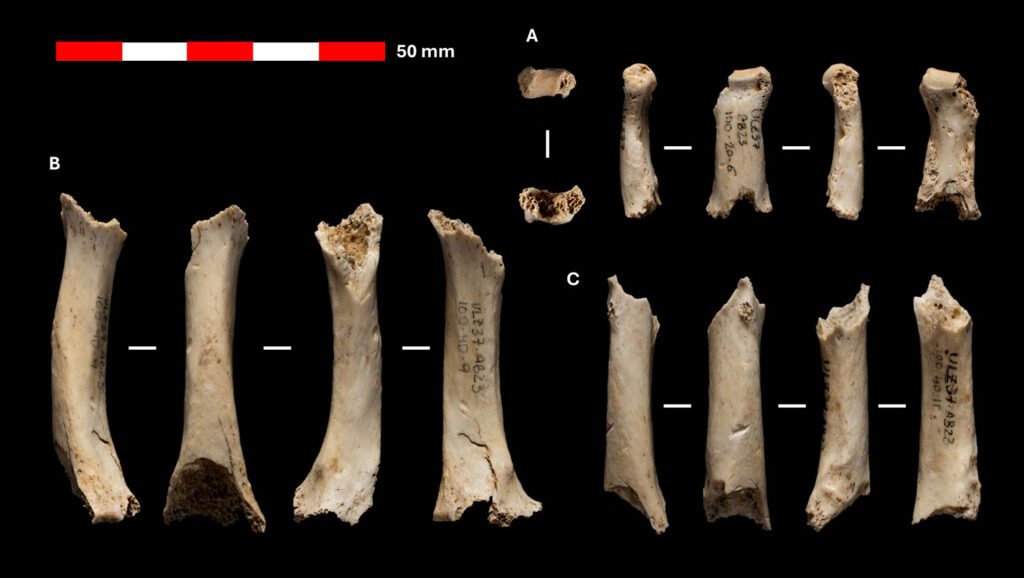
The excavation yielded 1,366 stone artefacts, including 135 flakes, the cores from which they were removed, and simple tools such as scrapers and choppers. These artefacts were relatively crude compared with those made by Neanderthals living elsewhere in Eurasia at the same period. Yet the Denisovans appear to have been successful hunters. Among 1,654 identifiable animal bones, researchers found large numbers of deer and bovids, along with rhinoceroses, hyenas, and bamboo rats. Many bones bore cut marks indicating they had been butchered by hominins, while few showed signs of being gnawed by non-human animals.
Deer and bovids were the main prey, and the condition of the bones suggests the Denisovans generally hunted animals in prime condition. Li said this indicates a highly skilled hunting strategy, arguing that the group probably relied less on stone tools than other hominin populations, which may explain why their stone artefacts were relatively simple. The team also discovered seven bone tools, and Li suspects these were used extensively. Tools made of wood or bamboo may also have been used but have since decayed.
Pollen evidence indicates the area was a mix of conifer forest and steppe with a temperate climate and rich wildlife. This environment contrasts sharply with the harsher conditions faced by Denisovans in Siberia or on the Tibetan plateau, where cold and low oxygen would have demanded different technologies and survival strategies. The new findings, published in the journal Nature, offer the first evidence of Denisovans in this region and shed light on how a single hominin species adapted to a comparatively comfortable ecosystem over tens of thousands of years.
122