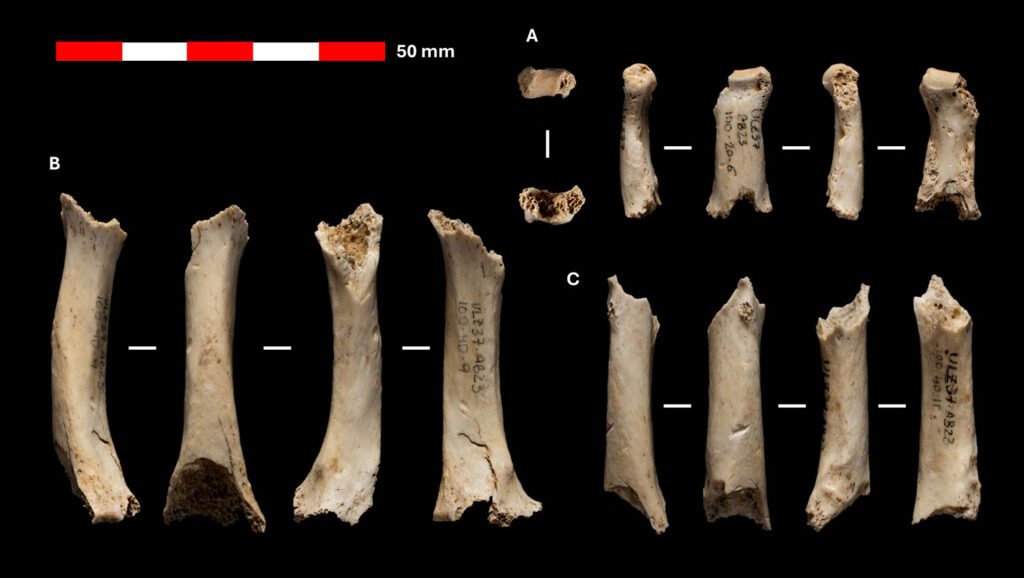
Human remains recovered from three caves in southern Spain show clear evidence that Neolithic people practiced cannibalism, according to a new analysis of roughly 1,000 bones and teeth. The study, led by Palmira Saladié of the Catalan Institute of Human Paleoecology and Social Evolution, examined cut marks, fractures, cooking traces, and human bite marks to reconstruct how the dead were treated.
The most striking assemblage came from Malalmuerzo Cave, where the bones of at least 36 individuals date to the Early Neolithic period, between about 5300 and 4950 B.C. Researchers suggest these individuals may have died in a single violent episode. More than half of the remains bear signs of boiling, and two skulls show blunt force trauma.
At Carigüela Cave, dating revealed that the bones spanned much of the Neolithic period. Nearly all of them carried butchery marks, and two skulls had been fashioned into drinking cups. The third site, Majolicas Cave, yielded bones dated to the Late Neolithic, between 3950 and 3760 B.C. These remains had been stained red with cinnabar, a mineral pigment, pointing to cannibalism as part of a ritual or funerary practice.
Saladié and her colleagues concluded that these cases of cannibalism occurred at different times, for different reasons, and in different ways. The findings, published in the Journal of Archaeological Science, add to a growing body of evidence that prehistoric communities in Europe treated human bodies in complex and varied manners, sometimes consuming them as part of violence, survival, or ceremony.
The research also highlights how much variation existed within the Neolithic period itself. The Early Neolithic remains at Malalmuerzo Cave suggest a possible single catastrophic event, while the later evidence from Carigüela and Majolicas caves points to repeated or ritualized practices over centuries. The use of skulls as cups and the application of cinnabar indicate that the treatment of the dead was not merely nutritional but carried symbolic weight.
Similar discoveries elsewhere in Europe have shown that cannibalism was not unique to southern Spain. Skull cups found at Gough's Cave in England, dating to the Magdalenian period, offer another example of how prehistoric people modified human remains. Together, these finds suggest that the consumption of human bodies was a widespread but highly contextual behavior, shaped by local customs, circumstances, and beliefs.
The new study does not resolve why these particular groups turned to cannibalism, but it makes clear that no single explanation fits all cases. Violence, ritual, and funerary tradition may each have played a role at different sites and times. For archaeologists, the challenge now is to understand the social and environmental conditions that led communities to treat their dead in such divergent ways.
102