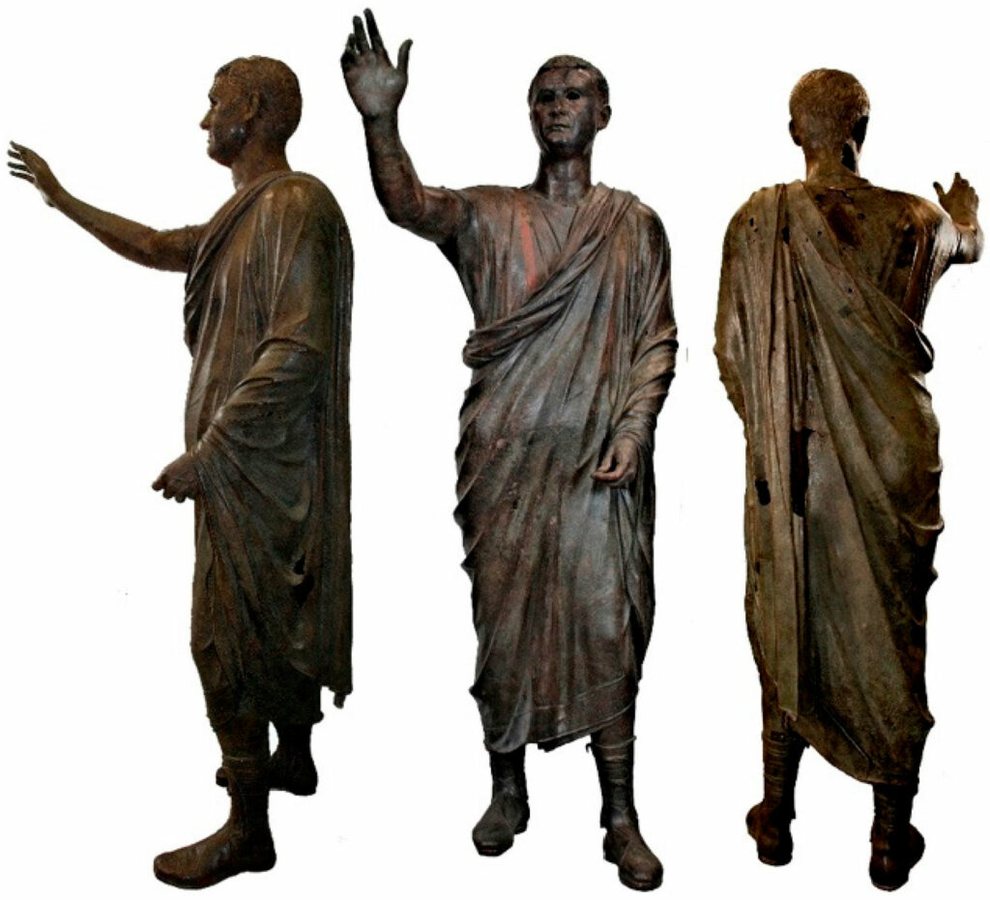
A bronze statue of an Etruscan man wearing a toga, unearthed in 1567, may have been deliberately blackened by its makers roughly 2,200 years ago, according to a new study. The sculpture, known as the Arringatore — or Orator — of Pila, has long been assumed to have darkened through natural corrosion over the centuries. Conservators now say the evidence points to an intentional heat treatment instead.
Historical accounts of the discovery describe the statue as green when it was first recovered. That color is typical of ancient bronze that has oxidized over time. The prevailing explanation held that the figure's current dark appearance resulted from the same slow chemical process. The new research challenges that assumption by examining the surface layers directly.
Salvatore Siano of the Institute of Applied Physics «Nello Carrara» and Sonia Mugnaini of the University of Siena led the conservation work. The team removed brown coatings from the statue and uncovered smooth, nearly black areas on the figure's face, hair, clothing, and arm. These patches were not the mottled green expected from centuries of exposure.
The researchers analyzed 15 samples of the black material using microscopy, X-rays, and Raman spectroscopy. In several samples they identified tenorite, a dark copper oxide, sitting above a red layer of cuprite, another copper oxide. This layered structure is characteristic of patina produced by heating rather than by natural weathering. The scientists were unable to reconstruct the exact heating process used to create the effect.
X-ray imaging also revealed that the sculpture was assembled from eight hollow sections. The researchers concluded that the figure likely had glass-paste eyes originally, adding to the impression of a carefully finished work. The findings suggest that the black surface was part of the statue's intended appearance, not a later accident of decay.
The Arringatore is one of the best-known Etruscan bronzes, and its dark surface has shaped how viewers have interpreted it for centuries. If the coating was deliberate, the statue belongs to a tradition of ancient metalworking in which color was controlled through heat and chemical treatment. Such techniques were used to produce specific visual effects on bronze objects, though direct evidence for them is rare.
The research was published in the journal Heritage. It adds to a growing body of work on Etruscan bronze production, including 14 bronze sculptures recovered from a sanctuary site in Tuscany that were named among Archaeology's Top 10 Discoveries of 2023. Those finds have helped scholars understand the scale and skill of Etruscan metal workshops.
For now, the exact method used to blacken the Arringatore remains unknown. The team could not determine how the heat was applied or how the layered oxides were achieved. Further study of the statue and comparable bronzes may clarify whether the technique was widespread or unique to this figure.
The statue's history makes the question more than technical. Discovered in the 16th century, it entered European collections at a time when ancient bronzes were often cleaned and restored according to contemporary tastes. Conservators in later centuries removed coatings and patinas, sometimes altering surfaces in ways that complicate modern analysis. The removal of brown coatings by Siano and Mugnaini is part of an effort to see past those interventions.
The new findings do not settle every question about the Arringatore, but they shift the burden of proof. Instead of assuming natural corrosion, researchers now have chemical evidence that the black surface was created on purpose. That distinction matters for how museums present the statue and for how scholars interpret Etruscan attitudes toward color, finish, and display.
9