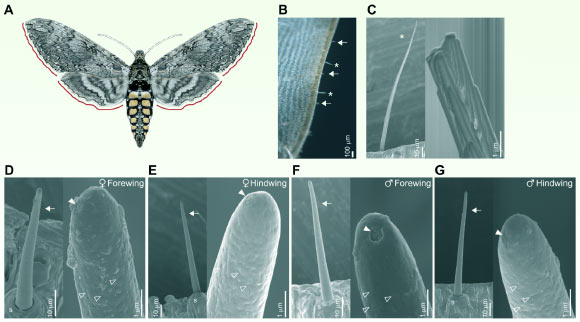
Researchers at the Max Planck Institute for Chemical Ecology have found that moth wings carry odor-detecting receptors, suggesting the insects may use their wings as well as their antennae to sense chemical cues in the air while flying.
The finding adds a new layer to the understanding of insect smell. Antennae have long been considered the main olfactory organs in moths and other insects, but the new evidence points to wing tissue as another part of the body with a potential role in odor detection. This means the machinery that allows moths to perceive their chemical surroundings may be distributed more widely across the body than scientists had assumed.
Olfactory receptors are proteins that bind to odor molecules in the environment and trigger signals in the animal's nervous system. In insects, these molecular sensors are involved in essential behaviors such as finding food, locating mating partners, and selecting egg-laying sites. The presence of such receptors on moth wings suggests that the insects' sense of smell is not limited to their antennae.
The location of the receptors may be especially significant because of how moths fly. Wings move continuously during flight, so receptors on the wing surface could be exposed to airborne chemicals in a different way than receptors on the antennae. That arrangement might allow moths to sample odors from the air moving over their wings and respond quickly to scent cues while traveling. It could also help explain how moths manage to locate odor sources in complex environments.
The work was carried out at the Max Planck Institute for Chemical Ecology, a research center that focuses on chemical communication among insects. The discovery adds to a growing picture of how moths collect information from their surroundings and raises the possibility that other flying insects use their wings in similar ways. Future studies may examine how signals from wing receptors reach the nervous system and whether these receptors influence behavior in flight.
The findings also highlight a broader theme in biology: body parts that appear to have one function can turn out to have additional roles. Wings are often described mainly as structures for flight, but the new evidence suggests they may participate in sensory perception as well. If so, the evolutionary history of wings may be more complex than a simple story about movement through the air.
For now, the main takeaway is that moth wings appear to be dual-purpose structures. They provide the lift and maneuverability needed for flight, and they may also serve as sensory surfaces that help the insect detect relevant odors in the environment.