An international research team has demonstrated that optogenetic therapy is safe and shows potential for restoring visual function in patients with advanced retinitis pigmentosa, an inherited degenerative condition that destroys photoreceptors in the retina and can lead to irreversible blindness. The results, published in the New England Journal of Medicine, expand on a 2021 first-in-human study that produced partial visual recovery in a single blind patient.
The trial enrolled 10 participants with blindness due to late-stage retinitis pigmentosa. Each received an injection into their worse-seeing eye of a gene encoding ChrimsonR, a light-sensitive protein that responds to amber light at around 590 nanometers. The team divided participants into three dose-escalation groups, receiving 5.0 x 10^10, 1.5 x 10^11, or 5.0 x 10^11 vector genomes per eye. The primary aim was to evaluate safety.
Researchers observed 33 mild and moderate adverse ocular events in nine participants, including temporary inflammation and increases in eye pressure, plus one severe event that resolved within minutes after treatment. Within the limits of the study, they concluded the treatment was safe.
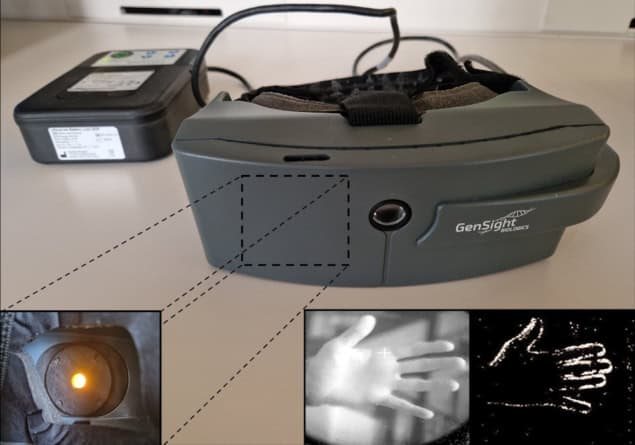
Optogenetics uses light to characterize and manipulate neuronal activity. The therapy developed by José-Alain Sahel of the University of Pittsburgh School of Medicine and Botond Roska of the Institute of Molecular and Clinical Ophthalmology Basel combines gene therapy that makes surviving retinal ganglion cells light-sensitive with specialized goggles that stimulate the altered cells.
«Although patients with retinitis pigmentosa lose their rod and cone cells, which normally detect light, many other cells within the retina can remain present for years after vision loss,» said Sahel, director of the UPMC Vision Institute and first author on the study. «Optogenetics enables us to introduce a light-sensitive protein into these surviving cells, allowing them to respond to light and transmit visual information to the brain. The therapy bypasses the damaged photoreceptors and takes advantage of retinal circuits that remain intact.»
Sahel noted that retinitis pigmentosa can be caused by mutations in any one of hundreds of different genes, making optogenetic therapy potentially suitable regardless of the underlying mutation.
The goggles contain a camera that detects changes in light intensities pixel by pixel and converts the visual data into pulses of amber light. This light is projected onto the eye to activate ChrimsonR in the modified retinal ganglion cells.
Vision tests revealed that the treatment increased light sensitivity in seven of the 10 participants, by a factor of 2.0 to 62.3, with six patients showing a clinically meaningful improvement. Participants also performed tasks to detect, localize and touch a notebook and a staple box. In the notebook task, five of eight participants had higher accuracy when wearing the goggles than when not wearing them, while four showed improved accuracy in the staple-box task. In a task determining the orientation of a single bar, accuracy was higher with the goggles in five of eight participants.
To provide an objective measurement of brain activity in response to light, researchers obtained electroencephalographic recordings in five patients performing two visual tests: detection of a tumbler placed in front of them, with eyes open or closed, and passive viewing of periodic visual stimuli. In the tumbler test, EEG decoding accuracy was higher with goggles than without when the eyes were open, but not when they were closed, implying a genuine improvement in visual processing rather than an artefact. The second test also showed increased decoding accuracy, which correlated with mean improvements in the notebook and staple-box tasks.
The changes in visual performance were consistent across multiple tasks and testing sessions, with responses observed in all three dose groups. Participants who spent longer being trained to use the goggles performed better in the visual behavioral tests.
The researchers point out, however, that functional changes were modest: improving object detection and discrimination capabilities but not restoring normal sight. The small sample size also limited their ability to characterize treatment response.
Several projects are underway to further enhance the technology, including digital holographic goggles with an eye tracker being developed by the team of Valentina Emiliani at the Institut de la Vision in Paris.
11