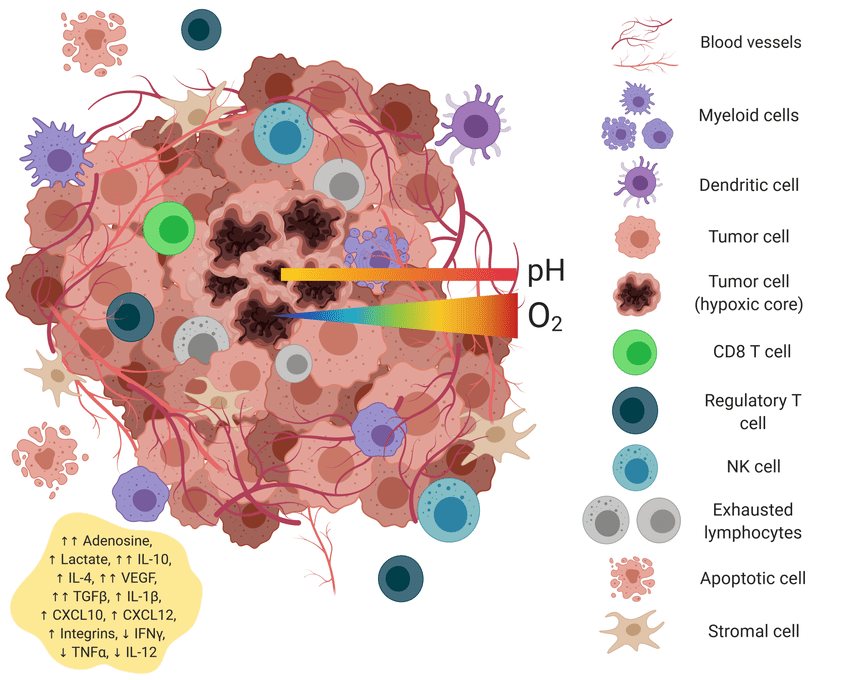
Tumours do not grow in isolation. They are surrounded by a complex community of immune cells, blood vessels, connective tissue and other supporting cells, collectively known as the tumour microenvironment. A new study published online in Nature in November 2026 suggests that many features of this surrounding environment follow shared patterns, regardless of where a tumour develops in the body or which species it appears in.
The research team carried out a pan-cancer analysis at single-cell resolution, examining the microenvironment across 42 cancer types. Rather than studying one tumour type at a time, the approach allowed the authors to compare the surroundings of cancers arising in different organs. The work also extends across two species, which is what led the researchers to argue that certain characteristics of the microenvironment are conserved rather than unique to each tumour or tissue.
The central claim is that these conserved features may offer a more unified way to think about cancer biology. If the surrounding cellular community behaves in broadly similar ways across organs and species, it could help explain why some treatment approaches affect different cancers in comparable ways, and it could guide the search for common targets. The publication notes that such patterns are a starting point for further investigation rather than a finished therapeutic answer.
Several important details remain unclear from the available summary. The study does not name the two species involved, and it does not specify the particular cell populations or the numbers of samples analysed. The full results, methods and sample sizes would be needed to judge how strongly the conservation holds across the 42 cancer types. Readers should therefore treat the findings as a broad conceptual result that will need confirmation and detailed follow-up work.
The study is a reminder that cancer research increasingly relies on large, cross-cutting datasets that look beyond the organ where a tumour begins. Whether the shared features it describes can be translated into clinical benefit will depend on the studies that follow, which will need to examine the specific cell types and mechanisms behind the reported conservation.
Credit. Based on reporting by Michael Januszyk, John M. Lu, Maria Korah and Serena L. Jing for Nature. Is this your work? Write to us.
27