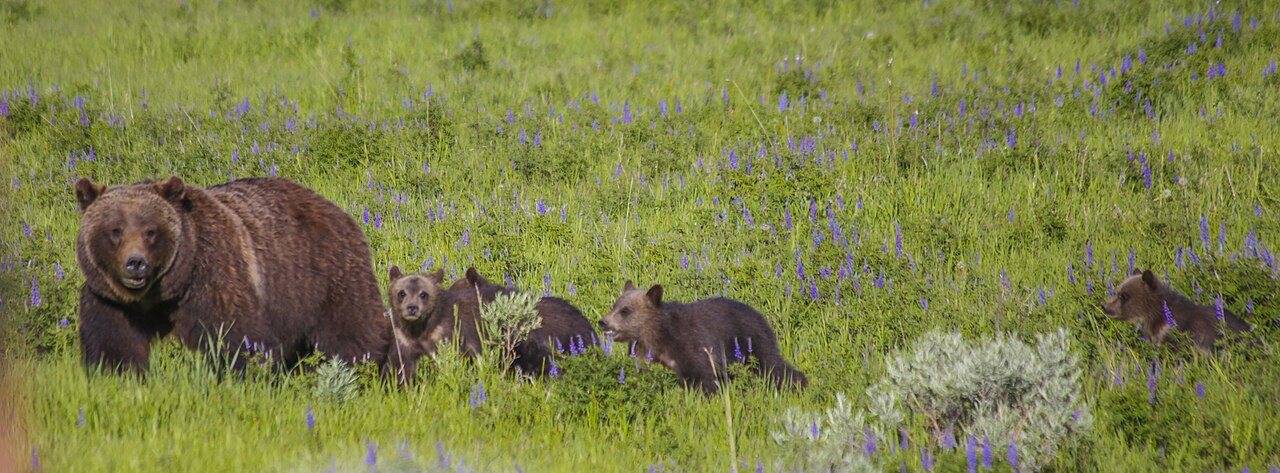
Grizzly 399, the most famous bear in the Greater Yellowstone Ecosystem, died in October 2024, leaving behind a legacy that transformed public understanding of grizzly bear conservation. The 28-year-old female grizzly, known for raising an unprecedented number of cubs in full view of tourists and wildlife photographers, had become a living symbol of the delicate balance between human activity and wild nature.
Her life and impact are the subject of «Grizzly 399: Queen of the Tetons,» a documentary that premiered on May 8, 2024, on PBS Nature. The film chronicles how this single bear, named for her research collar number, drew global attention to Grand Teton National Park and the challenges facing one of America’s most iconic species.
Grizzly 399 was born in 1996 and spent nearly three decades navigating a landscape increasingly shaped by human presence. She raised at least 18 cubs over her lifetime, a remarkable reproductive record that made her a favorite among wildlife enthusiasts. Her habit of raising cubs near roads and developed areas of Grand Teton National Park brought her into frequent, close contact with people, turning her into an accidental ambassador for wildlife coexistence.
Her death marks the end of an era for bear watchers and researchers alike. For years, she was the most photographed bear in the world, with thousands of visitors traveling to Wyoming each spring and summer hoping to catch a glimpse of her and her latest litter. Wildlife photographers documented her every move, and her image appeared in countless magazines, documentaries, and social media posts.
Beyond her celebrity, Grizzly 399 played a significant role in scientific understanding of grizzly bear behavior in human-dominated landscapes. Researchers studied how she adapted to living near roads, developed areas, and thousands of seasonal visitors. Her ability to raise large litters of cubs in such conditions offered rare insight into the resilience and adaptability of a species still listed as threatened in the lower 48 states.
Her passing also highlights ongoing conservation challenges. Grizzly bears in the Greater Yellowstone Ecosystem have made a remarkable recovery since being listed under the Endangered Species Act in 1975, when fewer than 150 bears remained. Today, an estimated 1,000 bears inhabit the region. Yet their expanding population brings them into increasing conflict with humans, as bears push into new territory in search of food and space.
Grizzly 399’s story is one of coexistence, both successful and fragile. She lived her entire life in one of the most heavily visited national parks in the United States, yet she never seriously injured a person, a testament to both her temperament and the careful management of park visitors. Her death, while a loss, serves as a reminder of the ongoing work required to ensure that grizzly bears and humans can continue to share the landscape.
The PBS Nature documentary preserves her story for future generations, capturing not only her life but also the broader narrative of grizzly bear recovery in the American West. Through archival footage and interviews with researchers, photographers, and park officials, the film offers an intimate portrait of a bear whose life intersected with human history in extraordinary ways.
As the wildlife community mourns her passing, Grizzly 399’s legacy endures in the cubs she raised, the photographs she inspired, and the conservation awareness she sparked. She was more than a bear; she was a bridge between the wild and the human world, and her memory will continue to shape how people understand and protect the great bears of the Tetons.
133