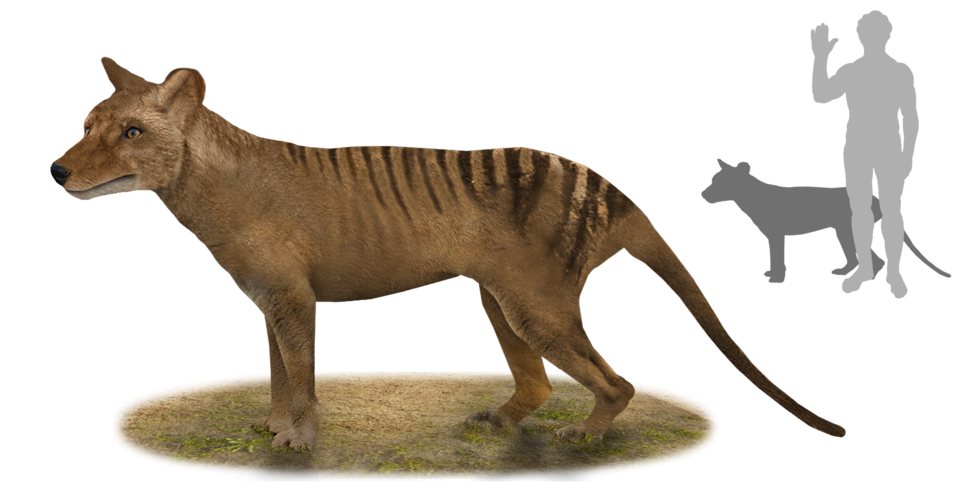
The thylacine is often introduced as a textbook example of convergent evolution. With its long muzzle, upright ears and dog-like body, the marsupial predator looked remarkably similar to a wolf despite being separated from canids by deep evolutionary history. A detailed skull analysis now shows that the resemblance concealed a more distinctive way of feeding.
Researchers quantified thylacine cranial shape and compared it with a broad range of living carnivorous mammals. Instead of clustering cleanly with wolves or any other modern predator, the thylacine showed a mosaic of traits. Its skull combined a relatively tall, gracile snout, expanded regions around the canines and other features that do not occur together in the same way among living comparison species.
Those proportions point toward a rapid, high-impact snapping bite rather than the exact killing mechanics used by wolves. Canids often rely on sustained bites, cooperative pursuit and repeated gripping of prey. The thylacine's anatomy suggests a different balance between speed, force and jaw movement, even though natural selection produced a superficially canine silhouette.
That finding changes how convergence should be understood. Evolution can produce similar outward shapes when unrelated animals occupy comparable ecological roles, but it does not have to reproduce the same internal mechanics. Two predators can both be built for pursuing vertebrate prey while using different muscle arrangements, bite strategies and behavioral sequences.
The thylacine disappeared from mainland Australia thousands of years ago and survived in Tasmania until the 20th century. The last known captive animal died in 1936. Because direct behavioral observations are sparse and early accounts are incomplete, anatomy remains one of the best sources for reconstructing how the animal hunted.
Skull shape cannot reveal every aspect of behavior. Prey selection, social hunting, scavenging and habitat use also depend on ecology, learning and opportunity. Biomechanical interpretations are strongest when combined with tooth wear, limb anatomy, historical records and comparisons with other marsupial carnivores. The new analysis therefore narrows the range of plausible feeding strategies rather than replaying an extinct hunt with certainty.
Its broader value lies in showing why extinct animals cannot always be understood by finding the closest modern look-alike. The thylacine resembled a wolf because evolution pushed two distant lineages toward similar external solutions. Under the skin, however, it retained a distinct marsupial history and evolved its own combination of cranial traits. The Tasmanian tiger was neither tiger nor wolf in function. It was a predator whose closest mechanical analogue may no longer exist.
77