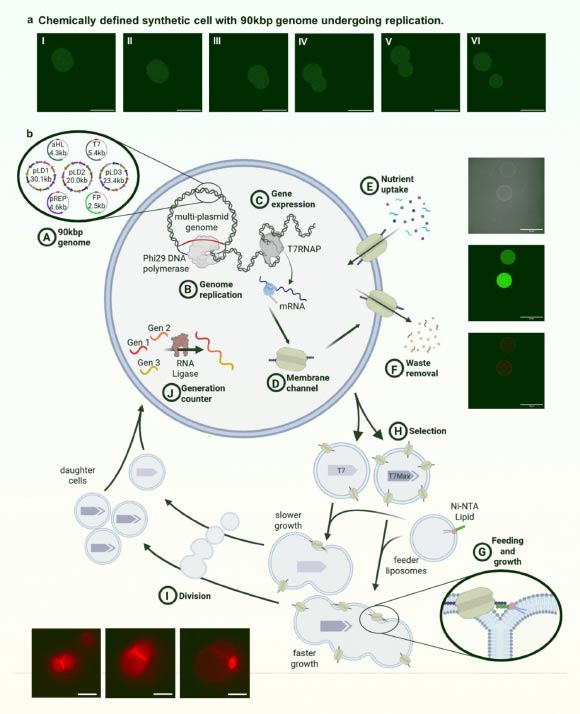
Researchers at the University of Minnesota have achieved a milestone in synthetic biology by constructing a synthetic cell entirely from non-living chemical components that can carry out all the fundamental processes of life. The cell is capable of taking in nutrients, growing, copying its genetic material, dividing into daughter cells, and even passing along beneficial mutations to subsequent generations. This breakthrough represents a significant step toward understanding the basic principles of life and could open new avenues in biotechnology and medicine.
The synthetic cell, built from scratch using chemical building blocks, demonstrates a complete life cycle that mirrors that of natural cells. Unlike previous efforts that relied on modifying existing living organisms, this cell was assembled from non-living materials, making it a truly artificial creation. The team, led by biologists at the university, designed the cell to perform essential functions such as metabolism, replication, and evolution, which are hallmarks of living systems.
One of the key achievements of this research is the cell's ability to undergo natural selection. As the synthetic cells divide and replicate, they can accumulate mutations that may confer advantages in their environment, allowing them to evolve over time. This evolutionary capability is a critical feature that distinguishes this synthetic cell from earlier artificial constructs, which often lacked the ability to adapt and change.
The construction of the synthetic cell involved a complex process of assembling genetic material, membranes, and metabolic pathways from chemical precursors. The researchers used a minimal set of genes necessary for life, which they synthesized and inserted into a synthetic membrane. The cell then demonstrated the ability to take up nutrients from its surroundings, use them for energy and growth, and replicate its DNA before dividing into two daughter cells.
This development builds on decades of research in synthetic biology, including the creation of the first synthetic bacterial genome by the J. Craig Venter Institute in 2010. However, the Minnesota team's work goes further by creating a cell that can not only replicate but also evolve, marking a step closer to understanding the origins of life and the minimal requirements for a living organism.
The implications of this research are vast. In medicine, synthetic cells could be engineered to produce drugs, target diseases, or serve as biosensors. In environmental science, they might be designed to break down pollutants or produce sustainable fuels. The ability to create cells with tailored functions could revolutionize industries ranging from pharmaceuticals to agriculture.
Despite the excitement, the researchers caution that the synthetic cell is still a basic model and far from being a fully autonomous organism. It requires a controlled laboratory environment and specific chemical conditions to function. Further work is needed to make the cell more robust and capable of surviving in diverse environments.
The study also raises ethical questions about the creation of artificial life. As scientists gain the ability to build living systems from scratch, society must consider the implications for safety, regulation, and the definition of life itself. The researchers emphasize that their work is conducted with strict ethical oversight and that the synthetic cell is designed for research purposes only.
This achievement underscores the progress in synthetic biology and the potential for creating custom-designed organisms. While the synthetic cell is a proof of concept, it lays the groundwork for future innovations that could transform our understanding of biology and our ability to engineer life for practical applications.
119