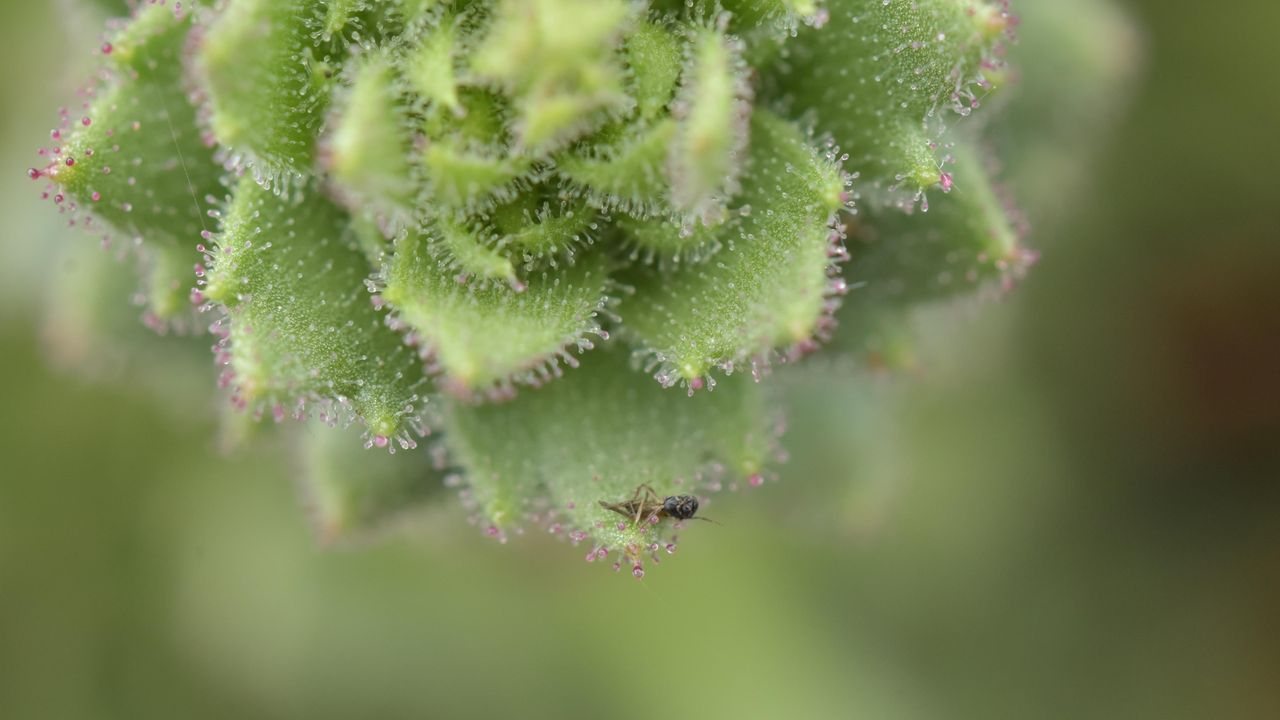
Scientists working with a carnivorous plant in China say their findings strengthen a hypothesis that Charles Darwin proposed more than 150 years ago: some plants evolved to capture and digest animals in order to survive in soils that are poor in essential nutrients.
Darwin developed the idea inInsectivorous Plants, published in 1875, after years of experiments with sundews, Venus flytraps and other species that trap prey. The notion that plants could be active predators was controversial in his day. Darwin argued that the structures and behaviors these plants use to catch insects were too refined to be accidental, and that they had been shaped by natural selection for a clear ecological purpose. He devoted considerable attention to the subject even though his work on evolution often overshadowed it.
The new research, focused on a carnivorous plant that grows in China, offers a modern test of that hypothesis. The researchers described Darwin's work as an important inspiration for their investigation. « Darwin's hypothesis provided an important inspiration », they said, adding that the evidence they collected aligns with his original reasoning about why plant carnivory exists.
Carnivorous plants are not a single botanical family. The ability to catch prey has appeared independently in many plant groups, and scientists now recognize more than 600 species around the world. Their traps vary widely, from the hinged leaves of Venus flytraps to the slippery pitchers of tropical pitcher plants and the sticky tentacles of sundews. The repeated evolution of such complex mechanisms has made carnivorous plants a valuable subject for studying how natural selection can produce similar solutions to similar environmental problems.
Most carnivorous species grow in places where sunlight and water are not the main limits to growth. Instead, they tend to live in wetlands, rocky slopes and other habitats with thin soils that lack nitrogen and other minerals. This pattern was central to Darwin's hypothesis. He reasoned that a plant able to extract nutrients from insects would have a decisive advantage in these settings, because the cost of building traps and producing digestive fluids would be repaid by the nutrients obtained from prey.
The plant at the center of the new study appears to fit that pattern. According to the research team, the findings show that carnivory provides the plant with a meaningful nutritional benefit and that the adaptation is not simply a harmless curiosity. In this sense, the results support the cost-benefit logic that Darwin outlined, while giving later scientists a clearer picture of how the strategy works in a natural population.
The study also helps explain why carnivorous plants are often restricted to habitats that other plants find difficult. In richer soils, the energy spent on traps and digestive enzymes would be wasted, and non-carnivorous plants would be able to compete more successfully. Darwin anticipated this distribution, and the new evidence from China reinforces it.
More broadly, the work shows how a long-standing hypothesis can remain useful to modern biology. Darwin studied carnivorous plants without the tools that scientists use today, but he identified an ecological principle that continues to guide research. The study from China is the latest reminder that careful observation can still form the basis for major scientific questions, even when the answers take more than a century to refine.