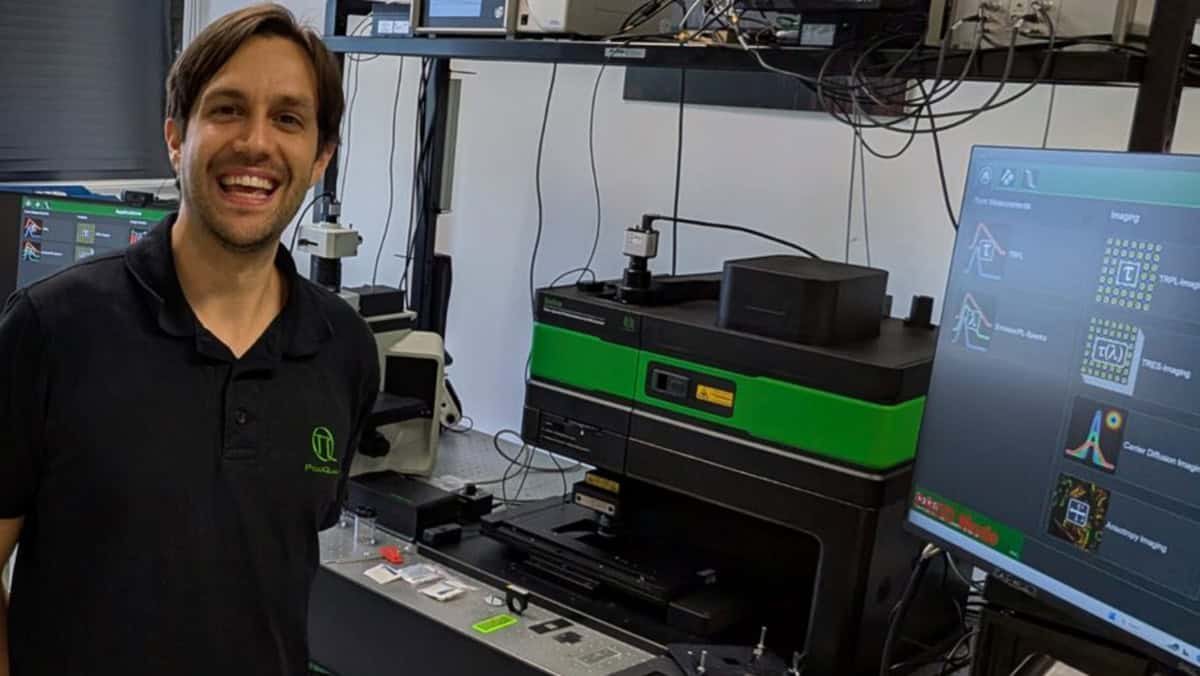
Researchers now have a way to check whether solid-state light sources, known as quantum emitters, release photons one at a time, a basic requirement for many proposed quantum technologies. The approach, built around a single upright microscope developed by PicoQuant, pairs imaging with photon correlation measurements in one instrument.
Quantum emitters are considered promising building blocks for quantum communication, quantum computing and quantum networks. Compared with trapped atoms, they are generally easier to integrate into devices. The central difficulty, however, has been producing pure, stable quantum light consistently. A bright spot under a microscope is not enough on its own: an isolated fluorescence spot does not prove that a single emitter is responsible for the light. Confirming that requires a second type of measurement.
The system works in two stages. Imaging first locates candidate emitters on a sample. Correlation measurements then test whether each candidate emits single photons. In the antibunching test, photons are split by a beam splitter, and the instrument checks for suppressed coincident detections. A second-order correlation value, written g(2)(0), below 0.5 indicates that one emitter dominates the signal. In the reported measurements, fitted values were about 0.4 for a commercial sample and 0.21 for a laboratory sample.
Nitrogen-vacancy centres in diamond were used as a test case. In these defects, a nitrogen atom replaces a carbon atom next to an empty lattice site. They operate at room temperature and sit in a stable host lattice, which is why they are widely used as calibration standards for other emitters.
Users praised how easy the integrated system is to operate. The reporting does not describe how well the approach performs across a broader range of material types, so its general applicability remains to be shown in further validation work.
Credit. Based on reporting for Physics World. Is this your work? Write to us.
25