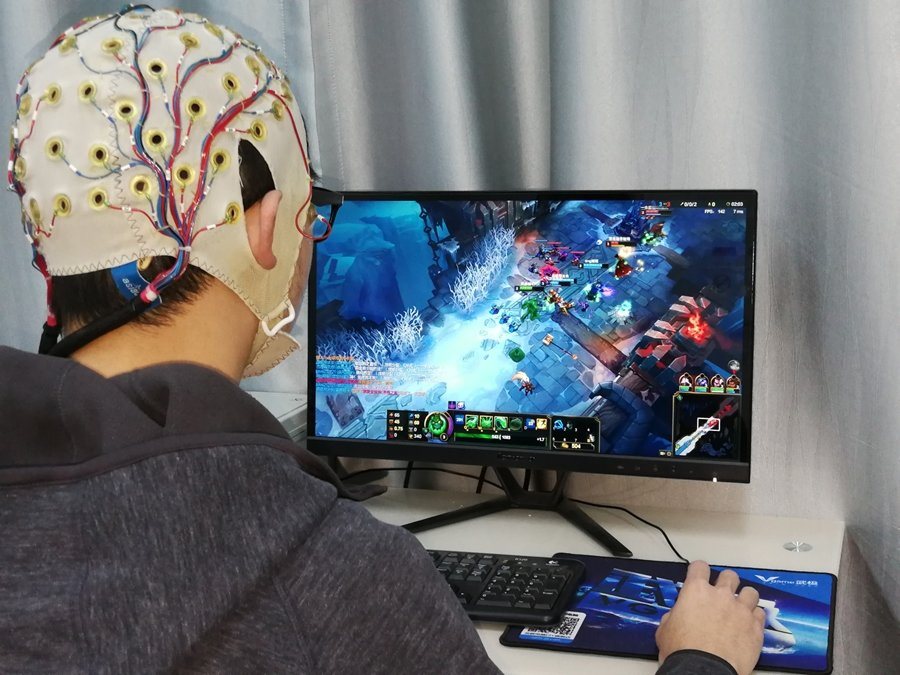
Six months of action-video-game training was followed by measurable improvements in visual attention and changes in resting-state EEG organisation in a cohort of relatively inexperienced student gamers, according to a 2026 study in the International Journal of Psychophysiology.
The paper, “Multi-scale EEG evidence for attention enhancement following long-term action video game training,” by Jihan Wang, Yan Peng, Bin Lv and Dezhong Yao, recruited 49 healthy university students from Chengdu University of Information Technology. Participants were screened for substantial prior gaming experience and completed a longitudinal intervention totalling 120 hours over six months.
The study was designed to examine attention at both behavioural and neurophysiological levels. Behaviourally, the authors used the d2 Test of Attention and an Attention Breadth task. The d2 test requires rapid discrimination of targets from visually similar distractors, engaging selective attention, concentration and controlled visual search. The attention-breadth measure probes the spatial distribution of attention across the visual field.
Participants performed better on both measures after the training period. The authors interpret the pattern as evidence of enhanced selective and distributed visual attention following long-term action-game practice. Importantly, the outcome is specific: the experiment assessed attention-related performance rather than general intelligence or broad cognitive functioning.
The neurophysiological component used resting-state electroencephalography. The analysis combined power-spectral-density-based local measures with network indices intended to capture large-scale functional organisation. The post-training recordings showed changes that the authors describe in terms of alpha suppression and network reorganisation.
Some EEG features were also associated with individual differences in behavioural gains. That relationship is a central contribution of the study: it links changes in attention performance to multiscale properties of resting brain activity rather than treating behavioural improvement as an isolated result. The authors further report that EEG characteristics could predict individual attention gains to a degree, suggesting that the neural changes were not uniform across participants.
The findings are compatible with experience-dependent plasticity. Action games place repeated demands on rapid target selection, distractor suppression, spatial monitoring and time-sensitive response selection. Long-term exposure to such environments could plausibly tune systems involved in attentional control. The new work adds a longer-duration longitudinal dataset to a literature that has often relied on cross-sectional gamer-versus-non-gamer comparisons or shorter interventions.
However, the study’s causal strength is limited by its single-group design. There was no control condition. All 49 participants underwent the gaming intervention, so the researchers could not compare their trajectory with a matched group receiving another training programme or no intervention. The paper explicitly notes that practice effects from repeated assessment, familiarity with testing procedures, spontaneous maturation or other time-dependent influences cannot be unequivocally ruled out.
That limitation is especially important in a field where transfer effects are debated. A 2018 meta-analysis by Bediou and colleagues reported positive associations and intervention effects for action games, with benefits particularly apparent in top-down attention and spatial cognition. By contrast, a meta-analysis by Sala and colleagues concluded that the evidence did not support a causal enhancement of overall cognitive ability from video-game training. Together, the reviews suggest that narrow or near-transfer attention effects may be more defensible than broad claims of global cognitive improvement.
The new paper should also not be described as a direct test of Dota 2 or Counter-Strike 2. Its accessible text discusses action video games as a category and identifies first-person shooters as a common example of fast, perceptually demanding play, but it does not identify Dota 2 or CS2 as the titles used for the six-month intervention.
Related title-specific work does exist. A 2021 Frontiers in Psychology study trained FPS-naive young adults using Counter-Strike: Global Offensive for three weeks and reported improvement in some cognitive performance measures, particularly in an adaptive training condition. A 2018 Frontiers in Human Neuroscience experiment using League of Legends reported short-term changes in visual selective attention and EEG after a gaming session. Those studies provide context for the types of gaming environments researchers have used, but they differ substantially in duration, sample size and design.
The 2026 study therefore strengthens a specific hypothesis rather than closing the debate: sustained action-game training can be accompanied by improvements in selective and distributed visual attention and by multiscale changes in resting EEG organisation. Stronger causal evidence will require randomised or otherwise well-matched control conditions, preferably with active comparison tasks and longer follow-up to test durability and far transfer.
A separate claim circulating with summaries of the study — that even losing matches is cognitively beneficial — is not supported by the reported experiment. Match outcome was not isolated as an experimental variable, and the paper does not establish a distinct effect of wins versus losses.
79