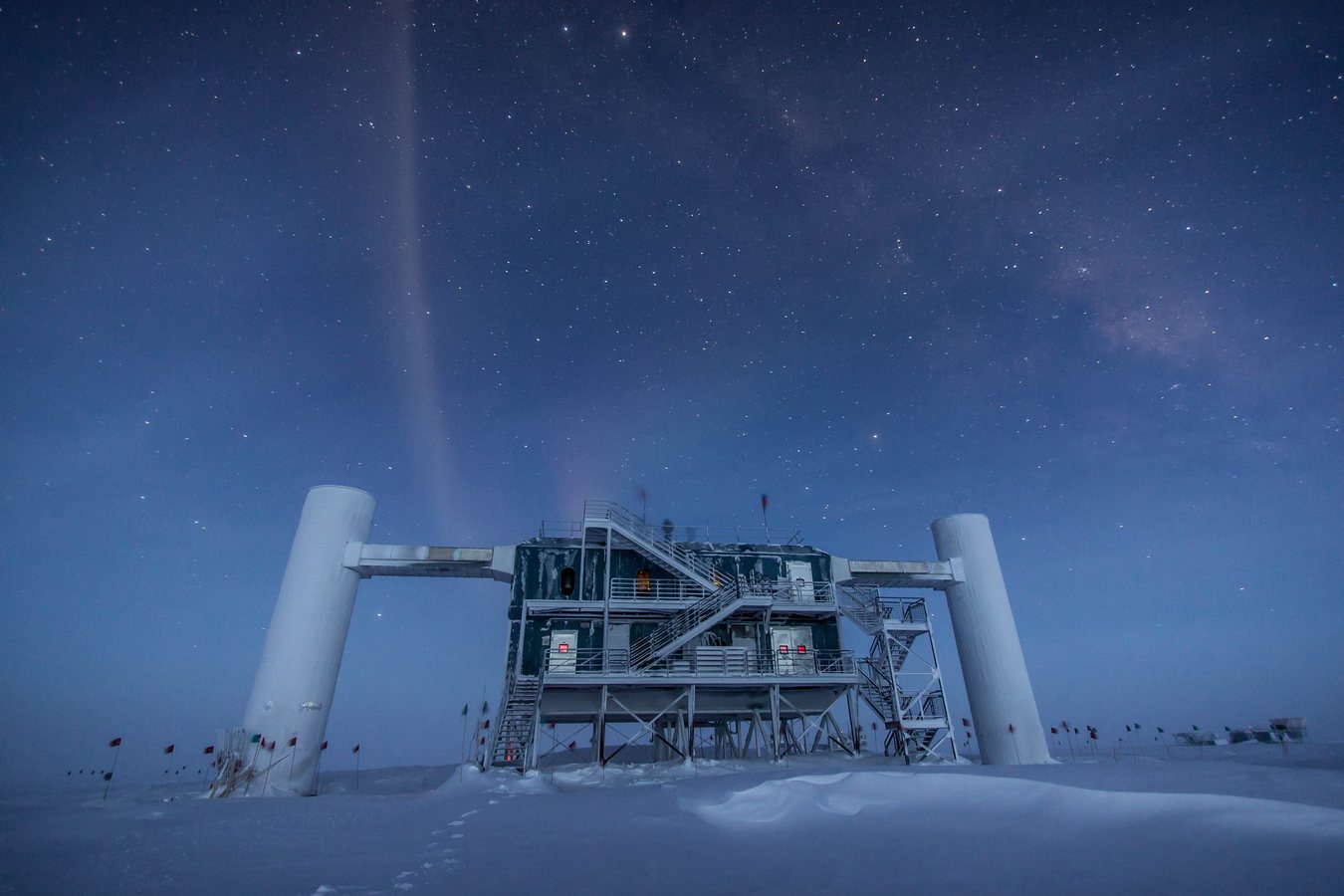
Francis Halzen has been named the sole recipient of the 2026 Nobel Prize in Physics for his work in neutrino astronomy, the field built around the IceCube Neutrino Observatory he helped conceive. The detector sits buried in the Antarctic ice near the South Pole, and its scientific reach now extends to some of the most distant objects in the universe.
IceCube spans a cubic kilometre of ice, instrumented with thousands of light sensors that pick up the faint flashes produced when neutrinos, nearly massless particles that rarely interact with matter, pass through the ice. The idea traces back to Halzen, who was inspired in part by rumoured Soviet work using ice as a detection medium. Researchers chose ice over water because it is darker and more stable, and because it contains no marine life to interfere with measurements. A research base nearby also made the remote site practical to run.
The project grew out of AMANDA, its smaller predecessor, which relied on holes drilled with hot water. Over time the instrument has detected neutrinos arriving from distant sources, including a blazar about four billion light years away. Those detections have opened a new window on high-energy events that light and other signals alone cannot easily reveal.
Looking ahead, the team plans an upgrade called IceCube Gen2, which would cover roughly eight times the volume of the current detector. The Nobel recognition places Halzen's long effort on a remote polar project at the centre of modern astrophysics, and it highlights how much of the field's progress depends on instruments built in some of the harshest places on Earth.
Credit. Based on reporting by Alastair Williams for thequantumcat.space. Is this your work? Write to us.
18