Physicists in Romania have used a beam of artificially produced muons to image a structure for the first time. The result builds on last year's demonstration of the first laser-based muon source and raises hopes that muon-based imaging will become more widely available for objects that are not suited to traditional X-ray techniques.
Muons are heavier cousins of electrons, and their greater mass allows them to penetrate further into thick, dense objects than conventional electron tomography can. For this reason, muon tomography, or muography, is most often used to image large-scale structures in archaeology, geosciences and civil engineering. It is also used where non-invasive scanning is required, for example to image the core of a burning blast furnace or a nuclear waste storage facility.
To date, muography has relied on muons produced naturally when cosmic rays collide with atoms 15 to 20 km above the Earth's surface. That cosmic muon flux is low, at just 1 particle per square centimetre per second, and it arrives from one direction only: straight up. The combination of low flux and fixed directionality means that accumulating enough data for tomography can take months. An artificially produced muon beam would avoid these shortcomings, and in 2025 physicists led by Davide Terzani at the Accelerator Technology and Applied Physics division of the Lawrence Berkeley National Laboratory in the United States took an important step toward developing one.
Their compact muon source is based on a technique called laser plasma acceleration, which generates electrons with energies in the 10 GeV range. When these energetic electrons strike a solid target, they produce a shower of secondary particles, including electrons, positrons, gamma rays, neutrons and, importantly, muons.
In the new work, described in an arXiv preprint, teams led by Alexandra Saftoiu and Domenico Doria at the Horia Hulubei National Institute for Physics and Nuclear Engineering used the 10 petawatt-class laser at the Extreme Light Infrastructure Nuclear Physics facility to produce a similar muon beam, and then set out to optimize it. Saftoiu said the main challenge was to achieve an optimal balance between suppressing the background particles, which come unavoidably from the same process that creates muons, and keeping the muon beam high in flux and energy. The background must be reduced to a level that allows muons to be detected unambiguously.
To address this, the researchers used the GEANT4 platform to run extensive Monte Carlo simulations of how different particles pass through matter. The simulations indicated that an optimal, background-suppressing shield would have three layers. The first comprises stacks of polyethylene sheets and bricks with a total thickness of 100 cm along the axis of the muon beam. The second, 60 cm thick along the beam axis and 40 cm beside and above it, consists of paraffin bricks and encapsulates the entire polyethylene structure. A final layer, made of a lead beam dump and a two-metre reinforced concrete wall, completes the shielding.
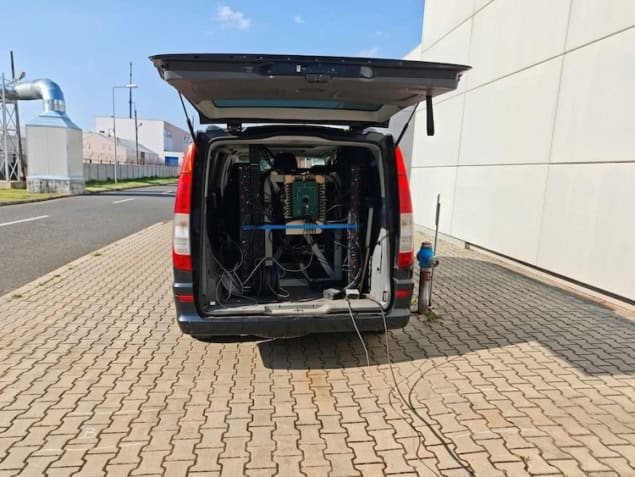
Once the shield was built, the teams used three different scintillator-based detectors to monitor the beam. Measurements from these detectors showed that 90 per cent of the particles in the beam were muons. The researchers used this beam as a proof of concept to create a low-resolution image showing the shadow of a pile of lead bricks placed in front of a van.
Doria said an artificial muon source would have many applications. Among the most prominent are border security, where it could scan containers for illegally trafficked weapons or radioactive materials, and nuclear safety, where it could scan waste-storage casks or the reactors themselves. In principle, he added, it could also be used for resource management, such as scanning for ores with a single borehole to probe distances of kilometres rather than metres, for archaeological searches for hidden spaces, for assessing the safety of dams, tunnels and mine galleries, and for monitoring volcano and glacier activity.
Terzani, who was not involved in the work, said the study shows progress in developing filters that can isolate muon signals from unwanted background. Without removing secondary particles, he said, detectors would be swamped by noise that is difficult to subtract, producing essentially unusable images.
Both Saftoiu and Doria stressed that much work remains before laser-driven artificial muon sources can be deployed in real-world settings. The laser technology needs to become substantially more compact and capable of operating at higher repetition rates. Muography also requires detectors with higher spatial resolution that can measure intense muon bunches rather than relying on single-particle counting. The researchers also see value in developing more effective shielding strategies to further minimize the background generated alongside the muons.
15