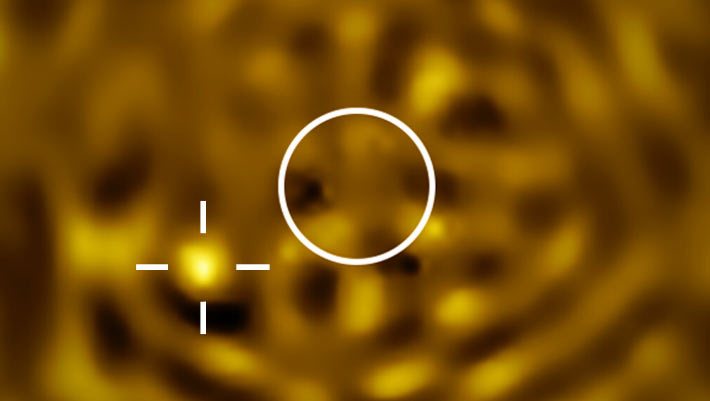
After a century of hints and indirect evidence, astronomers have finally captured a direct image of the long-suspected companion star orbiting the red supergiant Betelgeuse. Using the European Southern Observatory's Very Large Telescope (VLT), researchers obtained the clearest evidence yet that one of the night sky's most famous stars is not alone.
The discovery puts an end to decades of speculation about a possible stellar companion that could help explain Betelgeuse's mysterious dimming events and other unusual behavior. The companion star, temporarily designated Betelgeuse B, is much fainter than the primary red supergiant, which is why it has eluded direct observation for so long.
Betelgeuse, located in the constellation Orion, is one of the brightest stars visible from Earth and has been studied intensively for centuries. Its brightness varies over time, and in 2019–2020 it experienced an unprecedented dimming event known as the Great Dimming, which was later attributed to a dust cloud. The presence of a companion star could provide additional clues about such phenomena.
The direct imaging was made possible by the VLT's advanced adaptive optics system, which corrects for atmospheric blurring and allows telescopes to resolve extremely close and faint objects near bright stars. Even with this technology, detecting Betelgeuse B was challenging because the red supergiant is roughly 100,000 times brighter than its companion.
Astronomers have long suspected that Betelgeuse might have a companion based on subtle variations in its radial velocity and other indirect measurements. However, confirming the existence of such a faint object next to such a brilliant star required the sharpest possible observations. The new images provide direct confirmation and allow researchers to study the companion's properties.
The discovery also sheds light on the evolutionary history of the Betelgeuse system. Red supergiants are massive stars in the late stages of stellar evolution, and many are thought to have binary companions. Understanding the binary fraction and the effects of such companions on stellar evolution is important for models of how massive stars live and die.
Betelgeuse is expected to eventually explode as a supernova, an event that could be visible from Earth even during the day. The presence of a companion star could affect the dynamics of the explosion and the subsequent formation of a neutron star or black hole.
The research team plans to continue observing Betelgeuse and its newly imaged companion to refine the orbit and determine the companion's mass and other characteristics. These observations will help astronomers better understand the role of binary interactions in the lives of massive stars.
The direct imaging of Betelgeuse B marks a significant milestone in stellar astronomy, demonstrating the power of modern telescopes and adaptive optics to solve long-standing mysteries about even the most familiar stars in our galaxy.