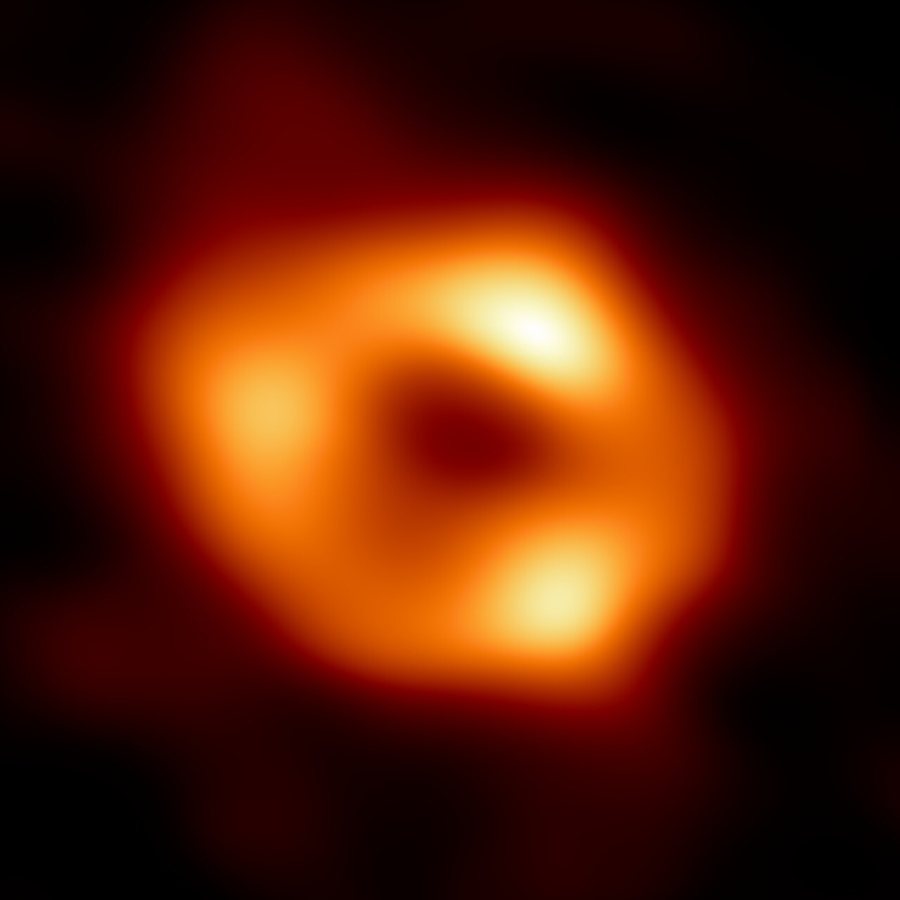
Astronomers are looking for a star that could help them measure the spin of Sagittarius A*, the supermassive black hole at the center of the Milky Way. The question, posed in a weekly physics quiz, points to a growing area of research: using the motion of nearby stars to probe the fundamental properties of the black hole.
Sagittarius A* has a mass about four million times that of the Sun. While its mass has been measured with increasing precision, its spin remains far more difficult to pin down. Spin is a key parameter that influences how a black hole drags space and time around it, a phenomenon known as frame dragging. Measuring it would give astronomers a deeper understanding of how the black hole formed and how it interacts with its surroundings.
The challenge is that the spin signal is subtle. Stars orbiting close to Sagittarius A* move through the strong gravity of the black hole, and their paths are affected by the black hole's spin. If a star passes close enough, its orbit could reveal the telltale effects of frame dragging. But finding such a star, and tracking it with enough precision, is difficult. The quiz asks which star could serve as that probe, highlighting the search for a suitable stellar tracer.
Current observations have already tracked stars like S2, which completes an orbit around Sagittarius A* in about 16 years. S2's motion has been used to test general relativity and to study the black hole's gravity. However, S2 does not come close enough to measure spin effects clearly. Astronomers are therefore looking for stars on tighter, faster orbits, or for other objects that pass very near the black hole.
The question of which star could help measure the spin of Sagittarius A* is not just a trivia item. It reflects a broader effort to turn the galactic center into a laboratory for testing gravity in extreme conditions. Instruments such as the GRAVITY interferometer at the Very Large Telescope have already detected the orbital precession of S2, a relativistic effect. Future observations, including those from the James Webb Space Telescope and next-generation ground-based telescopes, could identify and track stars even closer to the black hole.
If a suitable star is found, its orbit could be monitored over years or decades. The subtle wobbles caused by the black hole's spin would then be extracted from the data. That would provide a direct measurement of Sagittarius A*'s spin, complementing mass measurements and offering clues about how the black hole grew over cosmic time.
The search also connects to wider questions about black hole physics. Spin is one of the few properties a black hole can have, along with mass and charge. Knowing the spin of Sagittarius A* would help astronomers compare it with other supermassive black holes, such as the one in M87 that was imaged by the Event Horizon Telescope. Differences in spin could reveal different formation histories and evolutionary paths.
For now, the quiz serves as a reminder that some of the most important measurements in astrophysics depend on finding the right natural probe. In this case, a single star orbiting the Milky Way's central black hole could unlock a new window into the physics of gravity and the life of supermassive black holes.
14