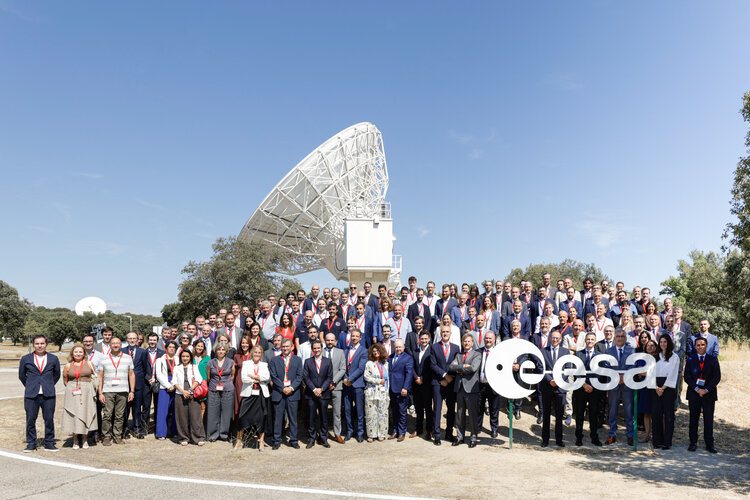
The European Space Agency has signed 18 consolidation contracts bringing together nearly 80 companies to study new secure and resilient connectivity services and associated mission concepts, the agency announced. The work is intended to shape the future of the European Union's secure connectivity constellation, IRIS², which is designed to provide Europeans with resilient communications when and where they matter most.
The contracts mark the next phase in the evolution of IRIS² through low-Earth-orbit activities. By drawing on a broad industrial base, ESA aims to consolidate technical options and service definitions before the constellation moves further toward deployment. The agency said the studies will examine how secure and resilient connectivity can be delivered across a range of mission concepts, helping to define the architecture that will underpin the EU's sovereign communications capability.
IRIS² is intended to give Europe an independent, secure communications infrastructure. The program is expected to support governmental and institutional users, including civil protection, crisis management, and defense-related communications, while also enabling commercial services. The consolidation contracts are a step toward narrowing design choices and aligning the contributions of the many companies involved.
The nearly 80 companies participating in the contracts reflect the scale of the industrial effort behind IRIS². Their work will cover service studies and mission concepts, feeding into decisions about how the constellation should be built and operated. ESA did not disclose the individual values of the contracts or a detailed timeline for the next phase.
In a separate but related development, ESA has awarded two contracts, one to ICEYE and one to Leonardo, to carry out parallel architecture studies for the EU's future Earth Observation Governmental Service, known as EOGS. Those activities are funded by the European Commission and form an integral part of Element 1 of ESA's European Resilience from Space for Earth Observation program, or ERS-EO. That program was decided at the Ministerial Council in November 2025.
The two sets of contracts illustrate a broader push to strengthen Europe's space-based capabilities for both connectivity and Earth observation. While IRIS² focuses on secure communications, EOGS is intended to serve governmental Earth observation needs. Together, they point to an effort to reduce dependence on non-European systems and to build capacity that can be relied on during crises.
For ESA, the consolidation contracts are also a coordination exercise. Bringing together nearly 80 companies across multiple countries requires aligning technical approaches, schedules, and industrial roles. The studies are expected to produce a clearer picture of which mission concepts are most viable and how they can be integrated into the IRIS² framework.
The agency has not announced when the next set of decisions will be made or how the consolidation work will feed into procurement for the operational constellation. Further details on the contracts and the participating companies were not immediately available.