Half a century after NASA's Viking 1 lander made history by touching down on Mars, the agency is preparing to rewrite the rules of interplanetary exploration by handing a central role to the private sector. NASA Administrator Jared Isaacman has announced that the next mission to Mars will pair the agency's scientific expertise with commercial innovation, a departure from the model that guided every previous planetary mission.
The announcement comes as the space community marks the 50th anniversary of Viking 1's landing on July 20, 1976. That mission, built on two twin spacecraft each comprising an orbiter and a lander, was NASA's first attempt to softly set a payload on the Martian surface. The agency had no prior experience with such a maneuver, yet the gamble paid off: Viking 1 survived the so-called seven minutes of terror and began transmitting the first images from the Red Planet's surface, followed weeks later by its sister probe Viking 2 on September 3.
Under the new public-private model, NASA will be responsible for the scientific instruments aboard the orbiter Aeolus, dedicated to studying the Martian atmosphere, while California-based Relativity Space will provide the spacecraft, the Terran launcher, and mission operations during the long journey to Mars. Isaacman framed the approach as a force multiplier, arguing that combining world-class NASA tools with private-sector innovation and investment can produce more scientific results more frequently and shorten the time needed to deliver essential data to researchers preparing for future human missions.
The move represents a significant shift for NASA, which, while using commercial launchers in recent years, has always retained full responsibility for its interplanetary missions. It is also a calculated risk, as the Terran rocket is not yet operational. The agency is betting that the Aeolus mission will enjoy the same fortune as the extraordinary Viking program.
The Viking legacy extends far beyond the landing itself. The landers, inspired by astronomer Carl Sagan, carried four instruments designed to search for biological traces, even inert ones, in the Martian soil. Samples were placed in environments with moisture or nutrients brought from Earth to test whether chemical reactions could reveal the presence of carbon-and-water-based life. The instruments worked flawlessly but returned ambiguous results, with some samples offering hope and others none at all. It took three decades before the Phoenix lander, which touched down in Mars's polar regions in May 2008, identified perchlorate in the soil as the source of the confusion.
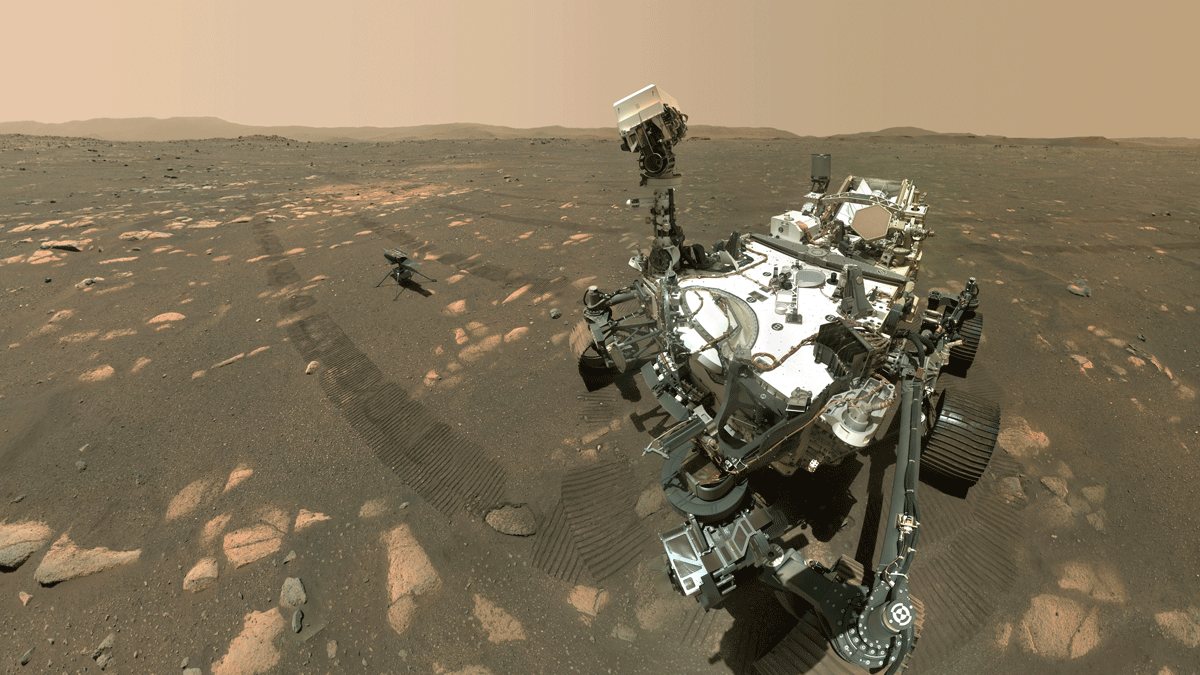
Despite the inconclusive biology results, the Viking missions launched the enduring quest for life on Mars that now drives NASA's Curiosity and Perseverance rovers. These sophisticated vehicles have confirmed the ancient presence of water on the planet's now-desert surface and found organic compounds of great interest. However, rovers are better suited to geological studies than to the kind of astrobiological chemistry that requires terrestrial laboratories. That is why Perseverance has been diligently collecting and encapsulating promising samples, originally destined for return to Earth by the Mars Sample Return mission, which NASA has since canceled.
It now appears likely that the first Martian samples will be brought back by China. The country's Tianwen-3 mission, planned for 2028, will be its second Mars expedition, following Tianwen-1 launched in 2020. Using a double launch of the most powerful Long March rockets, Tianwen-3 will feature a lander with a drill for sample collection, a launch system to return the material to orbit, and a spacecraft to bring it back to Earth by 2031.
Drilling deep to search for past or present life is also the goal of the European Space Agency's Rosalind Franklin rover, equipped with an Italian drill capable of digging up to two meters below the surface. The rover was originally scheduled to launch in 2020 aboard a Russian Proton rocket, but technical problems compounded by the pandemic and geopolitical tensions following the invasion of Ukraine forced ESA to redesign the mission in collaboration with NASA.
As the anniversary of Viking 1's landing is celebrated, the landscape of Mars exploration looks very different from 1976. What was once a purely governmental endeavor is now a field shared by national agencies and private companies, with China, Europe, and the United States each pursuing distinct strategies to unlock the Red Planet's secrets.
70