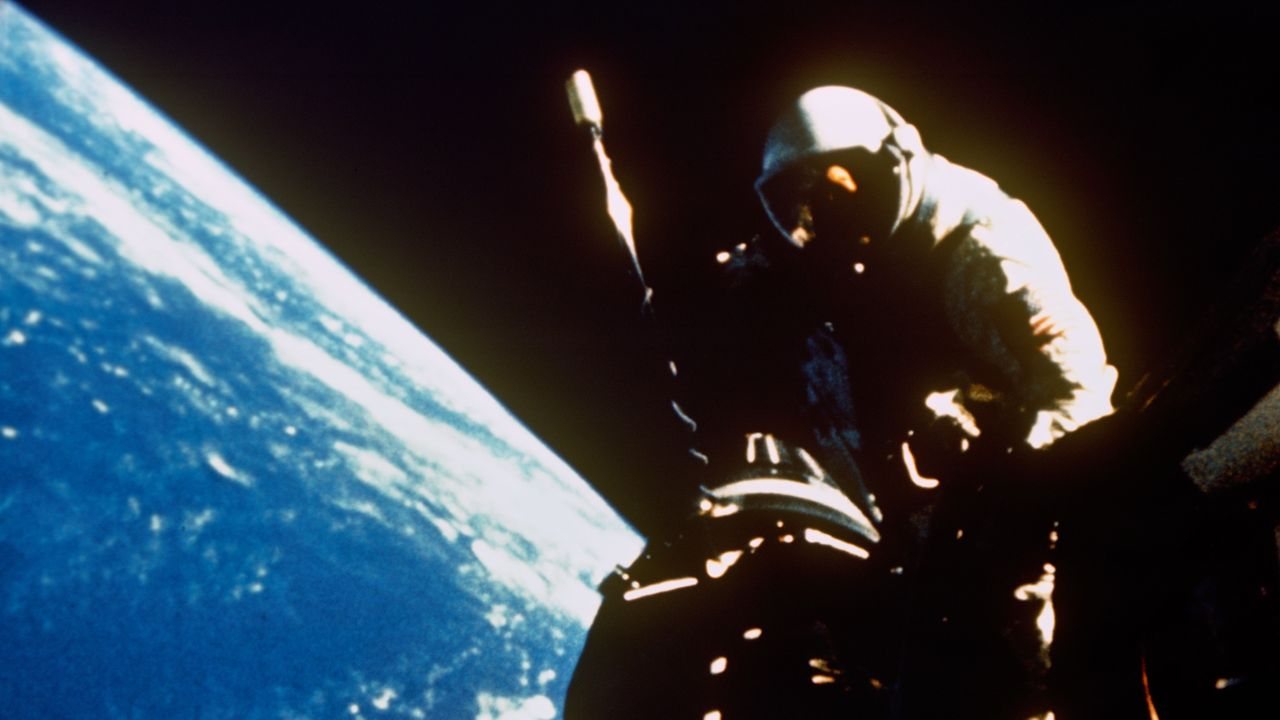
NASA's Gemini 11 mission set a crewed Earth orbit altitude record on Sept. 14, 1966, a mark that stood unbroken for 58 years. Astronauts Charles «Pete» Conrad Jr. and Richard F. Gordon Jr. flew their Gemini spacecraft to an apogee of roughly 850 miles (1,370 kilometers) above Earth, the highest altitude ever reached by humans in orbit around the planet at that time.
The record was achieved through a docking maneuver with an Agena target vehicle. After launching from Cape Kennedy, the Gemini 11 crew rendezvoused and docked with the Agena, then fired the Agena's main engine to boost the combined spacecraft into a highly elliptical orbit. This technique demonstrated the kind of orbital maneuvering that would later be essential for the Apollo lunar missions.
The high-altitude orbit was not an end in itself. Gemini 11 was part of a series of missions designed to test the technologies and procedures needed to send astronauts to the Moon. The flight included two spacewalks by Gordon, one of which involved a tether experiment to test whether a line connecting the Gemini capsule to the Agena could produce artificial gravity through rotation. The crew also conducted scientific experiments and took photographs of Earth and the stars.
The altitude record set by Gemini 11 remained unchallenged for 58 years. It was finally surpassed in 2024 by the crew of the Polaris Dawn mission, a private spaceflight that reached a higher Earth orbit. The long duration of the Gemini 11 record underscores how the rapid advances of the 1960s gave way to a different era in human spaceflight, one focused on low Earth orbit and the International Space Station rather than pushing the boundaries of orbital altitude.
Gemini 11 launched on Sept. 12, 1966, and splashed down in the Atlantic Ocean on Sept. 15 after 44 orbits. The mission was the ninth crewed flight of the Gemini program and the penultimate one before Gemini 12. Its success helped validate the rendezvous and docking techniques that NASA would rely on during the Apollo program, when astronauts had to dock with the lunar module and the command module in lunar orbit.
Conrad and Gordon were both naval officers and test pilots. Conrad later commanded Apollo 12, the second crewed Moon landing, and became the third person to walk on the lunar surface. Gordon served as command module pilot on Apollo 12 and remained in lunar orbit while Conrad and Alan Bean descended to the surface. Their Gemini 11 experience contributed directly to the skills used on those later missions.
The 58-year gap between Gemini 11 and the next record-setting Earth orbit highlights a shift in space exploration priorities. While the Apollo program sent astronauts far beyond Earth orbit to the Moon, no crewed mission returned to a higher Earth orbit until private spaceflight began pushing those limits again. The Gemini 11 record thus stands as a reminder of the ambitious early years of human spaceflight, when each mission set new benchmarks for what was possible.