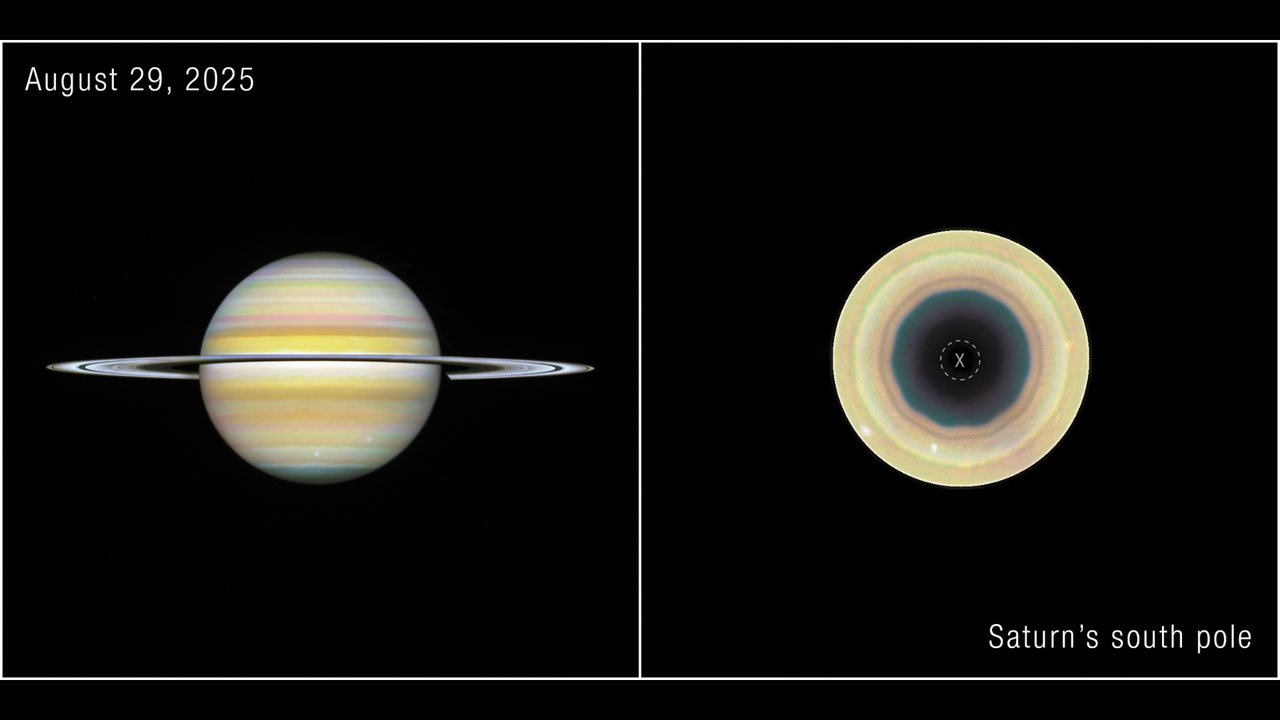
A giant 10-sided atmospheric pattern has appeared around Saturn's south pole, giving the planet a surprising counterpart to its famous northern hexagon. Observations from the Hubble Space Telescope suggest the decagon only began emerging in the past few years and is still growing stronger, according to NASA scientists.
The discovery adds a new chapter to the study of Saturn's polar meteorology, which has long been dominated by the six-sided jet stream at the planet's north pole. That hexagonal feature was first spotted by NASA's Voyager spacecraft in the 1980s and has remained active ever since, making it one of the most distinctive atmospheric structures in the solar system.
The newly identified southern decagon appears to be a similar type of polygonal jet-stream pattern, though it is younger and less established. Researchers analyzing Hubble data say the feature was not present in earlier observations, indicating that it formed recently under conditions that are not yet fully understood. The pattern is also reported to be intensifying, which suggests it may become a more prominent and durable feature over time.
The emergence of a decagonal structure raises new questions about the dynamics of Saturn's atmosphere. Polygonal jet streams are rare in the solar system, and Saturn is the only planet known to host them at both poles. Scientists are now working to determine what triggered the southern pattern's formation and why it took shape with 10 sides rather than the six seen in the north.
One possibility under consideration is that seasonal changes on Saturn are driving the development of the new pattern. Saturn takes about 29 Earth years to complete one orbit around the Sun, meaning each season lasts more than seven years. The planet's southern hemisphere has been experiencing summer in recent years, and the associated heating and atmospheric circulation changes could play a role in generating the decagon.
Researchers also hope to learn whether the southern decagon will persist for decades, much like its northern counterpart, or whether it will prove to be a transient phenomenon. Continued observations with Hubble and other telescopes will be essential for tracking the feature's evolution and for testing models of how such polygonal structures form and stabilize in a planet's atmosphere.
The discovery highlights how much remains to be learned about the outer planets, even after decades of spacecraft flybys and orbital missions. Saturn's hexagon has been studied extensively since Voyager first imaged it, yet the sudden appearance of a similar structure at the opposite pole shows that the planet's atmosphere is far more dynamic and changeable than previously appreciated.
Understanding the decagon could also have broader implications for planetary science. Polygonal jet streams are thought to be related to the balance between atmospheric rotation and wave activity, and studying them on Saturn offers a natural laboratory for testing theories that may apply to other worlds, including gas giants beyond our solar system.
For now, the decagon remains an active area of investigation. Scientists are eager to gather more data as the feature continues to develop, and they expect that upcoming observation campaigns will shed light on the mechanisms behind its sudden emergence and its long-term prospects.
133