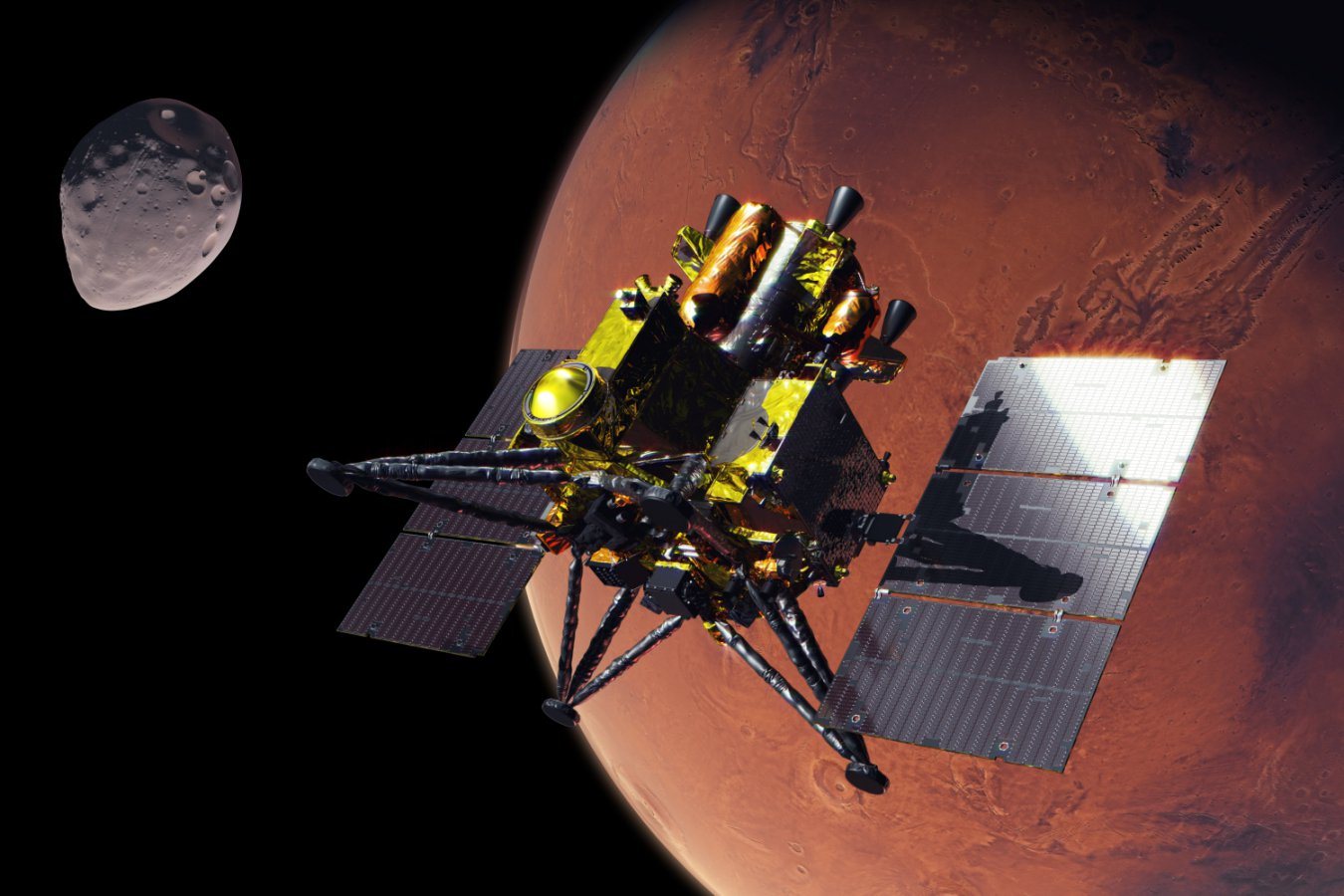
Japan is preparing to launch a spacecraft to Phobos, the larger of Mars's two moons, on a mission that could finally resolve a century-old debate about how the Martian moons formed. The Martian Moons eXploration (MMX) probe is scheduled to lift off on October 20 from Tanegashima Space Center, according to the Japan Aerospace Exploration Agency (JAXA). If successful, it will become the first mission to return samples from a moon of another planet.
The spacecraft is expected to arrive at Mars in August 2027, entering an orbit that keeps it flying alongside Phobos. From that vantage point, MMX will build a detailed map of the moon's surface while also observing Deimos, the smaller and more distant Martian moon. Once the map is complete, operators at JAXA will use it to select a landing site on Phobos.
During one or two brief touchdowns, MMX will carry out two tasks: deploying a small rover called IDEFIX and collecting samples. The rover is the first ever designed to operate on such a small cosmic body, and part of its purpose is to confirm whether a wheeled vehicle can even function in Phobos's extremely low gravity. The samples, however, are the mission's primary goal.
MMX carries two sampling devices. One fires a puff of gas at the surface, blowing dust and pebbles into a collection container. The other drives a hollow cylinder several centimeters into the ground to extract a deeper sample. After collection, the samples will be stored inside the spacecraft, which will then begin its journey back to Earth, with arrival expected in 2031.
Once the samples are analyzed in laboratories on Earth, scientists hope to settle the question of whether Phobos and Deimos are captured asteroids or the result of a massive impact on Mars, similar to the leading theory for the origin of Earth's moon. For more than a century, researchers have debated the two possibilities. The moons' irregular shapes and surfaces resemble asteroids, but their circular orbits around Mars's equator align more closely with the impact hypothesis. Determining their composition should provide a definitive answer.
The findings could also shed light on the early solar system, billions of years ago, when these strange moons formed. «Having the answer will help illuminate that early era when Earth and the other inner planets may have been acquiring much of their water and organic compounds,» said Tom Statler, a member of the NASA team collaborating on the MMX mission, in a statement.
Scientists also note that the samples could contain bonus material from Mars itself. Impacts on the Red Planet may have launched dust and debris into space, which could have settled on Phobos and been preserved there for billions of years. If present, such material could illuminate not only the history of the Martian moons but also the history of Mars.
The MMX mission represents a significant international effort, with NASA among the collaborators. Its success would mark the first sample return from a moon other than Earth's, and the data could reshape understanding of planetary formation and the delivery of water and organic molecules to the inner solar system.
11