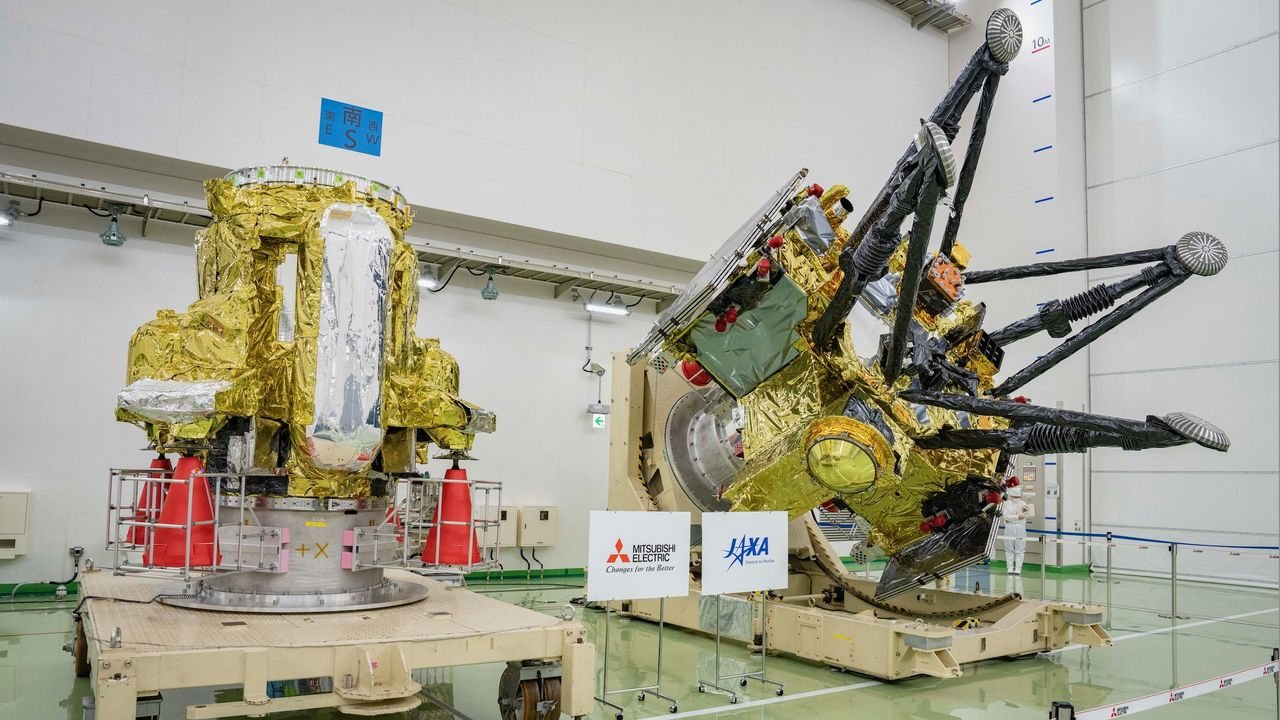
Japan's space agency has unveiled the spacecraft that will attempt an unprecedented mission: collecting samples from a Martian moon and returning them to Earth. The Martian Moons eXploration (MMX) probe was presented to the public ahead of its scheduled launch on October 19, marking a significant step in the country's deep-space exploration program.
The spacecraft, developed by the Japan Aerospace Exploration Agency (JAXA), is designed to travel to Phobos, the larger of Mars' two moons, land on its surface, and collect regolith samples. If successful, MMX would be the first mission ever to return material from a moon of another planet. Scientists believe the samples could provide critical insights into how the Martian moons formed and, more broadly, into the early history of the solar system.
Phobos and its companion moon Deimos have long puzzled planetary scientists. Their small size and irregular shapes have led to competing theories about their origins: some researchers argue they are captured asteroids, while others suggest they formed from debris ejected by a massive impact on Mars. The samples collected by MMX could help settle this debate by revealing the composition and age of the moon's surface material.
The mission profile is complex. After launch, MMX will travel to the Mars system, enter orbit, and then descend to Phobos to perform the sample collection. The spacecraft is equipped with a coring mechanism designed to retrieve material from up to two meters below the surface, which could preserve volatile compounds that have been altered by space weathering on the surface. Following collection, the return module will separate from the main spacecraft and head back to Earth, with the samples expected to arrive in 2029.
JAXA has built on its experience from the Hayabusa and Hayabusa2 missions, which successfully returned samples from asteroids Itokawa and Ryugu. The MMX mission applies similar technologies but faces new challenges, including the lower gravity of Phobos and the need to operate in the Martian environment. The agency has also partnered with NASA, the European Space Agency, and France's CNES, which are contributing instruments and expertise to the mission.
The unveiling comes as Japan strengthens its position in planetary exploration. The country has recently joined an international push to study the Martian system, and MMX is expected to complement ongoing efforts by other nations to explore the Red Planet. While NASA and China have focused on Mars itself, Japan's decision to target its moons offers a distinct scientific return that could fill gaps in the understanding of the planet's history and the evolution of its satellites.
The October launch window is critical. MMX will lift off aboard a H3 rocket from the Tanegashima Space Center in southern Japan. The H3 rocket, which had a troubled development history with its first launch failing in 2023, has since completed two successful flights. A smooth launch will put MMX on a trajectory that requires precise timing to reach Mars efficiently.
Once the samples are returned, they will be distributed to research institutions worldwide for analysis. Scientists hope the material will not only clarify the origin of Phobos and Deimos but also provide a window into the conditions of the early solar system, when planets were still forming and collisions were common. The mission could also inform future human exploration, as Phobos has been proposed as a staging point for crewed missions to Mars.
92