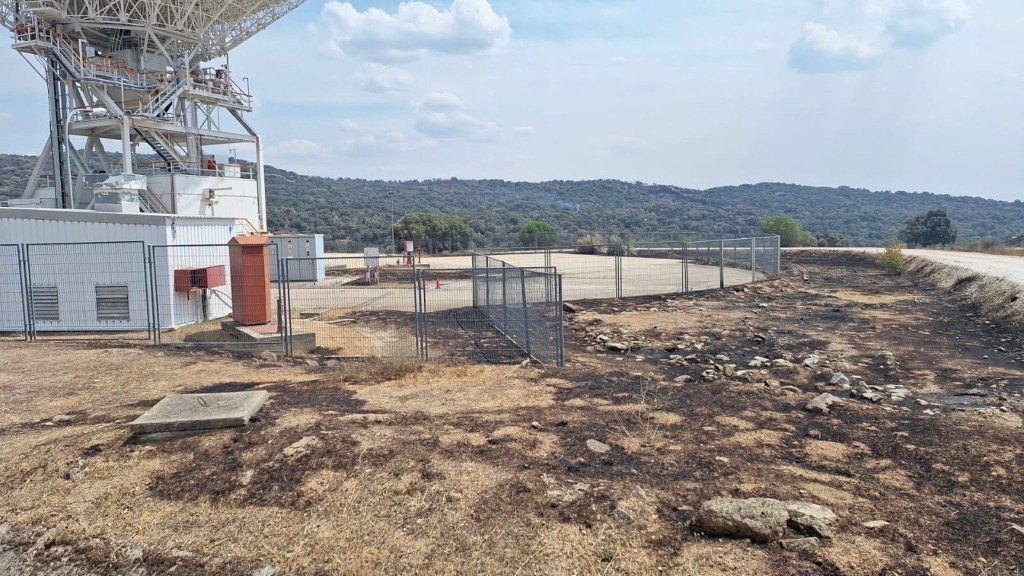
Major wildfires that have been burning across parts of Spain came dangerously close to critical ground stations operated by NASA and the European Space Agency, but officials confirmed that the facilities have avoided significant damage. The fires, which have threatened several areas of the country, did not cause any structural harm to the antennas or support buildings at the affected sites, allowing space communication links to remain largely uninterrupted.
The most prominent among the threatened facilities is NASA's Deep Space Network antenna complex at Robledo de Chavela, about 50 kilometers west of Madrid. This station is one of only three such complexes worldwide that provide continuous communication with interplanetary spacecraft, including the Mars rovers, the James Webb Space Telescope, and the Voyager probes. Nearby, ESA operates its own ground station at Cebreros, also west of Madrid, which supports missions such as Mars Express and Gaia. Another ESA facility at Villafranca del Castillo has similarly been kept out of the fire's path.
The wildfires, fueled by a combination of dry conditions and strong winds, have been among the most severe in Spain this year. Emergency services deployed crews and aircraft to contain the flames, and preventive measures were taken around the space facilities, including clearing vegetation and reinforcing firebreaks. Space agency personnel worked closely with local authorities to monitor the situation and ensure that critical equipment remained protected. No evacuation of the stations was required, though some nearby roads were temporarily closed.
Operations at the ground stations have continued normally throughout the crisis. The antennas at Robledo and Cebreros are vital for commanding spacecraft and receiving scientific data, and any prolonged disruption could have affected ongoing missions. The ability to keep the facilities operational underscores the preparedness of both agencies and Spanish emergency responders. Minor smoke and ash were reported, but no damage to sensitive electronics or dish surfaces occurred.
The threat to these facilities highlights a broader vulnerability of space infrastructure to natural disasters. Ground stations are often located in remote, mountainous areas to minimize radio interference, but these same locations can be prone to wildfires, storms, or seismic activity. Both NASA and ESA maintain contingency plans for such events, including backup communication links through other ground stations in the network. The incident in Spain serves as a reminder of the need for continuous risk assessment and mitigation strategies.
Spanish authorities have managed to bring the fires largely under control, though pockets of fire activity remain. The space agencies have expressed gratitude for the rapid response from local firefighting teams and have assured the public that no mission data has been lost. Routine maintenance and monitoring have resumed at all sites, with extra vigilance for any signs of lingering fire risk.