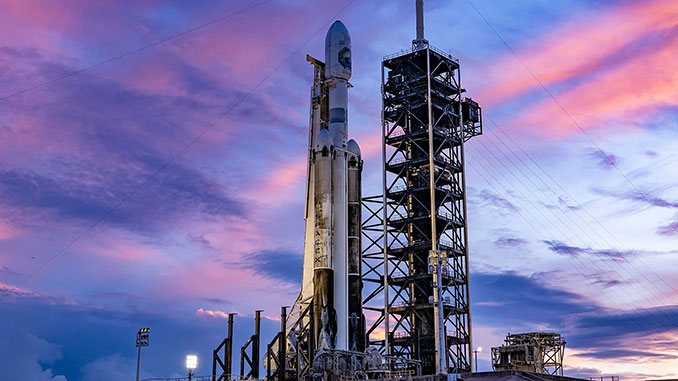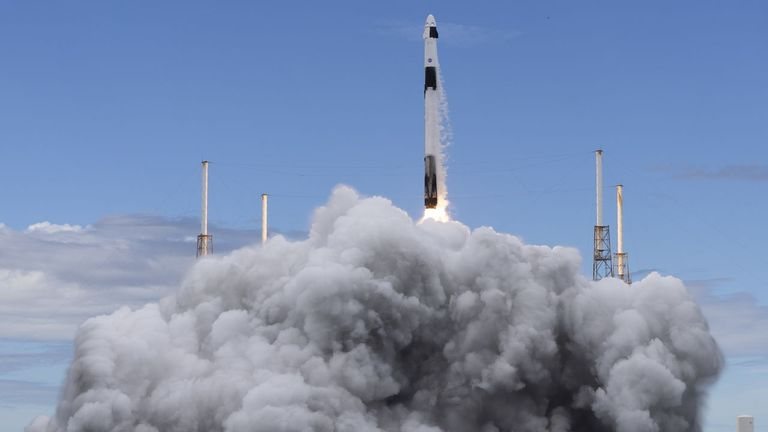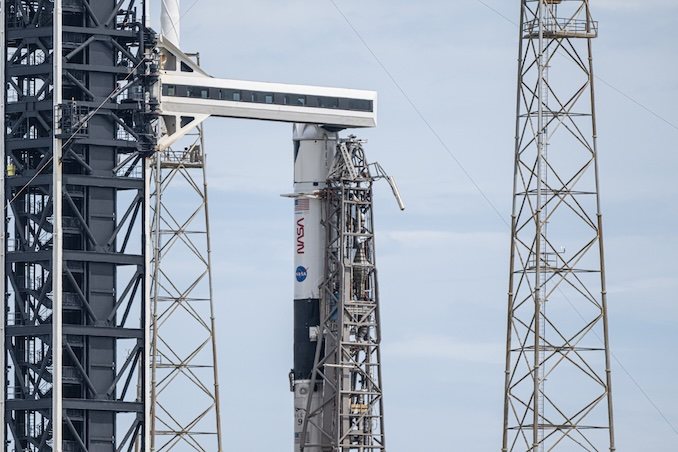
NASA and SpaceX launched four astronauts toward the International Space Station on Thursday, sending the Crew-13 mission into orbit aboard a Falcon 9 rocket and the Dragon spacecraft named Grace. Liftoff from Space Launch Complex 40 at Cape Canaveral Space Force Station occurred on schedule at 11:10 a.m. EDT, with the rocket flying a north-easterly trajectory after leaving the pad.
The crew is led by NASA astronaut Jessica Watkins, who becomes the first agency astronaut to fly twice aboard a SpaceX Dragon. She is joined by NASA astronaut and pilot Luke Delaney, Canadian Space Agency astronaut Joshua Kutryk, and Roscosmos cosmonaut Sergey Teteryatnikov. The four will spend roughly six months aboard the station as part of the orbiting laboratory's rotating expedition crew.
Docking is scheduled about eight hours after launch, the shortest transit time ever for a Dragon spacecraft. The abbreviated rendezvous reflects refinements in the capsule's automated approach profile rather than any change to the station's orbit, and it means the crew will arrive at the outpost sooner than on previous Dragon flights.
Weather was the main uncertainty in the hours before launch. The 45th Weather Squadron forecast only a 55 percent chance of acceptable conditions, with meteorologists tracking clouds and rain near the pad. Launch weather officers warned Wednesday that a weak low-level disturbance sliding along the south side of a high-pressure ridge into the Gulf would bring breezy onshore flow through the primary launch window, keeping the threat of Atlantic showers moving onshore along the coast. The exact timing and location of that activity was described as the main forecast challenge. In the event, the mission lifted off on time.
The Falcon 9 first stage booster, tail number B1101, was making its third flight. It previously launched 29 Starlink V2 Mini satellites on the Starlink 6-88 mission and carried the Dragon Freedom on NASA's SpaceX Crew-12. Less than eight minutes after liftoff, B1101 was to return to Cape Canaveral and target a touchdown at Landing Zone 40. A successful landing would mark the seventh at LZ-40 and the 664th Falcon booster landing to date.
For Watkins, a geologist and avid athlete, the mission is a second trip to space. She previously served as a mission specialist on Crew-4 in 2022. Between flights she worked as a branch chief within the Astronaut Office and later supported work on the crewed rovers and spacesuits needed for future Moon-bound missions within the Artemis Program. She has described the kind of leadership she hopes to bring to the commander's seat as that of a servant leader, shaped by coaches, mentors, teachers, crewmates and classmates.
Delaney, a former test pilot, occupies the pilot's seat. Before his selection as a member of the 2021 astronaut class, he worked as a research pilot and aerospace engineer at NASA's Langley Research Center in Virginia. He grew up in Central Florida, where watching space shuttle launches helped steer him toward engineering and aviation. He has said that seeing humans ride a vehicle into space and live there for a time was a major inspiration for his career.
Kutryk, one of two mission specialists, becomes the second Canadian to fly to space in 2026, following Jeremy Hansen's flight with the Artemis 2 crew. The last Canadian to serve aboard the space station was David Saint-Jacques, who launched in December 2018 and returned to Earth in June 2019. Kutryk was selected by the Canadian Space Agency to train as an astronaut in 2017 and was previously assigned to the Boeing Starliner-1 mission, which was altered to a cargo-only flight after the significant issues that arose during the Starliner Crew Flight Test.
The four crew members arrived at Kennedy Space Center aboard T-38 jets on Saturday, Sept. 26, 2026, ahead of the launch. Their six-month expedition continues the regular rotation of international crews to the station, with the Dragon fleet handling crew transport for NASA alongside its Russian and Canadian partners.
14