NASA's DaVinci probe has successfully endured six thermal cycles that simulate the extreme heat of Venus's atmosphere, reaching 465 degrees Celsius in about an hour, the agency has announced. The tests, conducted from August 28 to September 10 at Rex Heat Treat in Bedford, Pennsylvania, used an engineering model of the spherical descent probe — about one meter in diameter and built with a titanium shell — to demonstrate that the spacecraft can protect its sensitive instruments during the plunge to the planet's surface.
The model was placed inside a ceramic-lined chamber with heat-blackened walls, where temperatures were ramped up to 465 °C in roughly one hour, matching the rate at which the real probe will heat up during its descent. The process was repeated five more times, and the hardware survived each cycle without damage. More than one hundred thermal sensors monitored the simulated instruments throughout the test campaign.
«The experiment was a great success, with six cycles up to Venus surface temperature, following our 55-60 minute descent timeline and with all the internal instrumentation,» said Jim Garvin, principal investigator for DaVinci at NASA's Goddard Space Flight Center in Greenbelt, Maryland. «Not since the mid-1970s has such a complete evaluation of a spacecraft's hardware at Venus temperatures been carried out in the United States.»
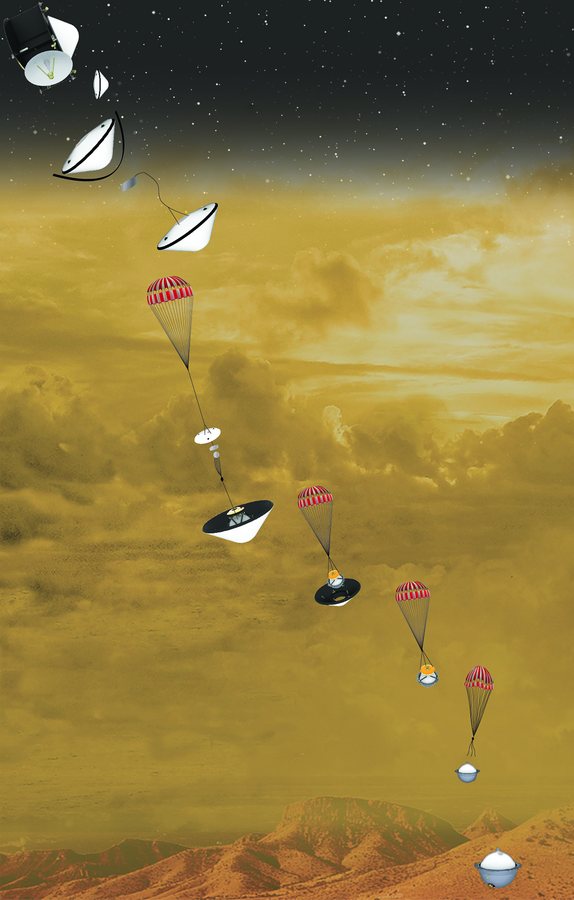
The DaVinci mission — short for Deep Atmosphere Venus Investigation of Noble gases, Chemistry, and Imaging — aims to drop a spherical probe through Venus's toxic atmosphere. During its descent, the probe will collect chemical data to analyze the composition of the planet's gases, determining which molecules are present and studying the atmosphere's structure and layering. It will also capture the highest-resolution images ever obtained of Venus's surface and its relief, which scientists will use to build a three-dimensional map of the landing region. A radio system will keep the probe in contact with and transmitting data to the main orbiter, which will circle at an altitude of about nine thousand kilometers.
«It's a huge engineering challenge, given the extreme harshness of the Venusian environment,» said Kristen Brown, probe manager for DaVinci at Goddard. «We had to create a system capable of protecting the instruments from the planet's oppressive heat, while at the same time strategically allowing its high-temperature gases to enter the probe to be studied through special inlet openings.»
The thermal test follows a campaign conducted earlier this summer to demonstrate the correct operation of the probe's imaging system. The mission is currently working to obtain approval to move into its final design and fabrication phase.
Venus presents one of the most hostile environments in the solar system, with surface temperatures hot enough to melt lead and atmospheric pressure dozens of times greater than Earth's. The DaVinci probe's ability to withstand such conditions is central to the mission's goal of understanding the planet's chemistry and geology. The successful thermal cycling at Rex Heat Treat — one of the few facilities capable of reaching Venus-like temperatures with the required speed — provides critical evidence that the probe's heat shield and internal systems can endure the descent.
With the thermal and imaging tests complete, the DaVinci team is now focused on securing the green light for the next stage of development, moving from engineering models to the actual flight hardware that will eventually make the journey to Venus.
10